
Spec Construction Financing: What Builders Must Know in 2026

What is spec construction financing?
Spec construction financing is a short-term loan used to fund the construction of residential properties without a pre-committed buyer in place. The builder assumes full market risk, betting that the finished home will sell at a profit once construction is complete. Unlike a custom build, where a signed buyer contract anchors the underwriting, speculative construction relies on market conditions at the time of sale to repay the loan.
This structure differs fundamentally from owner-occupied or custom construction loans. Lenders cannot underwrite against a guaranteed buyer, a stabilized income stream, or an existing appraisal. Instead, they evaluate the loan-to-cost ratio, the credibility of the builder’s exit strategy, and the strength of local market absorption. The result is a product with tighter qualification standards and higher pricing than conventional construction financing.
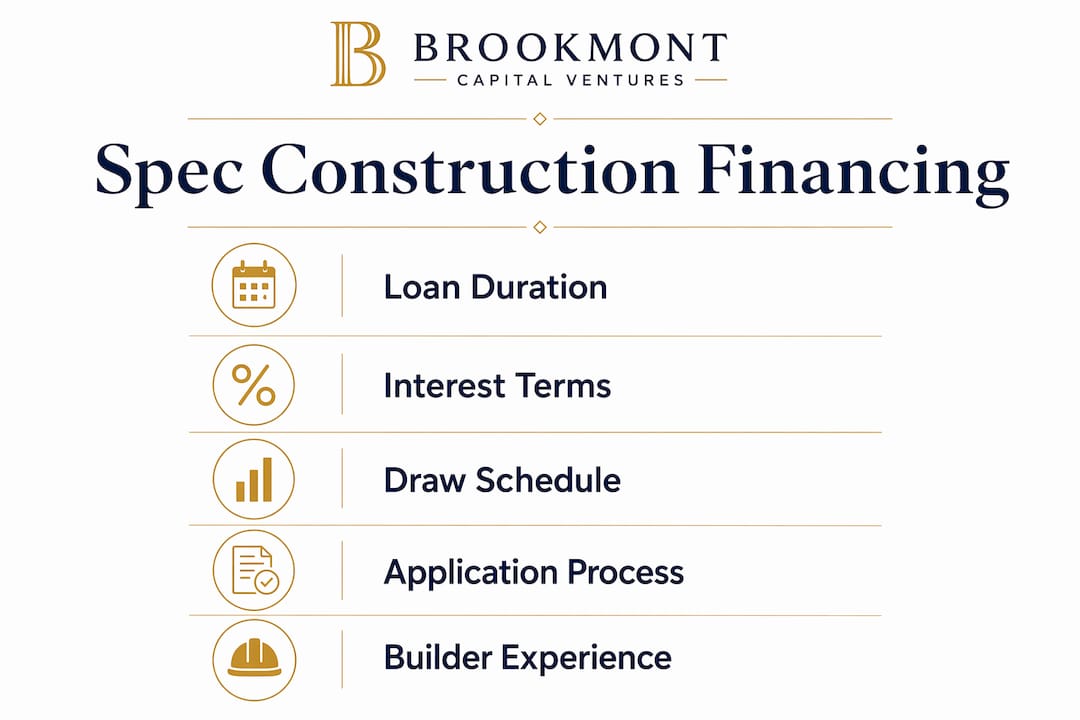
The core elements of spec construction financing at a glance:
- Short-term duration: Spec construction loans typically run 12–18 months, with some extending to 24 months for larger projects.
- Interest-only payments: Borrowers pay interest on drawn funds only, not on the full committed loan amount.
- Draw schedule disbursement: Funds release in stages tied to verified construction milestones, not at closing in a lump sum.
- Loan-to-cost underwriting: Lenders size the loan against total projected project cost rather than appraised value.
- No buyer contract required: The builder sells into the open market post-completion.
- Higher rates and stricter criteria: Lenders price for the absence of a guaranteed exit.
How loan terms, costs, and draw schedules work
Spec construction loans are structured as short-term, interest-only facilities generally running 12–18 months. Some lenders will extend to 24 months for larger or more complex projects, though that extension typically comes with additional fees or tighter covenants. Repayment occurs either from sale proceeds at project completion or through a refinance into permanent financing if the builder elects to hold the asset.

During the construction period, borrowers pay interest only on the amount actually drawn, not on the full loan commitment. This keeps carrying costs manageable in the early months when very little capital has been deployed. As draws increase through the build cycle, monthly interest obligations rise proportionally.
How the draw schedule works:
- At closing, the lender and borrower agree on a draw schedule tied to a line-item budget called the Schedule of Values (SOV).
- Each SOV line covers a specific cost category: site work, foundation, framing, roofing, mechanical/electrical/plumbing, drywall, finishes, permits, and contingency.
- A licensed third-party inspector verifies percent complete before each draw releases.
- Target turnaround from inspection approval to wire is usually within a few business days.
- A typical single-family ground-up loan carries multiple draws over the construction period.
On the cost side, spec construction loans carry higher interest rates than conventional construction products because lenders are pricing for the absence of a guaranteed buyer. Rates are often floating, priced as a spread over a benchmark index. Some loan structures capitalize interest into an interest reserve, drawing it monthly to cover payments, which creates a recursive increase in the outstanding balance over time. Others require the borrower to service interest out of pocket each month. Understanding which structure applies to your deal before you sign is critical, because the two approaches produce materially different cash flow profiles.
Pro Tip: When reviewing term sheets, model both an interest reserve structure and a monthly pay structure against your projected draw curve. The difference in total interest cost can be meaningful on a 12-month build, particularly if your draws front-load during site work and foundation.
What the application process and documentation require
Getting approved for speculative construction funding requires more documentation than a standard mortgage, and the quality of that documentation directly affects both approval odds and final loan terms. Lenders are underwriting a project that does not yet exist, so they need to build confidence from paper before a single shovel hits the ground.
Application steps:
- Initial lender consultation. Present the project scope, your builder track record, and a preliminary budget. This is where lenders assess whether the deal fits their credit box before you invest time in a full submission.
- Loan application submission. Submit financial documents, construction plans, cost budgets, and a construction timeline with defined milestones.
- Exit strategy and market analysis. Provide comparable sales data, your proposed list price, and a realistic absorption timeline for the submarket.
- Underwriting and approval. The lender reviews loan-to-cost, borrower creditworthiness, builder experience, and exit strategy credibility. See construction loan requirements for a detailed breakdown of what lenders expect.
- Loan closing and initial draw. The first draw at closing typically covers land acquisition and pre-closing soft costs such as permits, design fees, and financing costs.
- Construction period draws. Subsequent draws release against verified SOV milestones, with the borrower managing the inspection and documentation process at each stage.
- Repayment. The loan is repaid in full from sale proceeds, or converted to permanent financing if the builder retains the property.
Required documentation typically includes:
- Final, approved building plans and specifications
- Detailed line-item construction budget tied to the SOV
- Construction timeline with milestone dates
- Comparable sales analysis and proposed sales price
- Personal financial statements and credit history
- Builder resume or track record of completed projects
- Entity documents and any required licenses
- Exit strategy narrative, including contingency plan if the property does not sell immediately
Borrower creditworthiness and builder experience carry real weight in spec loan underwriting. A first-time builder will face more scrutiny than an experienced developer with a track record of completed and sold projects. Lenders may require a lower loan-to-cost advance rate, additional reserves, or a personal guarantee from less-seasoned borrowers.
Key risks, pitfalls, and strategic considerations for builders

The absence of a pre-sold buyer is the defining risk in speculative construction. If the market softens between groundbreaking and completion, the builder may face a sale price below pro forma, an extended carry period, or both. Lenders account for this by pricing higher and underwriting more conservatively than they would on a custom build.
Critical considerations and risk mitigation strategies:
- Market absorption risk. Analyze submarket inventory, days on market, and absorption rates before committing to a spec project. A credible exit strategy is not just a lender requirement; it is your primary risk management tool.
- Cost overrun exposure. Construction loan agreements typically require lender consent before reallocating budget line items or drawing on contingency. Undisciplined job costing creates funding delays and disputes.
- Draw timing and cash flow. Delayed inspections or incomplete documentation can stall draw releases, creating cash flow gaps. Build inspection lead times into your construction schedule.
- Creditworthiness impact. A stronger personal credit profile and demonstrated builder experience generally produce better advance rates and lower pricing. First-time builders should expect tighter terms.
- Private versus institutional lenders. Non-agency and private lenders dominate the spec construction loan market because traditional banks and agency lenders require stabilized income, existing collateral, and sales contracts that spec builds cannot provide. Private lenders offer more flexibility but typically charge higher rates. Institutional debt funds may offer better pricing for experienced sponsors with strong track records.
- Exit strategy options. The two primary exits are an outright sale of the completed home and a refinance into a DSCR or permanent loan if the builder elects to hold. A build-to-rent conversion requires a separate underwriting process and a different lender profile. Plan your exit before you close the construction loan, not after.
- Interest reserve management. If your loan capitalizes interest into a reserve, model the recursive balance growth carefully. Undersizing the reserve is one of the most common and costly mistakes in spec construction financing.
You can use a builder loan calculator to stress-test your draw curve, interest reserve, and total project cost before approaching lenders. Running those numbers in advance puts you in a stronger negotiating position and surfaces budget gaps before they become problems.
Pro Tip: Negotiate your Schedule of Values and milestone definitions before closing, not after. Vague milestone language gives inspectors discretion that can delay draw releases. Specific, measurable completion criteria, such as “framing complete and passed rough inspection,” produce faster approvals and cleaner cash flow.
Expert underwriting insights from Brookmont Capital Ventures
Spec construction underwriting operates on a fundamentally different logic than conventional mortgage or even custom construction lending. Because there is no completed collateral and no guaranteed buyer, lenders anchor their analysis on two variables: the loan-to-cost ratio and the credibility of the exit strategy. Appraised value at stabilization matters, but it is a secondary check, not the primary sizing tool.
Construction lenders typically size spec loans to a loan-to-cost range, with the advance rate reflecting both the risk profile of the project and the experience of the borrower. Higher-risk projects and less-seasoned builders attract lower advance rates, meaning more equity required at the table. The interest reserve and draw schedule structure critically affect how carrying costs accumulate over the loan term, and both are negotiable at origination.
Clean, verified milestone inspections are the operational backbone of a well-run spec construction loan. Lenders hold back retainage on hard costs until substantial completion, require lien waivers from contractors and material suppliers, and fund draws only after a licensed inspector confirms work is in place. Borrowers who treat the inspection and documentation process as an administrative burden rather than a financing tool consistently experience draw delays and carrying cost overruns.
The build-and-sell repayment cycle requires an upfront plan for every scenario, including a slower-than-expected sale. If the home does not sell within the loan term, the borrower needs either an extension option negotiated at origination or a clear path to refinance into a bridge or DSCR product. Waiting until the loan matures to address that question is the single most avoidable mistake in spec construction financing. Brookmontcapital’s underwriting criteria guide covers how lenders evaluate these scenarios in the current market.
Structural and risk management best practices:
- Size the interest reserve using a draw-by-draw model, not a simple average, because the draw curve is S-shaped and front-loaded draws understate average outstanding balance.
- Negotiate milestone definitions and inspection turnaround expectations before closing.
- Maintain internal job costing discipline; lender consent is required for most contingency reallocations.
- Prepare a secondary exit narrative, whether a price reduction strategy, a rental hold, or a refinance, before the loan closes.
- Match lender type to project profile: private lenders for speed and flexibility, institutional debt funds for better pricing on proven sponsor track records.
Key Takeaways
Spec construction financing is a short-term, interest-only loan sized to loan-to-cost, repaid through a sale or refinance, and underwritten primarily on exit strategy credibility rather than existing collateral.
| Point | Details |
|---|---|
| Loan duration | Spec construction loans typically run 12–18 months, with some extending to 24 months. |
| Draw schedule structure | Funds release in stages tied to verified SOV milestones, with 4–6 draws on a typical single-family build. |
| Underwriting focus | Lenders prioritize loan-to-cost ratio and exit strategy credibility over appraised value. |
| Lender type | Non-agency and private lenders dominate spec construction because agency criteria require stabilized income and collateral. |
| Exit planning | A documented exit strategy, sale or refinance, must be in place before closing, not after the loan matures. |
Work with Brookmontcapital on your next spec build
Brookmontcapital structures and sources spec construction financing for residential builders, developers, and investors across the United States. Whether you are financing a single spec home or a phased residential development, the team at Brookmont Capital Ventures connects you with the right lenders at the right terms for your project profile.
Explore construction financing solutions or review the full range of real estate financing options available through Brookmontcapital. For projects requiring capital stack advisory, preferred equity, or bridge financing alongside your construction loan, the advisory services team is available to structure the full deal.
Recommended
- Construction Lender Underwriting Criteria: 2026 Guide | Brookmont Capital Ventures
- Common Construction Financing Mistakes to Avoid in 2026 | Brookmont Capital Ventures
- Vertical Construction Financing: A Developer’s 2026 Guide | Brookmont Capital Ventures
- Construction Loan Requirements for Developers | Brookmont Capital Ventures