
Rent Stabilized Property Loans: An Investor’s Guide

A rent-stabilized property loan is financing secured against a multifamily building where rent increases on more than 50% of residential units are legally capped by state or local statute — not by an affordable housing regulatory agreement. Per Fannie Mae’s multifamily guidance, lenders underwrite these assets to current in-place rents only, never to speculative future market-rate conversions. The ANHD best-practices standard sets the minimum Debt Service Coverage Ratio (DSCR) at 1.2x for stabilized buildings, and Brookmontcapital structures deals to meet or exceed the 1.2x DSCR minimum explained for Canadian investors, though many institutional lenders now target benchmarks above that, particularly for buildings with large shares of stabilized units.
Lenders apply cap-rate stress testing and require an appraisal before rate lock, which compresses underwriting value relative to a market-rate building. Borrowers must arrive with a funded replacement reserve plan, a clean rent roll, and a DSCR that clears at least 1.2x on current rents — not speculative future projections. Many lenders prefer DSCRs above this minimum for properties with high stabilized occupancy.
Key Takeaways
A rent-stabilized property loan requires underwriting to current in-place rents, a DSCR of at least 1.2x (industry minimum; many lenders target 1.25x depending on stabilized unit share), a funded replacement reserve, and an appraisal completed before rate lock.
| Point | Details |
|---|---|
| Definition and threshold | A loan on a building where >50% of residential units have rent increases capped by statute, per Fannie Mae guidance. |
| DSCR benchmark | Minimum is 1.2x (industry floor); many lenders target 1.25x or above, especially for properties with high stabilized occupancy. |
| Underwriting basis | Always underwrite to current in-place rents — exclude speculative future market-rate conversions from projected cash flow. |
| Appraisal and reserves | Obtain an appraisal before rate lock; fund a replacement reserve custodial account from loan closing. |
| Brookmontcapital advisory | Brookmontcapital structures and places bridge, DSCR, and CMBS financing for stabilized multifamily assets nationwide. |
Table of Contents
- What is a rent stabilized property loan, and when does the label apply?
- How lenders underwrite rent-stabilized properties
- Key lender benchmarks: DSCR, LTV, and replacement reserves
- Which loan types work for rent-stabilized buildings?
- Underwriting checklist and a worked DSCR example
- What documents lenders will request — and where borrowers stumble
- Primary risks and how disciplined sponsors mitigate them
- Legal and regulatory considerations
- The Brookmontcapital perspective on stabilized-asset financing
- Brookmontcapital can help you finance your stabilized asset
- Sources
What is a rent stabilized property loan, and when does the label apply?
The legal trigger is straightforward: when more than 50% of a building’s residential units carry rent increases limited by state or local statutory controls, the asset is classified as rent-stabilized, and any loan against it is treated as a rent-stabilized property loan. This classification comes from Fannie Mae’s Multifamily Selling and Servicing Guide and shapes every underwriting decision that follows.
The distinction matters because rent stabilization is a statutory control, not a voluntary regulatory agreement. Affordable housing programs tied to Low-Income Housing Tax Credits (LIHTC) or HUD Section 8 contracts carry their own underwriting rules. Rent stabilization is different: it is a local or state law that limits annual rent increases regardless of whether the owner participates in any subsidy program.
New York City is the most prominent jurisdiction, where the Rent Stabilization Law covers hundreds of thousands of units. But similar controls exist in New Jersey, California (through AB 1482 and local ordinances), Oregon, and Washington, D.C. Before underwriting any multifamily asset, verify the applicable statute in that specific jurisdiction — the rules on allowable annual increases, vacancy decontrol, and capital improvement pass-throughs vary materially by location according to local regulations.
How lenders underwrite rent-stabilized properties
The primary underwriting rule is non-negotiable: income is based on current in-place rents, including preferential rents, with no adjustment for anticipated tenant turnover or future market-rate conversion. Fannie Mae guidance is explicit — exclude potential rent increases from units converting to market rate when projecting net cash flow.
Why the hard line? Counting on turnover to justify higher rents creates a displacement incentive that regulators and courts have increasingly scrutinized. Beyond the ethical dimension, it is a legal and financial risk: if projected conversions do not materialize, the loan’s debt service coverage collapses. Lenders who have absorbed that lesson since 2023 are not willing to revisit it.
Cap-rate stress testing is the second pillar. Lenders apply a stressed cap rate — typically above the going-in market cap rate — to determine underwriting value, which directly reduces the loan proceeds available. Appraisal timing is equally important: Fannie Mae recommends obtaining an appraisal before rate lock, and the appraiser must have demonstrated experience with rent-stabilized assets. An appraiser unfamiliar with local stabilization law will miss the income ceiling and produce a value that lenders will not accept.

Pro Tip: Order the appraisal at least 60 days before your target rate lock. Stabilized-building appraisals require rent roll analysis, lease addenda review, and local statute research — they take longer than standard multifamily appraisals, and a delayed appraisal can push you past a favorable rate window.
Key lender benchmarks: DSCR, LTV, and replacement reserves
| Metric | Benchmark | Why It Matters |
|---|---|---|
| DSCR | ≥1.2x (industry minimum); many lenders target 1.25x | Measures cash flow cushion after debt service on current stabilized rents |
| LTV | Typically lower than market-rate comps | Lenders reduce leverage to offset income ceiling and appraisal compression |
| Replacement Reserve | Custodial account funded during loan term | Covers capital replacements; required by Fannie Mae guidance |
The ANHD best-practices framework sets 1.2x as the floor; many institutional lenders target DSCRs above this, often 1.25x or greater, especially for buildings with high stabilized shares. Hitting a DSCR above the minimum on current rents alone is challenging for these properties. Borrowers who present compensating factors — lower LTV, strong sponsor track record, documented ancillary income — can sometimes negotiate around a thin DSCR, but the bar has risen in recent years.
The replacement reserve is a custodial account funded throughout the mortgage term, per Fannie Mae’s multifamily servicing requirements. On stabilized buildings, where rent growth is constrained, deferred maintenance is a chronic risk. Lenders treat an underfunded reserve as a red flag, not a negotiating point.
Which loan types work for rent-stabilized buildings?
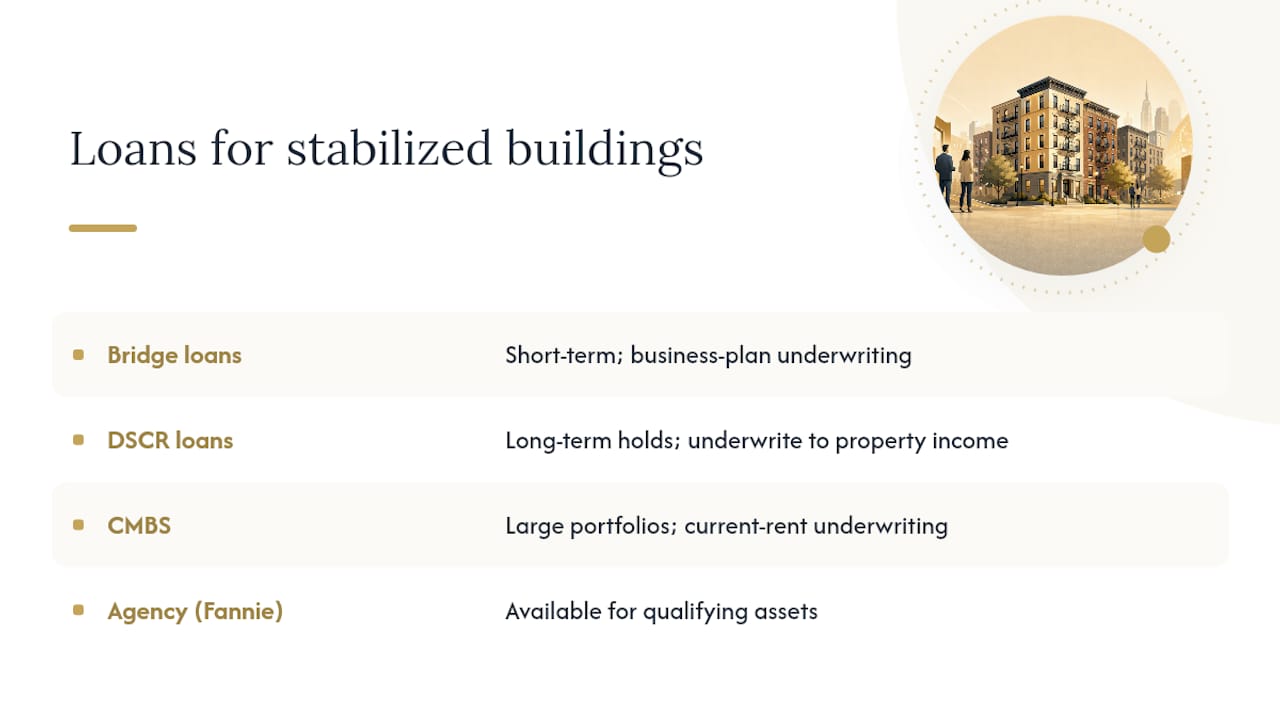
Bridge loans suit short-term acquisitions or light repositioning where cash flow is temporarily below stabilized targets. Because bridge lenders underwrite to a business plan rather than permanent debt service, they can accommodate a building mid-renovation — but they still apply conservative assumptions to stabilized income. Brookmontcapital structures bridge financing for stabilized assets with exit strategies tied to permanent DSCR loan placement.
DSCR loans are the workhorse for long-term holds. These products qualify based on property income rather than borrower personal income, which suits investors with complex ownership structures. The trade-off: lenders apply conservative haircuts to stabilized rents, and the DailyMoss analysis confirms that institutional DSCR lending for stabilized assets has contracted in recent years, making lender selection more consequential.
CMBS can work for larger stabilized portfolios where the loan size justifies the securitization process. CMBS lenders underwrite to current rents and apply their own stressed cap rates, often more conservatively than bank lenders. The fixed-rate structure and non-recourse terms are attractive, but prepayment flexibility is limited. See Brookmontcapital’s CMBS loan structuring for portfolio-level considerations.
Agency and refinance options through Fannie Mae’s multifamily programs are available for qualifying stabilized assets, though the underwriting requirements described throughout this guide apply in full. For a broader view of agency product eligibility, Brookmontcapital’s agency financing guide covers current lender criteria.
Underwriting checklist and a worked DSCR example
Before engaging a lender, assemble these documents:
- Current rent roll with unit-level regulation status flagged
- Lease addenda and renewal history, including preferential rent documentation
- Operating statements for the prior 3–5 years
- Capital expenditure records and deferred maintenance log
- Appraisal order confirmation (pre-rate lock)
- Replacement reserve funding plan
- Sponsor track record and entity structure
Worked DSCR example using current stabilized rents:
This example clears the 1.2x industry minimum but sits below the 1.25x benchmark many institutional lenders now require, especially for properties with high stabilized occupancy. A borrower in this position would typically present a lower LTV request or documented ancillary income (laundry, parking, storage) to close the gap.
Pro Tip: Ancillary income from laundry, parking, and storage is generally includable in underwriting — but document it with 12 months of actual receipts. Projected ancillary income without historical support rarely survives lender scrutiny.
What documents lenders will request — and where borrowers stumble
Beyond the checklist above, lenders conducting full due diligence on a stabilized asset will request:
- Tenant preference documentation for any units with preferential rents
- Evidence of annual rent registration filings (required in most jurisdictions)
- Capital improvement pass-through records if IAIs (Individual Apartment Improvements) were claimed
- Utility and tax escalation history for the prior three years
The most common pitfalls: missing preferential-rent paperwork (which forces lenders to underwrite the preferential rent as permanent), relying on projected turnover to justify higher pro forma rents, and submitting an incomplete reserve plan. Each of these signals to a lender that the sponsor has not fully internalized the stabilized-income framework — and that perception slows approval or kills the deal.
Clear, well-organized documentation for every stabilized unit reduces perceived regulatory risk and accelerates the lender’s credit process. Treat the rent roll as the centerpiece of your package, not an afterthought.
Primary risks and how disciplined sponsors mitigate them
Rent-stabilized assets carry a specific risk profile that differs from market-rate multifamily. The core risks:
- Limited rent growth: Allowable annual increases are set by local boards, often below CPI, compressing NOI growth over time.
- Vacancy and turnover sensitivity: A stabilized building’s cash flow depends heavily on low vacancy; turnover is expensive and does not produce the rent reset a market-rate building would.
- Regulatory change: Local rent boards can tighten allowable increases, and state legislatures can expand stabilization coverage — both reduce asset value.
- Expense inflation: Property taxes, insurance, and utility costs rise at market rates while revenue is capped, squeezing margins.
- Appraisal compression: Cap-rate stress testing and income ceilings produce lower appraised values, limiting refinance proceeds.
Mitigation starts with conservative underwriting: model expenses at actual or slightly above, hold vacancy at 5%–7%, and stress the cap rate before projecting exit value. Larger replacement reserves — funded from day one — protect against deferred maintenance that would otherwise erode NOI. Sponsors who document ancillary income, maintain low LTV, and demonstrate a track record on stabilized assets present the strongest compensating factors to lenders who have tightened their criteria since 2023.
Legal and regulatory considerations
This article is informational and does not constitute legal advice. Rent stabilization law is jurisdiction-specific, and the rules governing allowable increases, vacancy decontrol, capital improvement pass-throughs, and unit registration vary by city and state. Verify the applicable statute before underwriting.
When unit regulatory status is unclear — for example, when a building’s registration history is incomplete or when planned capital work could trigger rent adjustments — retain counsel familiar with local housing law before proceeding. Fannie Mae’s Section 207 guidance is a relevant regulatory reference for federally backed multifamily loans on stabilized properties, covering underwriting to current rents, cap-rate stress testing, sponsor alignment, and replacement reserve funding. It is the starting point for understanding how federal agency programs treat these assets, but local law governs the unit-level rent rules.
The Brookmontcapital perspective on stabilized-asset financing
Rent-stabilized lending is not a niche that rewards generalists. The sponsors who get deals done are the ones who arrive with clean documentation, a realistic DSCR built on current rents, and a reserve plan that a lender can actually underwrite. What I see most often is sponsors who have done the acquisition math on projected market-rate rents — and then discover, mid-process, that no institutional lender will touch those projections. The gap between a sponsor’s pro forma and a lender’s underwriting value is where deals die.
At Brookmontcapital, we work with sponsors on multifamily financing across bridge, DSCR, CMBS, and agency structures, including assets with significant stabilized unit counts. The advisory work starts before the lender conversation: stress-testing the DSCR on current rents, sizing the replacement reserve, coordinating the appraisal, and packaging the deal in a format that institutional lenders can underwrite efficiently. Lender matching matters here — not every lender is willing or equipped to underwrite stabilized income, and placing a stabilized deal with the wrong lender wastes time and damages sponsor credibility.
Brookmontcapital can help you finance your stabilized asset
Securing financing for a rent-stabilized building requires a lender who understands the income ceiling and an advisor who can package the deal to clear their underwriting bar. Brookmontcapital provides capital markets advisory for exactly this asset class.
Our services for stabilized-asset sponsors include:
- Bridge, DSCR, and CMBS structuring and placement
- Capital stack advisory and preferred equity sourcing
- Appraisal coordination and reserve sizing
- Lender introductions to institutional debt funds, banks, and agency programs
Submit your deal for a feasibility review or schedule a call to discuss financing structure. Start with Brookmontcapital’s financing solutions page to outline your asset and financing need.
Sources
- Rent-Stabilized Properties | Fannie Mae Multifamily Guide
- ANHD_Best-Practices-in-Multifamily-Lending.pdf
- Rent-Stabilized Buildings and DSCR Loans: What NYC Lenders Actually Look For - The DailyMoss
- Rent‑Stabilized Properties | Fannie Mae Multifamily Guide
Recommended
- Build-to-Rent Financing Explained for US Investors in 2026 | Brookmont Capital Ventures
- How to Underwrite a CRE Deal When Interest Rates Stay Higher for Longer | Brookmont Capital Ventures
- SFR & Build-for-Rent Financing | Brookmont Capital
- Commercial vs. Residential Real Estate Loans: Key Differences | Brookmont Capital Ventures