
Construction Escrow Accounts: What Contractors Need to Know

A construction escrow account is a neutral third-party holding account where project funds are deposited before work begins and released only when contractually defined conditions are met. Think of it as the financial constitution for your project: the escrow agreement governs every dollar in and every dollar out, with disbursements tied to verified milestones rather than a handshake. The primary benefit is payment security and title/lien protection for all parties. The primary downside is administrative overhead and the potential for payment delays that compress contractor cash flow.
Key facts up front:
- Who opens it: Typically the lender at loan closing on financed projects, though owners and general contractors can initiate escrow independently for self-funded work.
- What it protects: Funds are ring-fenced so they cannot be redirected; disbursements require documented proof of completion.
- What it costs you: Extra documentation, inspection fees, and processing windows that can take multiple business days per draw.
- How it differs from mortgage escrow: A mortgage impound account collects tax and insurance payments through your servicer. Construction escrow is milestone-based and focused on tying payment to verified work completion — an entirely different mechanism.
Key Takeaways
A construction escrow account protects project funds and reduces lien exposure, but its value depends entirely on how precisely the escrow agreement is drafted and negotiated.
| Point | Details |
|---|---|
| Core definition | A neutral third-party account that holds project funds and releases them only when verified milestones are met. |
| Primary benefit | Payment security and lien/title protection for all parties throughout the project. |
| Primary risk | Administrative overhead and 7–21 business day per-draw processing windows that compress contractor cash flow. |
| Documentation must-haves | Sworn contractor’s statement, tiered lien waivers, schedule of values, inspection reports, and change-order approvals. |
| Top negotiation items | Cap per-draw processing time, define milestones specifically, and require an electronic lien-waiver workflow in the agreement. |
Table of Contents
- What is a construction escrow account, step by step?
- Who manages escrow and what does each party do?
- What are the real benefits and risks of construction escrow?
- When is escrow set up and what does it cost?
- How escrow shapes construction financing — a Brookmontcapital perspective
- What documents does escrow require and how do you avoid disputes?
- Which escrow agreement clauses should you watch and negotiate?
- A practical contractor checklist for working with escrow
- When is construction escrow worth it?
- Sources
What is a construction escrow account, step by step?
Understanding the operational flow is where theory becomes cash flow. Setting up a construction escrow account requires choosing an escrow agent, negotiating the escrow agreement, depositing funds before work begins, and defining a draw schedule tied to project milestones. The process typically takes some weeks once contracts are finalized.
Here is the full sequence from agreement to closeout:
- Negotiate the escrow agreement. Define milestones, draw percentages, inspection criteria, lien-waiver tiers, holdback amounts, and dispute-resolution steps before a single dollar moves.
- Select an escrow agent. This is typically a title company, bank, or specialized escrow firm. On lender-funded projects, the lender may mandate a fund-control provider.
- Fund the account. The lender or owner deposits the full project budget (or a tranche) into the escrow account before work starts.
- Establish the draw schedule. Draws are tied to milestones — foundation complete, framing complete, mechanical rough-in, and so on — with specific percentages of the contract value assigned to each.
- Submit a draw package. At each milestone, the general contractor submits a complete draw request to the escrow agent. A draw package typically includes:
- Sworn contractor’s statement
- AIA-style schedule of values with percentage-complete notation
- Invoices from the GC, subcontractors, and suppliers
- Conditional and unconditional lien waivers (tiered by subcontractor level)
- Change-order approvals
- Proof of prior payees (canceled checks or ACH confirmations)
- Inspection and verification. A third-party inspector or fund-control agent visits the site to verify that the claimed work is complete. The lender and escrow agent review the inspection report before approving the draw.
- Approval and disbursement. Once the escrow agent confirms all conditions are met, funds are wired to the GC or directly to subcontractors and suppliers.
- Final closeout. The last draw requires full lien releases from all tiers, final inspection sign-off, certificate of occupancy (where applicable), and satisfaction of any retention holdback.
Pro Tip: Pre-collect lien waivers from your tier-2 and tier-3 subs and suppliers before you submit the draw package. A single missing waiver from a $4,000 material supplier can freeze a $200,000 draw for two weeks. Use a digital signature platform like DocuSign or Adobe Acrobat Sign to collect and organize tiered waivers in advance.
Who manages escrow and what does each party do?
Construction escrow accounts involve multiple parties with distinct responsibilities. Knowing who to call — and what they are accountable for — prevents delays and misdirected disputes.
- Escrow agent (title company, bank, or specialized escrow firm): The neutral disbursing party. Follows the written escrow agreement to the letter, collects documentation, and releases funds only when all conditions are satisfied. Does not advocate for any party.
- Lender/funder: Typically requires escrow on construction loans to control disbursements and confirm loan proceeds are used for verified work. Sets draw-approval criteria and may retain final sign-off authority.
- Owner/developer: Funds the account (or directs the lender to do so) and approves the draw schedule. On owner-funded projects, the owner may also serve as the primary approving party for each draw.
- General contractor: Submits draw packages, coordinates subcontractor lien waivers, and manages the draw schedule against the project timeline. The GC’s role in financing is central — incomplete submissions from the GC are the most common cause of draw delays.
- Subcontractors and suppliers: Provide invoices and lien waivers as required by the draw package. Their documentation compliance directly affects whether the GC’s draw is approved on time.
- Third-party inspector/fund-control agent: Conducts on-site verification that claimed work is complete before the escrow agent releases funds. Inspection windows typically run 3–7 business days from draw submission; budget for this in your schedule.
What are the real benefits and risks of construction escrow?
Construction escrow reduces title and lien risk by conditioning disbursements on verified completion and logging contractor lien releases at each phase. That protection has real value — but it comes with operational trade-offs that affect cash flow on every draw.
Primary benefits:
- Payment security: Funds are deposited and ring-fenced before work begins, so the contractor is not dependent on the owner’s liquidity mid-project.
- Lien and title protection: Collecting lien waivers at each draw phase reduces mechanic’s lien exposure and keeps the title clean for the lender and owner.
- Audit trail: Every disbursement is documented, which simplifies dispute resolution and supports lender reporting requirements.
- Direct sub-payment option: Some escrow arrangements allow the escrow agent to pay subcontractors and suppliers directly, bypassing the GC and reducing the risk of payment diversion.
Primary risks and contractor-facing downsides:
- Administrative burden: Escrow managers require additional documentation — invoices, lien waivers, inspection reports — and payments are slower because of additional approval steps.
- Holdbacks and retention: Escrow agreements commonly include a retention holdback (often 5–10% of each draw) that is not released until final completion and lien-free title confirmation.
- Cash-flow compression: A 7–21 business day processing window per draw means subcontractors may wait three to four weeks for payment after work is complete.
- Inspection and agent fees: These costs are real and recurring; they are typically borne by the owner or built into the project budget, but the GC should confirm this before signing.
| Criterion | Benefit | Risk/Trade-off |
|---|---|---|
| Payment security | Funds guaranteed before work starts | Funds inaccessible without documentation |
| Lien protection | Waivers collected at each draw | Missing waiver freezes entire draw |
| Audit trail | Clean disbursement record | Extra paperwork per draw cycle |
| Sub-payment | Direct pay reduces diversion risk | Requires escrow agent coordination |
| Cash flow | Predictable draw schedule | 7–21 business day processing lag |
Pro Tip: Maintain a subcontractor pay reserve equal to at least two to three weeks of your largest sub’s billing cycle. This buffer covers the escrow processing window and prevents you from defaulting on sub-payment obligations while waiting for draw approval.
When is escrow set up and what does it cost?
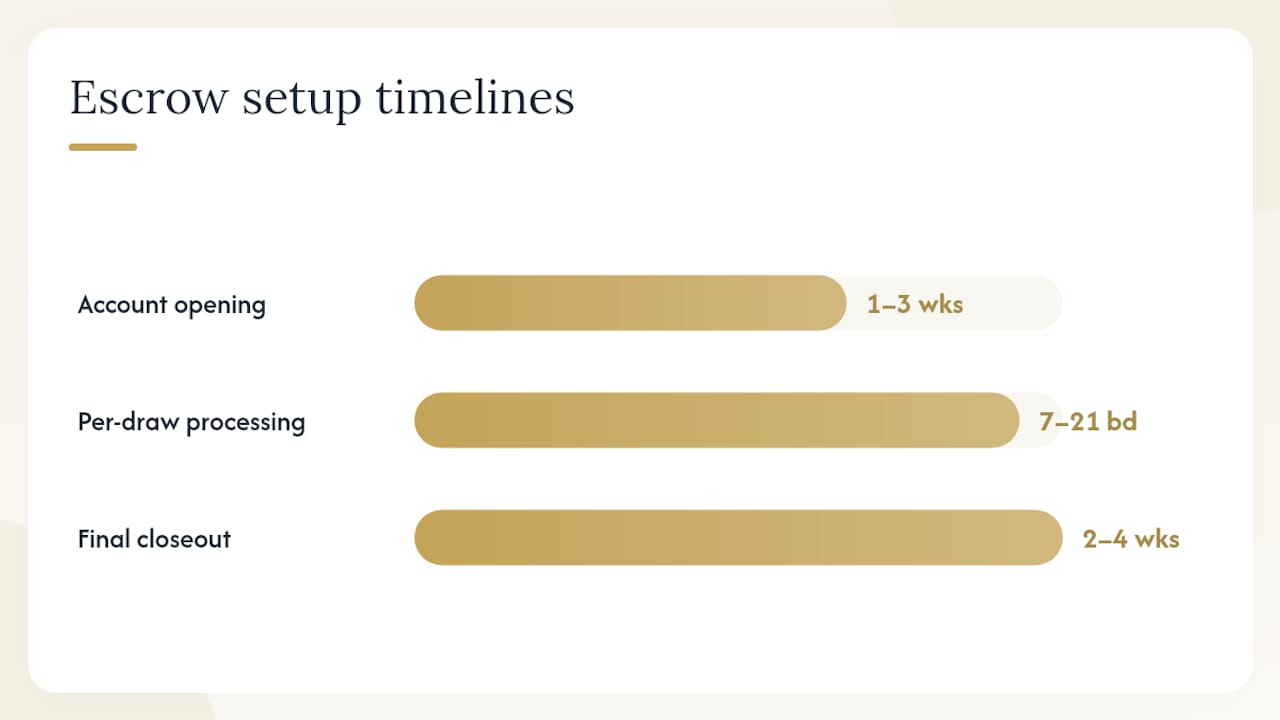
Setup timing depends on who initiates the account. On lender-funded construction loans, escrow is established at loan closing — the lender deposits funds with a title company or fund-control provider as a condition of the first draw. On owner-funded or self-financed projects, the owner or GC can request escrow at any point, though setting it up before mobilization is strongly preferred.
Typical timelines to plan for:
- Account opening: 1–3 weeks from contract execution
- Per-draw processing: 7–21 business days, depending on inspection scheduling and documentation completeness
- Final closeout: Add 2–4 weeks for full lien-release collection and retention holdback release
Common fee structures:
- Flat escrow agent fee: Charged at account opening; covers administration for the project term. Ranges vary by provider and project size — request an itemized fee schedule before signing.
- Per-draw fee: Charged each time a draw is processed. On a 10-draw project, these fees accumulate meaningfully.
- Inspection/fund-control fee: Charged per site visit by the third-party inspector or fund-control agent.
- Wire and processing fees: Small per-transaction fees that add up over a multi-draw project.
Who pays? On lender-mandated escrow, fees are typically built into the project budget or charged to the borrower. On owner-requested escrow, the owner usually bears the cost. Confirm this allocation in the escrow agreement before closing.
Timeline callout: Incomplete draw packages are the single most common cause of processing delays. A missing lien waiver or an unsigned change-order approval can add 5–10 business days to an otherwise clean draw. Reducing construction financing costs starts with minimizing draw-cycle friction.
How escrow shapes construction financing — a Brookmontcapital perspective
Escrow is not just a disbursement mechanism. It is a structural element of construction lender underwriting, and the terms you negotiate in the escrow agreement directly affect your cost of capital, draw velocity, and lien exposure. Brookmontcapital advises developers and sponsors to treat the escrow negotiation as seriously as the loan term sheet.
Well-drafted escrow agreements must specify disbursement rules, inspection criteria, dispute escalation, and definition of lien release. Omitting these details is a common cause of mid-project friction.
Five clauses to negotiate before signing:
- Scope and frequency of inspections: Define who conducts them, what constitutes a passing inspection, and the maximum turnaround time from draw submission to inspection completion.
- Definition of milestone completion: Vague language like “substantially complete” invites disputes. Require specific, measurable acceptance criteria for each draw phase.
- Lien-waiver tiers and timing: Specify which tiers of subcontractors and suppliers must provide waivers, whether conditional or unconditional waivers are accepted at draw time, and when unconditional waivers are due.
- Holdback percentage and release conditions: Negotiate the retention percentage (standard is 5–10%) and the specific conditions — not just “final completion” — that trigger holdback release.
- Dispute-resolution path: Include a named escalation contact at the escrow agent, a defined response window, and an arbitration clause so disputes do not stall the project indefinitely.
Brookmontcapital’s recommended action items:
- Request an itemized fee schedule from the escrow agent before account opening.
- Require an electronic lien-waiver workflow in the agreement — paper-based processes add unnecessary lag.
- Cap per-draw processing time contractually (e.g., 10 business days from complete submission).
- On lender-funded projects, negotiate the right to propose the fund-control provider rather than accepting the lender’s default selection.
Brookmontcapital’s capital stack advisory services include escrow structuring guidance as part of the broader financing engagement — because the terms in that agreement often have more impact on project cash flow than the loan rate itself. For documentation practices that intersect with title risk, tenant estoppel certificates offer a parallel example of how precise written conditions protect all parties in a real estate transaction.
What documents does escrow require and how do you avoid disputes?
Escrow account managers require additional documentation with every payment application. A complete draw package is the difference between a 10-day approval and a 30-day freeze.
Standard draw-package checklist:
- Sworn contractor’s statement (notarized on many projects)
- AIA G702/G703 or equivalent schedule of values with percentage-complete notation
- GC invoices and subcontractor/supplier invoices
- Conditional lien waivers from all tier-1 subs and suppliers for the current draw
- Unconditional lien waivers from all tier-1 subs and suppliers for the prior draw
- Tier-2 and tier-3 lien waivers where required by the escrow agreement
- Third-party inspection report confirming milestone completion
- Executed change-order approvals for any scope changes since the last draw
- Proof of prior payees (canceled checks, ACH confirmations, or paid receipts)
How to prevent disputes before they start:
- Define inspection acceptance criteria in the escrow agreement — not in a side email.
- Set document submission deadlines in the agreement (e.g., draw packages due by the 1st of each month).
- Name an escalation contact at the escrow agent and a response window for disputed items.
- Digitize your lien-waiver collection process. Use a platform that timestamps signatures and stores waivers by draw period and subcontractor tier.
- Confirm change-order approvals in writing before the work is performed, not after — an unapproved change order is a common draw-rejection trigger.
- Conduct a pre-draw internal review against the checklist before submission to catch missing items.
Avoiding common construction financing mistakes often comes down to documentation discipline at the draw stage — not the loan structure itself.
Which escrow agreement clauses should you watch and negotiate?
The escrow agreement is a legal contract where a neutral third party holds assets until specified conditions are met. Every clause in that contract has cash-flow implications. Here are the ones that matter most and what to push for:
- Milestone definitions: Vague milestones create disputes. Push for specific, measurable criteria (e.g., “framing complete and passed framing inspection by [jurisdiction] building department”).
- Draw schedule and percentages: Confirm that the draw percentages align with your actual cost-to-complete curve. A front-loaded cost structure on a back-loaded draw schedule creates a cash-flow gap.
- Inspection and approval process: Specify the inspector’s qualifications, the inspection window, and who bears the cost of re-inspection if a draw is rejected.
- Required evidence (lien waivers): Define the exact waiver tiers, forms, and timing. Ambiguity here is the most common source of draw freezes.
- Holdbacks and retention language: Negotiate the release trigger to be specific — “final lien-free title report and certificate of occupancy” rather than “owner’s satisfaction.”
- Agent fees: Request a fee cap or a fixed fee schedule so costs do not escalate mid-project.
- Dispute resolution: Include a tiered escalation path (escrow agent review, then mediation, then arbitration) with defined response windows at each step.
- Final closeout conditions: List every document required for the final draw and holdback release so there are no surprises at project end.
One important caution: lien rights and mechanics’ lien laws vary significantly by state. A lien-waiver form that is valid in California may not be enforceable in Texas or Florida. Always verify that your waiver language and escrow agreement terms comply with the mechanics’ lien statutes in your project’s jurisdiction before signing.
A practical contractor checklist for working with escrow
Escrow is manageable when you build its requirements into your project workflow from day one. The contractors who struggle are those who treat escrow as an afterthought and scramble for documentation at draw time.
Pre-bid and pre-mobilization:
- Confirm the escrow agent’s identity, contact information, and fee schedule before signing the prime contract.
- Review the escrow agreement for vague milestone definitions and push for specific acceptance criteria.
- Negotiate a per-draw processing cap (10 business days from complete submission is a reasonable target).
- Confirm who pays inspection and agent fees — and build those costs into your budget if they fall on the project.
During the project:
- Pre-collect conditional lien waivers from all subcontractors and suppliers before each draw submission.
- Maintain a digital draw-package folder organized by draw period, with sub-folders for invoices, waivers, and inspection reports.
- Track change orders in real time and obtain written approvals before work proceeds.
- Plan a 2–3 week cash-flow buffer to cover the escrow processing window for each draw.
Pro Tip: Model your cash-flow forecast with a 15-business-day lag on every draw. If your escrow agreement allows direct payment to subcontractors from the escrow account, negotiate that provision — it removes the GC as a payment intermediary and reduces your lien exposure significantly.
At closeout:
- Begin collecting unconditional final lien waivers from all tiers at least 30 days before the anticipated final draw.
- Confirm the exact document list for holdback release with the escrow agent in writing.
- Do not demobilize your documentation team until the final disbursement and holdback release are confirmed.
When is construction escrow worth it?
Escrow adds the most value when the financial or legal stakes are high enough to justify the administrative overhead. On large commercial ground-up projects with multiple subcontractor tiers, owners whose financial stability is uncertain, or spec developments where title protection is critical, escrow functions as an important financial mechanism.
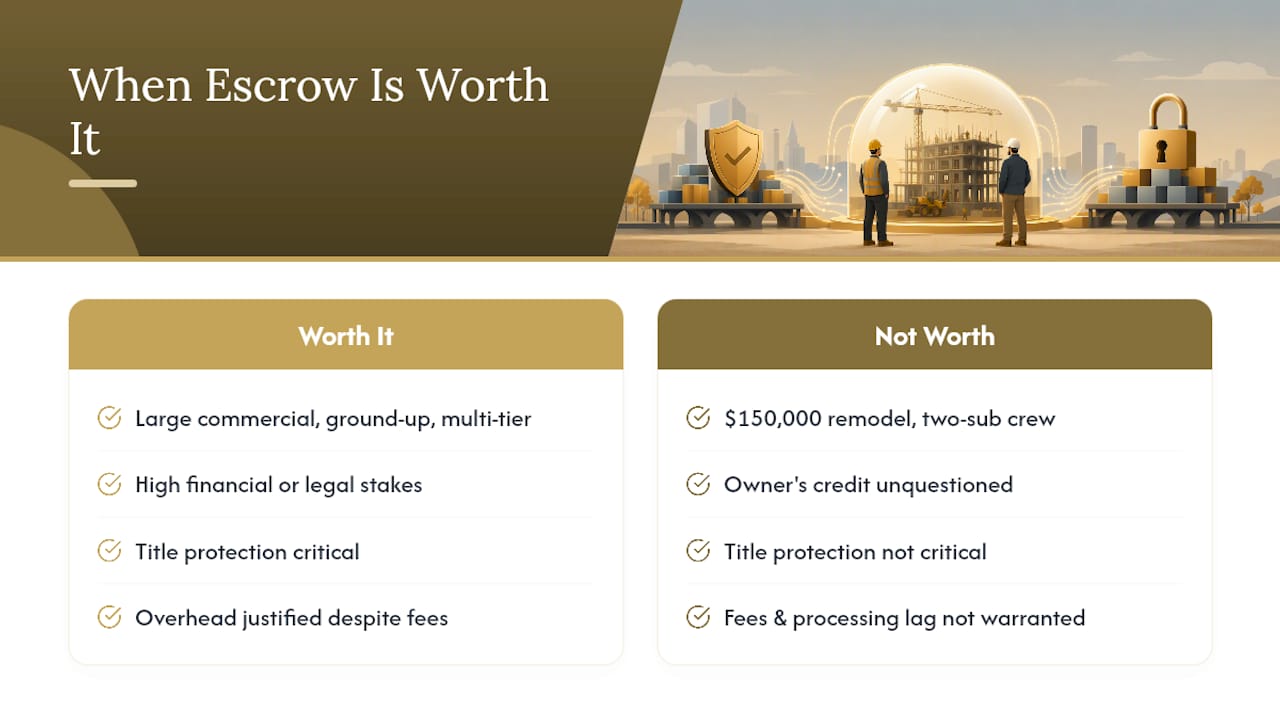
The calculus shifts on smaller projects. A $150,000 remodel with a long-standing owner relationship and a two-sub crew may not warrant the fee structure and processing lag that escrow introduces. The administrative cost-benefit tilts negative when the project is short-duration, the owner’s credit is unquestioned, and the subcontractor tier is shallow.
For spec construction financing, escrow is almost always present because the lender requires it as a condition of the construction loan. On bridge loan structures used for short-term construction or renovation, escrow terms are typically lighter but still present. The negotiation urgency is highest on multi-tiered commercial projects where a single disputed draw can stall the entire project for weeks.
The bottom line: escrow protects everyone when the project is complex and the stakes are high. On simpler jobs, weigh the fees and processing lag against the actual payment risk before agreeing to terms.
Sources
The sources below support the claims in this article and provide deeper reading on construction escrow, lien law, and financing structures:
- Construction Escrow: What Contractors & Suppliers Need …
- How to Set Up a Construction Escrow Account: Costs & Draws - LegalClarity
- Understanding Construction Escrow
- Escrow agreement definition — Investopedia
- What is an escrow or impound account? | CFPB
- Construction Escrow Accounts: Ensuring Payment and Performance - New Era Escrow
- FLEX ONE - What Is Construction Escrow?
- Construction Escrow Accounts
This article is general information, not a substitute for advice from a qualified financial advisor. Consult a qualified financial professional about your own circumstances before acting on anything here.
Recommended
- Common Construction Financing Mistakes to Avoid in 2026 | Brookmont Capital Ventures
- Construction Loan Requirements for Developers | Brookmont Capital Ventures
- Spec Construction Financing: What Builders Must Know in 2026 | Brookmont Capital Ventures
- Construction Lender Underwriting Criteria: 2026 Guide | Brookmont Capital Ventures