
Build-to-Rent Financing Explained for US Investors in 2026

Build-to-rent (BTR) financing is a specialized, multi-phase capital structure designed to fund the ground-up construction of residential properties intended for long-term rental rather than individual sale. Unlike a standard mortgage on an existing asset, you are financing something that does not yet exist, which means the capital structure must account for both the construction period and the eventual income-producing phase. The financing lifecycle moves through two distinct stages: an interest-only construction loan that disburses funds via a draw schedule tied to verified milestones, followed by a permanent DSCR (Debt Service Coverage Ratio) loan or portfolio term loan once the property reaches lease-up stabilization.
Core elements of build-to-rent financing at a glance:
- Construction loan: Funds 70%–85% of total project costs via milestone-based draws; interest-only payments during the build period
- Bridge-to-perm loan: Short-term runway financing if the construction loan matures before stabilization is achieved
- DSCR loan: Permanent financing underwritten on rental income, not personal income; typically 70%–80% LTV after stabilization above 90% occupancy
- One-time-close structure: Combines construction and permanent financing in a single transaction, eliminating a second closing
- Draw schedule: Capital released in stages tied to milestones such as foundation, framing, rough mechanicals, and drywall completion
- Interest reserve: Funded at closing to cover interest payments during construction so you are not writing checks out of pocket
According to Fannie Mae, BTR developments typically consist of 25 or more units on a single tax lot with centralized property management, resembling garden-style apartment communities rather than scattered single-family rentals.
Why build-to-rent financing is gaining traction with investors

The BTR model offers structural advantages that traditional rental acquisitions simply cannot replicate. When you build from the ground up, you control the design, unit mix, and amenity package to match your target tenant profile, which directly reduces vacancy risk and tenant turnover. Purpose-built rental communities in population-dense areas generate more durable cash flow than repositioned assets because tenants are not tolerating compromises in layout or infrastructure.
Key benefits driving BTR adoption in 2026:
- Long-term cash flow stability from purpose-designed communities with lower turnover rates
- DSCR qualification lets you scale a rental portfolio without personal income constraints
- Higher LTC thresholds (up to 85%–90% in one-time-close programs) compared to conventional investment property loans
- Cost efficiency from a two-phase financing structure that minimizes redundant closing costs
- Portfolio scalability because DSCR loans do not count against personal debt-to-income ratios
- Design control to reduce deferred maintenance and capital expenditure cycles from day one
How the construction financing phase actually works
The construction loan is the first and most operationally intensive phase of BTR financing. Funds are not disbursed in a lump sum. Instead, the lender releases capital in draws as each verified milestone is completed, covering hard costs such as framing and mechanicals, as well as soft costs including permits and architectural fees.
Key mechanics of the construction phase:
- Loan-to-cost ratio: Typically 70%–85% of total project costs, depending on developer experience and pro forma strength
- Draw inspections: Required before each disbursement to confirm progress against the approved schedule
- Interest-only payments: Accrue only on drawn funds, not the full loan commitment; covered by an interest reserve funded at closing
- Loan terms: Range from 12 to 24 months, with extensions negotiable upfront
- Personal guarantees: Common for smaller developers and first-time BTR sponsors
- Hard money construction loans: Structured on projected after-repair value (ARV) rather than existing improvements, useful when conventional lenders require more seasoning
The critical distinction from a traditional mortgage is that your pro forma drives underwriting, not a current rent roll. Lenders are evaluating your projected completed value, your construction budget, and your lease-up assumptions before a single unit exists.
What happens when permanent financing takes over
Once construction is complete and the property reaches stabilized occupancy, typically 90% or higher, the construction debt is retired and replaced with long-term permanent financing. This transition is the moment the project shifts from a cost center to an income-producing asset, and the underwriting logic changes entirely.
Permanent financing mechanics for BTR projects:
- DSCR underwriting: Qualification is based on the property’s rental income relative to its debt obligation, not the developer’s personal income
- LTV range: Up to 75%–80% LTV on stabilized value, depending on occupancy and debt service coverage
- Loan terms: Typically 30-year amortization, providing long-term payment predictability
- Occupancy threshold: Lenders require 90% or higher physical occupancy to trigger permanent financing conversion
- One-time-close conversion: Combines both phases into a single transaction, with automatic conversion to permanent financing upon stabilization and no second closing costs
- Portfolio loans: Available for sponsors holding multiple BTR properties under a single entity, allowing cross-collateralization and simplified management
DSCR loans are the preferred permanent vehicle because they scale cleanly. As your portfolio grows, each property qualifies on its own income rather than pulling against your personal debt-to-income capacity.
Five steps to execute a successful build-to-rent project
1. Land acquisition and entitlement financing Secure the site with a bridge or land loan, typically at 50%–65% LTV, covering the purchase, entitlement process, and permitting before vertical construction begins. Entitlement timelines vary significantly by municipality, so budget conservatively and avoid committing to a construction start date until zoning approvals are in hand.
2. Securing construction financing with a draw schedule Work with your lender to finalize the draw schedule before closing. Each draw milestone should align with your general contractor’s payment schedule to avoid cash flow gaps mid-construction. Coordinate your capital stack at this stage, including any preferred equity or mezzanine debt, so there are no surprises when a draw is requested.
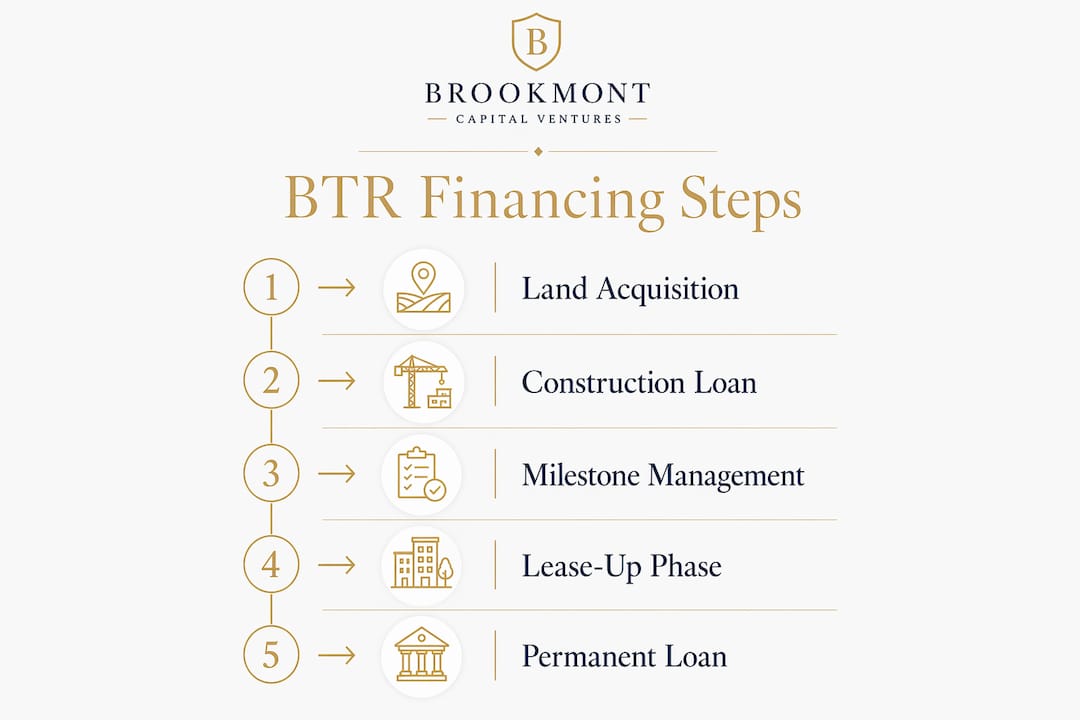
3. Managing construction to hit milestones Active milestone management is where projects succeed or fail. Delays in framing or mechanical rough-ins push your draw schedule back, which extends your interest reserve burn and compresses your lease-up window. Build schedule buffers into your pro forma and maintain weekly communication with your GC and lender’s inspection team.
4. Executing the lease-up phase to reach stabilization The lease-up phase is the most underestimated part of the BTR timeline. Lenders require 90%+ physical occupancy before triggering permanent financing, which means your marketing and leasing operations need to begin well before the certificate of occupancy is issued. Price units to lease quickly in the first 60–90 days rather than holding for top-of-market rents that slow absorption.
5. Transitioning to permanent financing and managing operations Once stabilization is achieved, execute the refinance or conversion to your DSCR or portfolio loan. At this point, your focus shifts from construction management to asset management: rent collection, maintenance protocols, and lease renewal strategy. Locking in a 30-year DSCR loan at stabilization converts your development profit into a long-term cash flow engine.
How to manage refinance risk and the stabilization gap
The refinance gap is the single largest financial risk in BTR development. It occurs when your construction loan matures before the property reaches the occupancy threshold required for permanent financing. In slower lease-up markets, this gap can force you into expensive short-term extensions or bridge financing at unfavorable terms.
Pro Tip: Negotiate loan extension options into your construction loan terms before closing. A 6-month extension right at a modest fee is far cheaper than scrambling for emergency bridge financing when your loan matures at 75% occupancy.
Strategies to close the stabilization gap:
- Bridge-to-perm loans: Short-term financing designed specifically to provide runway between construction debt maturity and stabilization; retired once the 90%+ occupancy benchmark is met
- One-time-close pre-commitments: Securing your permanent lender’s commitment before breaking ground eliminates refinance uncertainty entirely
- Lender pre-commitments: Some lenders offer pre-commitments for permanent financing at the construction loan closing, giving you a defined exit before the first draw
- Lease-up acceleration: Front-loading marketing spend and offering concessions in the first 90 days to compress the time to stabilization
- Extension negotiation: Building extension options into the original construction loan terms as a backstop against slower absorption
For a deeper look at how bridge-to-perm structures work in practice, the mechanics matter more than most developers realize until they are in the middle of a lease-up that is running two months behind.
Key financial metrics and underwriting criteria lenders use
Lenders underwriting BTR projects evaluate a distinct set of metrics that differ from standard investment property loans. Understanding these criteria before you approach a lender puts you in a stronger negotiating position.
| Metric | Typical Threshold | What It Measures |
|---|---|---|
| Loan-to-cost (LTC) | 70%–85% (up to 85%–90% in one-time-close programs) | Construction loan as a percentage of total project cost |
| Loan-to-value (LTV) | 70%–80% | Permanent loan as a percentage of stabilized appraised value |
| DSCR | 1.00x minimum | Rental income divided by monthly debt service |
| Occupancy for conversion | 90%+ physical occupancy | Threshold to trigger permanent financing |
| Interest reserve | Funded at closing | Covers interest payments during the construction period |
| Developer experience | Track record of completed projects | Risk factor affecting LTC and guarantee requirements |
Pro forma quality is the underwriting variable that separates approved deals from declined ones. Lenders scrutinize your rent assumptions, absorption timeline, and operating expense projections with particular attention to whether your DSCR clears 1.00x at stabilized rents. A DSCR below 1.00x means the property’s income does not cover its debt service, which disqualifies the loan regardless of other strengths in the deal.
Where BTR developers source financing in the US
The lender landscape for BTR projects in 2026 spans several distinct categories, each with different appetites for deal size, geography, and sponsor experience.
Regional and community banks remain active in BTR construction lending for smaller projects, typically below $5M in total cost. They often require stronger personal guarantees and more conservative LTC ratios, but their relationship-driven underwriting can work in your favor if you have an established track record in their market.
Debt funds and private lenders dominate the mid-market BTR space, offering higher LTC ratios (up to 85%) and faster closing timelines than banks. They price risk into their rates, so expect higher interest costs in exchange for flexibility and speed. For BTR construction financing in competitive markets, debt funds are often the most practical path.
Agency lenders such as Fannie Mae’s multifamily programs become relevant once a BTR project reaches stabilization and qualifies as a multifamily asset, typically 5 or more units. These programs offer the most competitive permanent financing rates but require full stabilization and compliance with agency underwriting standards.
One-time-close specialty lenders offer integrated BTR loan programs that combine construction and permanent financing in a single transaction, available in most US states. These programs fund up to 85%–90% loan-to-cost with automatic conversion to permanent DSCR financing at stabilization, eliminating the refinance gap by design.
Capital stack advisory firms like Brookmontcapital connect BTR sponsors with the right lender for each phase, whether that is a debt fund for construction, an agency program for permanent financing, or a one-time-close lender that handles both.
What the timeline from financing approval to stabilization looks like
A realistic BTR timeline for a ground-up project runs 18–30 months from financing approval to full stabilization, depending on project size, market, and lease-up velocity. The phases break down roughly as follows:
- Months 1–3: Loan closing, final permit approvals, and mobilization
- Months 3–15: Active construction with monthly draw requests and inspections
- Month 12: Begin DSCR refinance application with permanent lender (if using a two-loan structure)
- Months 15–18: Construction completion, certificate of occupancy, and lease-up launch
- Months 18–24: Lease-up to 90%+ occupancy threshold
- Month 24–30: Permanent financing conversion or DSCR loan closing; construction debt retired
Coordinating the capital stack across this timeline is where most BTR project delays originate. Funding gaps between construction loan maturity and DSCR loan closing are avoidable with proper planning, but they require lender coordination that starts at the construction loan closing, not six months before maturity.
Brookmontcapital structures BTR financing for serious developers
Developers pursuing BTR projects in 2026 face a lender market that is more fragmented than it looks. The right construction lender for your deal may not offer permanent financing, and the best DSCR lender may not touch ground-up construction. That gap in the capital stack is where deals stall.
Brookmontcapital specializes in structuring and sourcing the full BTR capital stack, from construction financing and bridge-to-perm facilities to DSCR loans and preferred equity, connecting sponsors with institutional lenders, debt funds, and equity partners who understand the BTR model. Rather than approaching lenders one at a time, you get a structured financing package built around your pro forma, your timeline, and your exit. Brookmontcapital works with developers on projects ranging from $500K to $5M and beyond, with direct access to lenders who offer the full range of financing solutions the BTR strategy requires. Contact Brookmontcapital to get your BTR deal structured and in front of the right lenders before you break ground.
Key Takeaways
Build-to-rent financing requires a two-phase capital structure: a construction loan covering a significant portion of project costs, followed by a permanent DSCR loan at a substantial loan-to-value ratio once the property stabilizes above 90% occupancy.
| Point | Details |
|---|---|
| Two-phase structure | Construction loans fund 70%–85% LTC (up to 85%–90% in one-time-close programs); permanent DSCR loans cover 70%–80% LTV after stabilization. |
| Occupancy threshold | Lenders require 90%+ physical occupancy before triggering permanent financing conversion. |
| Refinance gap risk | Bridge-to-perm loans or one-time-close structures eliminate the gap between construction maturity and stabilization. |
| DSCR qualification | Permanent loans qualify on rental income, not personal income, supporting portfolio growth without personal debt-to-income constraints. |
| Brookmontcapital advisory | Brookmontcapital structures and sources the full BTR capital stack, from construction financing to DSCR loans, for sponsors nationwide. |