
Vertical Construction Financing: A Developer’s 2026 Guide

Vertical construction financing is defined as short-term debt capital used to fund the physical building phase of a commercial or residential real estate development project. Unlike land loans or horizontal infrastructure financing, these loans release funds through milestone-based draws tied directly to verified construction progress. Loan-to-cost ratios, draw schedules, and third-party inspection requirements are the three structural pillars every developer must understand before approaching a lender. Private lenders in 2026 offer up to 90% LTC for qualified borrowers, while traditional banks typically cap at 65–80% LTC. That gap in leverage capacity is why many developers now work with capital advisors like Brookmontcapital to access the right lender for their specific project profile.
What is vertical construction financing and how does it work?
Vertical construction financing funds the hard costs of building: labor, materials, and contractor fees for the structure rising from the ground. The term “vertical” distinguishes this phase from horizontal construction, which covers site work, grading, utilities, and roads. Industry professionals also call this product a construction loan or ground-up construction loan, and both terms are used interchangeably across lender term sheets.
The funding process follows a draw schedule tied to verified construction milestones. A developer submits a draw request, a third-party inspector visits the site to confirm progress, and the lender releases the next tranche of funds. Draw approvals from specialized lenders can be completed within 24–48 hours, which keeps subcontractors paid and projects on schedule.

During the construction period, borrowers pay interest only on the funds actually drawn, not on the full loan commitment. That structure keeps carrying costs manageable in the early months when capital is deployed slowly. Loan terms typically run 12–24 months, with extensions available for complex projects.
At completion, the loan must be retired through one of three paths: a sale of the completed asset, a refinance into permanent debt, or a bridge-to-permanent transition. The exit strategy is not an afterthought. Lenders require a defined takeout plan before the first dollar is disbursed.
- Draw request submitted by the developer with supporting documentation.
- Third-party inspection confirms milestone completion on site.
- Lender reviews the inspection report and approves the draw.
- Funds are released directly to the borrower or title company.
- Interest accrues only on the cumulative drawn balance.
Pro Tip: If your lender takes more than five business days to process a draw, that delay costs you real money. Labor crews do not wait, and material prices do not hold. Prioritize lenders with documented 24–48 hour draw turnaround before you negotiate rate.
What are the main types of vertical construction loans?
Two primary structures dominate the construction financing market: construction-to-permanent loans and stand-alone construction loans. Each serves a different developer profile and project strategy.
Construction-to-permanent loans combine the building phase and the long-term mortgage into a single closing. The developer pays one set of closing costs, and the loan automatically converts to a permanent mortgage upon certificate of occupancy. This structure works best for developers who intend to hold the asset as a long-term investment and want rate certainty from day one.
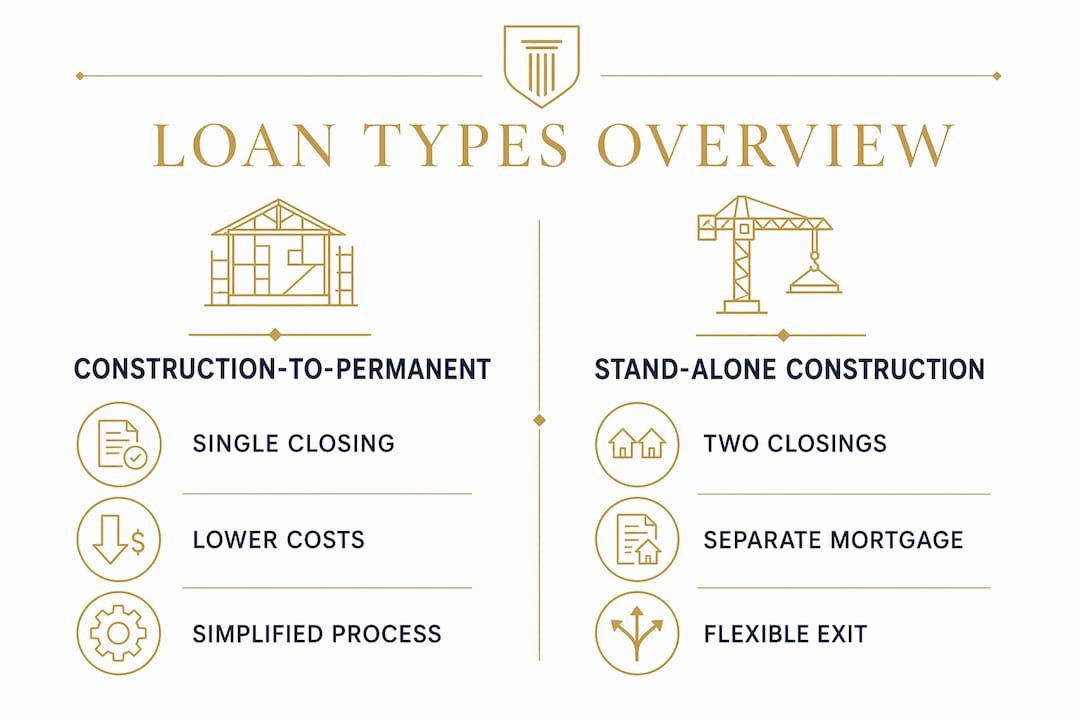
Stand-alone construction loans fund only the building phase. At completion, the developer refinances into a separate permanent loan or sells the asset outright. This structure offers more flexibility if interest rates shift favorably during construction, but it carries refinance risk and a second round of closing costs.
Key structural differences between the two:
- Closing costs: Construction-to-permanent loans require one closing; stand-alone loans require two.
- Rate certainty: Construction-to-permanent locks the permanent rate at origination; stand-alone loans expose the borrower to market rates at refinance.
- Flexibility: Stand-alone loans allow the developer to shop permanent financing after completion.
- Lender pool: Construction-to-permanent products are more common at banks and credit unions; stand-alone construction loans are the primary product for private lenders and debt funds.
| Feature | Construction-to-permanent | Stand-alone construction |
|---|---|---|
| Number of closings | One | Two |
| Permanent rate locked | At origination | At refinance |
| Typical LTC | 65–80% (bank) | Up to 90% (private) |
| Best for | Hold strategy | Sale or flexible exit |
| Refinance risk | Low | Moderate to high |
Construction-to-permanent loans reduce costs and administrative burden for developers who have a clear hold strategy from the start. Stand-alone loans give experienced developers the optionality to capitalize on rate movements.
How does vertical construction financing differ from other loan types?
Developers frequently misapply financing products because the terminology overlaps. Confusing bridge loans with construction loans is one of the most common and costly mistakes in real estate development. Understanding the distinctions prevents mismatched capital structures and budget overruns.
Horizontal construction financing funds site work: grading, utility installation, road construction, and lot preparation. It covers the infrastructure phase before any vertical structure begins. Vertical construction financing picks up where horizontal leaves off, funding the building itself.
Bridge loans provide short-term capital for land acquisition, pre-development costs, or transitional situations. They are not designed to fund hard construction costs. A developer who uses a bridge loan to fund framing and mechanical work will face a maturity crisis before the building is complete.
Ground-up financing is a broader term that can encompass both horizontal and vertical phases, sometimes including land acquisition. When a lender markets a “ground-up construction loan,” confirm whether it covers only the vertical phase or the full development cycle.
| Loan type | Phase covered | Primary use | Typical term |
|---|---|---|---|
| Horizontal construction | Site work and infrastructure | Roads, utilities, grading | 12–18 months |
| Vertical construction | Building phase | Hard construction costs | 12–24 months |
| Bridge loan | Pre-development or transition | Land, entitlements, gap capital | 6–18 months |
| Ground-up financing | Full cycle | Land through vertical build | 18–36 months |
For developers working on condo and townhome projects, the distinction between horizontal and vertical phases directly affects draw timing and lender selection. Getting this wrong at the term sheet stage creates expensive restructuring later.
How do you qualify for vertical construction financing?
Lender underwriting for vertical construction loans evaluates two parallel tracks: the project and the developer. Both must clear the bar before a term sheet is issued.
Project-level requirements include a complete set of construction plans and permits, a signed general contractor agreement with a fixed-price or guaranteed maximum price contract, site control through ownership or a purchase agreement, and a detailed project budget with contingency reserves.
Developer-level requirements center on what lenders call “Builder DNA.” Lenders assess the borrower’s track record as heavily as the project pro forma when determining loan terms. A developer with three completed projects of similar scope will access better leverage and lower pricing than a first-time builder with identical financials on paper.
Key qualification factors:
- Credit score: Most private lenders require a minimum score in the mid-600s; banks typically require 700 or higher.
- Prior experience: Documented completion of comparable projects is the single strongest qualification factor.
- Liquidity: Lenders require reserves to cover interest carry and cost overruns, typically 10–15% of the total project budget.
- Exit strategy: A defined takeout plan must be presented at application, not at maturity.
New developers who lack a track record can access higher leverage by partnering with an experienced co-developer or co-sponsor. That partnership structure satisfies the lender’s Builder DNA requirement while allowing the new developer to build their own record.
Some lenders offer bulk materials purchasing programs that reduce construction costs by 10–15%, which effectively lowers the total loan amount needed and improves the project’s return on cost. This is a negotiating point most developers overlook entirely.
Pro Tip: Structure your exit before you sign the loan documents. If your plan is a sale, have a broker opinion of value in hand. If your plan is a refinance, model the debt service coverage ratio at your target permanent loan amount before closing. Lenders reward clarity, and you avoid expensive emergency capital if the market shifts.
Key Takeaways
Vertical construction financing is the most specialized and operationally demanding form of real estate debt, requiring precise draw management, a credible developer track record, and a defined exit strategy before the first dollar is committed.
| Point | Details |
|---|---|
| Milestone-based draws control capital | Funds release only after third-party inspections confirm verified construction progress. |
| Leverage varies by lender type | Private lenders offer up to 90% LTC; banks typically cap at 65–80% LTC. |
| Builder DNA drives loan terms | Developer track record influences leverage and pricing as much as project financials. |
| Exit strategy is a loan requirement | Lenders require a defined takeout plan at origination, not at maturity. |
| Draw speed matters as much as rate | Slow draw approvals cause labor walkoffs and material cost increases that erode project returns. |
What I’ve learned about vertical construction financing after years of structuring these deals
The most common mistake I see developers make is selecting a lender based on the lowest quoted interest rate. Rate matters, but draw process efficiency matters more. A lender who takes ten business days to process a draw will cost you more in carrying costs, labor delays, and subcontractor premiums than a 50-basis-point rate difference ever saves you. I have watched well-capitalized projects unravel because the lender’s internal draw review process was slow and bureaucratic.
The second mistake is treating bridge loans and construction loans as interchangeable. They are not. Bridge capital is expensive short-term debt designed for transitional situations. Using it to fund hard construction costs is like financing a 30-year asset with a credit card. The math never works at maturity.
The third lesson is one most developers learn the hard way: your exit strategy must be modeled before you sign, not after you receive a certificate of occupancy. I have seen developers reach completion with a beautiful asset and no viable refinance path because rates moved 150 basis points during construction. The developers who fared best had modeled multiple exit scenarios at origination and structured their capital stack accordingly.
The developers who consistently perform well in this market work with advisors who understand the full capital stack, from senior debt through preferred equity, and who have direct relationships with lenders who specialize in vertical construction. That combination of structural expertise and lender access is what separates a good deal from a great one.
— Jerry
Brookmontcapital’s construction financing solutions for developers
Brookmontcapital structures and sources vertical construction financing for developers and investors across the country, with access to private lenders, debt funds, and institutional capital sources that offer up to 90% LTC on qualifying projects.
Whether you are building a multifamily asset, a mixed-use project, or a commercial development, Brookmontcapital’s advisory team structures your capital stack from the ground up. That includes senior construction debt, preferred equity, and exit strategy planning built into the loan structure from day one. Explore construction financing options tailored to your project, or review the full range of commercial real estate financing solutions available through Brookmontcapital. Contact the team directly to discuss your project and receive a term sheet within 48 hours.
FAQ
What is vertical construction financing in real estate?
Vertical construction financing is short-term debt that funds the physical building phase of a real estate development project. Funds are disbursed through milestone-based draws verified by third-party inspections, and borrowers pay interest only on drawn amounts.
How does a construction draw schedule work?
A draw schedule releases loan funds in tranches as the developer completes verified construction milestones. Specialized lenders can process draw approvals within 24–48 hours after inspection confirmation.
What is the difference between a construction loan and a bridge loan?
A construction loan funds hard building costs during the active construction phase. A bridge loan provides short-term transitional capital for land acquisition or pre-development. Mixing these two products creates maturity risk and budget overruns.
How much can I borrow with a vertical construction loan?
Private lenders in 2026 offer up to 90% loan-to-cost for qualified borrowers with strong Builder DNA. Traditional banks typically cap leverage at 65–80% LTC depending on project type and borrower experience.
What is Builder DNA and why does it matter?
Builder DNA refers to a developer’s documented track record of completing comparable construction projects. Lenders weight this factor heavily in underwriting, and developers with strong Builder DNA access higher leverage and better pricing than first-time builders with identical project financials.