
The Role of General Contractor in Financing Projects

The role of general contractor in financing is to actively manage project cash flow, secure construction-specific funding, and align payment structures with lender and developer requirements. This is not a passive administrative function. General contractors, or GCs, sit at the intersection of project execution and capital management, making decisions that directly affect a project’s financial viability. Payment delays of 30–90 days, retainage holdbacks of 5–10%, and front-loaded material costs create funding gaps that GCs must close using tools like mobilization financing, invoice factoring, and revolving lines of credit. Developers and investors who understand how GC financial management works gain a measurable advantage in structuring deals and controlling project risk.
What is the role of general contractor in financing?
The GC’s financing role is defined by one core responsibility: keeping the project funded between when costs are incurred and when payments arrive. Construction projects do not pay in real time. A GC mobilizes crews, orders materials, and pays subcontractors weeks or months before receiving a draw from the developer or lender. That gap is a structural feature of construction financing, not an exception.
GCs address this gap through three primary financial tools. Mobilization financing covers startup costs before the first draw. Invoice factoring converts unpaid pay applications into immediate cash. Revolving lines of credit provide flexible liquidity throughout the project lifecycle. Each tool serves a different phase of the payment cycle, and experienced GCs deploy them in combination rather than relying on a single source.

The industry standard for contractor payment terms creates a predictable but demanding financial environment. Payment cycles of 30–90 days are standard across commercial construction, with retainage adding a second layer of deferred income. On a $500,000 project with 10% retainage, $50,000 remains locked up for up to 18 months after completion. That is not a rounding error. It is a material drag on GC working capital that shapes every financing decision on the job.
How do general contractors manage cash flow challenges during construction?
Cash flow management is the central discipline in GC financial management, and it requires the same rigor as project scheduling. The two most common failure points are predictable: draw timing mismatches and retainage accumulation. Both are manageable with the right forecasting tools and contract structures.
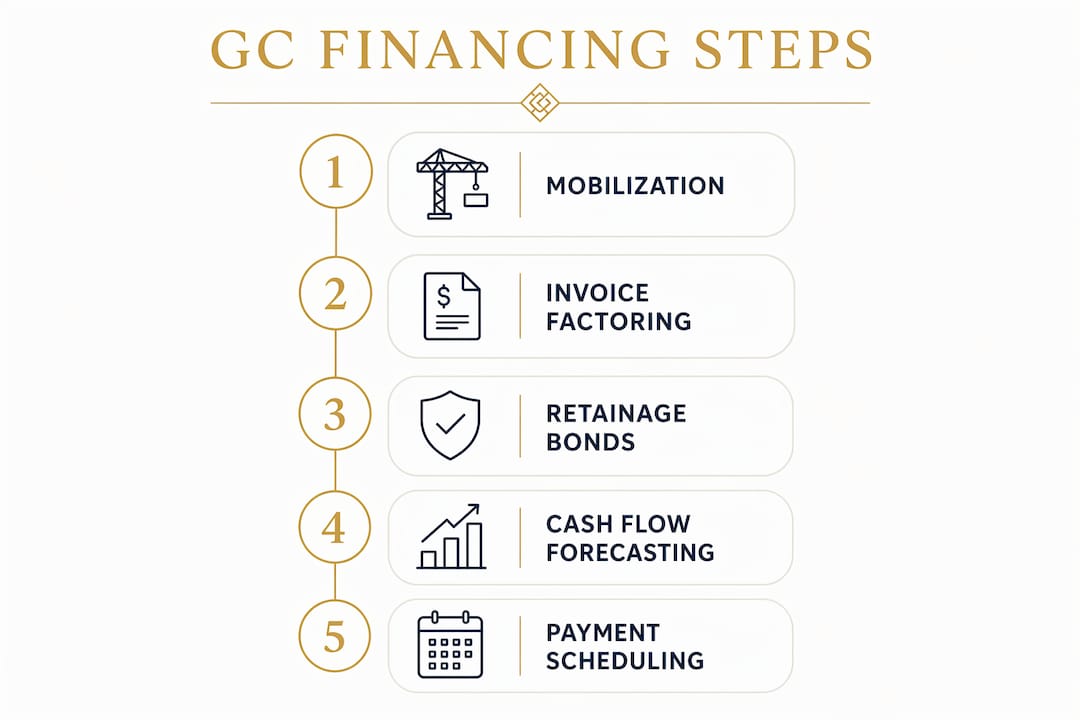
The most effective forecasting method is the 13-week rolling cash flow forecast. This tool maps expected inflows from draw requests against committed outflows to subcontractors, suppliers, and overhead. It gives GCs a 90-day visibility window, which is long enough to arrange bridge capital before a shortfall becomes a crisis. Seasoned project managers treat this forecast as a weekly operational document, not a one-time budget exercise.
Subcontractor and supplier payment terms must align with the project’s draw schedule. A GC who pays subs on net-30 terms but receives draws on net-60 terms is financing the gap out of working capital. Negotiating back-to-back payment terms, where sub payments are triggered by owner payments, reduces this exposure significantly. This practice is common in well-structured commercial projects and should be a standard contract requirement.
Retainage is the most underappreciated liquidity drain in construction finance. Retainage of 5–10% of each draw, held for 6–18 months post-completion, compounds across multiple simultaneous projects. A GC running three $2 million projects simultaneously could have $300,000 to $600,000 in retainage outstanding at any given time.
- Map all draw dates against subcontractor payment obligations at project start.
- Build a 13-week rolling cash flow forecast and update it weekly.
- Negotiate retainage release tied to milestone completion, not project closeout.
- Align supplier payment terms with draw receipt dates to avoid self-funded gaps.
- Identify financing triggers in advance so capital can be arranged before a shortfall occurs.
Pro Tip: Negotiate a retainage bond as a substitute for cash holdback. Developers who accept a surety bond in place of retainage free up GC liquidity without increasing their own risk exposure, and they typically receive more competitive bids as a result.
What financing tools do general contractors use to bridge project funding gaps?
GCs have access to a defined set of financing products built specifically for construction payment cycles. Each product addresses a different type of funding gap, and the right choice depends on the project phase, the GC’s contract position, and the creditworthiness of the project owner.
Mobilization financing covers the costs incurred before the first draw: equipment, materials, permits, and initial labor. Mobilization financing is secured against the signed contract, not the GC’s balance sheet. Lenders require a fully executed contract. A letter of intent does not qualify. Repayment is tied to pay application schedules, which means the loan structure mirrors the project’s cash flow rather than imposing fixed monthly payments.
Invoice factoring addresses the gap between submitting a pay application and receiving payment. Invoice financing advances 80–90% of unpaid invoice value immediately, bypassing the 60–90 day wait common in government and commercial projects. The factoring company collects directly from the owner or developer, and the GC receives the remaining balance minus fees at settlement.
Working capital loans are the most flexible option for general operating needs. Working capital loans fund within 24–48 hours with repayment terms ranging from 3 to 36 months. These are typically unsecured, which makes them accessible but also more expensive than asset-backed options.
| Financing Type | Primary Use | Collateral | Funding Speed | Repayment Structure |
|---|---|---|---|---|
| Mobilization financing | Project startup costs | Signed contract | 1–2 weeks | Tied to pay applications |
| Invoice factoring | Unpaid pay applications | Outstanding invoices | 24–72 hours | Collected from owner |
| Revolving line of credit | Ongoing liquidity | Business assets | Immediate (once established) | Revolving, interest on balance |
| Working capital loan | General cash flow gaps | Unsecured | 24–48 hours | Fixed term, 3–36 months |
- Mobilization financing depends on the owner’s creditworthiness, not just the GC’s financial strength.
- Invoice factoring fees reduce net margin, so GCs must price this cost into bids on projects with known payment delays.
- Revolving lines of credit carry interest rates of 7–10% and are most cost-effective when drawn and repaid within the same draw cycle.
- Working capital loans are best reserved for short-term gaps, not structural financing needs.
How do general contractors collaborate with developers and lenders in project financing?
Project financing structures treat the project’s contracts and cash flows as the primary collateral, not the sponsor’s corporate credit. This model, common in commercial real estate development, places the GC’s performance at the center of the lender’s risk assessment. Lenders require due diligence on delay risk, permits, and revenue reliability before financial close, and the GC’s track record directly influences whether that diligence clears.
Developers working within a project-financed structure must understand that their lender’s draw process controls the GC’s payment timing. Lenders release draws based on inspection reports, lien waivers, and compliance documentation. A GC who submits incomplete draw packages delays their own payment. This is a common and avoidable source of cash flow friction.
GC financial performance is scrutinized throughout the project lifecycle in structured deals. Lenders focus on completion certainty and compliance rather than corporate credit history. A GC who demonstrates clean work-in-progress (WIP) reporting, accurate cost-to-complete projections, and timely billing signals lower completion risk. That signal affects not just the current project but the GC’s ability to secure favorable terms on future deals.
The GC’s role in contract administration also carries direct financing implications. Successful construction firms integrate billing and collections as core operational metrics, linking WIP reporting to cash flow management. This is not standard practice across the industry, but it is the practice that separates financially stable GCs from those who rely on expensive emergency capital.
- Provide complete, accurate draw packages to avoid lender-caused payment delays.
- Maintain current WIP schedules and cost-to-complete reports throughout the project.
- Communicate proactively with developers and lenders when schedule changes affect draw timing.
- Treat billing and collections as operational priorities, not back-office functions.
- Understand the lender’s draw inspection process and build its timeline into the project schedule.
What financing strategies should developers use when working with general contractors?
Developers who treat the GC’s financial health as a project risk factor make better financing decisions. A GC under cash flow pressure cuts corners, delays subcontractor payments, and creates lien exposure. Selecting a GC with demonstrated financial management capability is as important as evaluating their construction experience.
The most direct way developers can improve GC financial performance is by restructuring retainage terms. Developers who negotiate early retainage release or accept bond substitutes attract stronger bids and better contractor performance. This is not charity. It is a risk management decision that reduces the probability of contractor financial distress mid-project.
Integrated financial reporting between the developer, GC, and lender creates transparency that benefits all three parties. When the GC’s cash flow forecast is visible to the developer and lender, draw timing can be coordinated to prevent gaps. This coordination reduces the GC’s need for expensive bridge capital and lowers the developer’s exposure to contractor default.
- Require GC candidates to submit a sample 13-week cash flow forecast as part of the bid qualification process.
- Negotiate retainage release tied to defined milestones rather than final project closeout.
- Align the draw request schedule with the GC’s subcontractor payment obligations.
- Request monthly WIP reports and cost-to-complete updates as a contract requirement.
- Evaluate the GC’s existing financing relationships as part of due diligence.
Pro Tip: Ask prospective GCs which financing products they use and how they manage draw timing gaps. A GC who cannot answer this question clearly has not thought through their cash flow management. That is a project risk, not just a financial detail.
Construction-specific financing products align repayment with project milestone billing, unlike fixed monthly payments in traditional loans. Developers who understand this distinction can structure contracts that support GC liquidity without increasing their own cost of capital.
Key Takeaways
The most effective approach to managing contractor involvement in financing is to treat GC cash flow as a project risk variable, not a contractor-only problem.
| Point | Details |
|---|---|
| GC financing role is active | GCs secure mobilization loans, invoice factoring, and credit lines to fund gaps between costs and draws. |
| Retainage is a material risk | 5–10% retainage held 6–18 months creates significant working capital pressure that affects project performance. |
| 13-week forecasting prevents crises | Rolling cash flow forecasts give GCs 90-day visibility to arrange capital before shortfalls occur. |
| Lenders scrutinize GC performance | In project-financed deals, GC completion certainty and WIP reporting directly influence draw approvals. |
| Developers control key variables | Restructuring retainage terms and aligning draw schedules reduces GC financial stress and project risk. |
What developers consistently underestimate about GC financing
The most common mistake I see developers make is treating the GC’s financing situation as the GC’s problem. It is not. When a GC runs out of working capital at month four of a twelve-month project, the developer owns that problem. Subcontractors stop showing up. Material deliveries halt. Lenders start asking questions about completion risk. The project does not pause politely while the GC sorts out their cash flow.
What I have found is that the developers who avoid this outcome are the ones who ask hard financial questions during GC selection, not after contract execution. They want to see how a GC manages draw timing, what financing relationships they maintain, and whether their billing and collections function operates as a core business process or an afterthought. Those questions reveal more about project risk than any construction resume.
The financing products available to GCs have improved considerably. Mobilization financing secured against signed contracts, invoice factoring with 80–90% advance rates, and working capital loans that fund within 48 hours give well-prepared GCs real tools to manage cash flow without relying on developer goodwill. The gap is not product availability. It is financial discipline and proactive communication.
Developers who build transparency into the financing structure, by sharing draw schedules early, accepting retainage bonds, and requiring monthly WIP reporting, create the conditions where GC financial management actually works. That is not a soft recommendation. It is the structural difference between projects that close on time and projects that do not.
— Jerry
Brookmontcapital’s financing solutions for construction projects
Real estate developers working with general contractors need financing that matches construction timelines, not standard amortization schedules. Brookmontcapital structures and sources commercial real estate financing specifically for developers and investors managing complex project-financed deals, including construction loans, bridge loans, and preferred equity.

Brookmontcapital connects sponsors with institutional lenders, debt funds, and equity partners who understand construction draw cycles, GC payment structures, and completion risk. Whether you are structuring a ground-up development or need bridge financing to cover a draw timing gap, Brookmontcapital provides the capital markets expertise to secure terms aligned with your project’s cash flow. Contact Brookmontcapital to discuss your financing structure.
FAQ
What is the primary financing responsibility of a general contractor?
The GC’s primary financing responsibility is managing the gap between project costs incurred and payments received. This involves securing working capital loans, mobilization financing, and invoice factoring to maintain liquidity throughout the construction cycle.
How does retainage affect a general contractor’s cash flow?
Retainage of 5–10% of each draw is held for 6–18 months post-completion, creating a significant and sustained drain on GC working capital. On a $500,000 project, 10% retainage means $50,000 is unavailable for up to 18 months.
What is mobilization financing and how does it work?
Mobilization financing covers project startup costs before the first draw is released. It is secured against a fully executed contract rather than the GC’s balance sheet, with repayment tied to the project’s pay application schedule.
How do lenders evaluate general contractors in project-financed deals?
Lenders focus on completion certainty, permit status, and cash flow reliability rather than the GC’s corporate credit. Clean WIP reporting and accurate cost-to-complete projections reduce perceived completion risk and support draw approvals.
Can developers reduce their project risk by changing retainage terms?
Developers who accept retainage bonds or negotiate milestone-based retainage release attract stronger bids and reduce the probability of GC financial distress mid-project. This is a direct risk management tool, not a concession to the contractor.