
Single Purpose Entity Requirements: The Lender’s Checklist

To close a commercial real estate loan, lenders will require a narrowly limited, operationally separate entity whose organizational documents, capitalization, cash management, and ongoing records each match the covenants in the loan agreement. That is the core of single purpose entity requirements, and every item below flows from that single principle.
Non-negotiable items lenders expect at diligence and closing:
- A purpose clause in the formation documents that restricts the entity to owning, operating, and financing one identified property
- Separate bank accounts, books of account, and financial statements maintained exclusively for the entity
- No commingling of funds or assets with any affiliate, sponsor, or related party
- An independent director or manager with a blocking vote on voluntary bankruptcy filings
- Prohibitions on incurring additional indebtedness beyond the subject mortgage
- Restrictions on asset acquisitions, mergers, consolidations, and transfers
- A cash management or lockbox arrangement routing all property revenues through lender-controlled accounts
- Adequate initial capitalization documented by bank statements or a capital contribution ledger
- Complete formation documents, all amendments, and any restatements delivered to lender counsel
Fannie Mae’s Single-Asset Entity requirements serve as the most widely cited agency benchmark, and they illustrate exactly what institutional lenders expect: a domestic entity formed solely to own the financed property, with review of all formation documents and prohibitions on additional debt or property. For CMBS loans, rating agencies treat the absence of these features as a structural deficiency that can affect bond ratings.
Pro Tip: Align your operating agreement and loan agreement before sending either to lender counsel. Mismatches between the purpose clause in the operating agreement and the permitted-use covenant in the loan document are among the most common reasons lender counsel requests a restatement at the eleventh hour.
Key Takeaways
A compliant single-purpose entity requires narrowly drafted formation documents, strict operational separateness, bankruptcy-remote mechanics, and a documented ongoing governance program that lenders can verify at any point during the loan term.
| Point | Details |
|---|---|
| Purpose clause is the foundation | Restrict the entity’s activities to one identified property; overbroad language triggers restatement requests from lender counsel. |
| Operational separateness matters more than documents | Separate bank accounts, no commingling, and documented arm’s-length affiliate transactions are what courts examine in consolidation analysis. |
| Independent director is a hard requirement | An unaffiliated professional with a blocking vote on bankruptcy filings is standard in institutional and CMBS financings. |
| Fannie Mae sets the agency benchmark | Domestic single-asset entity, complete formation documents, no additional debt or property, and domestic ownership tiers for foreign-owned borrowers. |
| Ongoing compliance is a governance program | Monthly reconciliations, quarterly operating statements, and annual officers’ certificates keep SPE protections intact over the loan term. |
Table of Contents
- What a single-purpose entity is and why lenders require it
- Formation documents and governing clauses lenders read first
- Operational practices that evidence separateness
- Bankruptcy-remote mechanics lenders demand and how courts treat them
- Capitalization standards and restrictions on additional debt
- Lockbox, cash sweep, and cash management controls
- Documents and evidence lenders request at diligence and closing
- Fannie Mae’s single-asset entity rules and what they mean for your deal
- Common negotiation points and drafting strategies
- Ongoing compliance after closing
- Risks and lender remedies when SPE requirements are breached
- Brookmont’s practical SPE closing checklist and 21–30 day timeline
- What Brookmont Capital Ventures sees most often in SPE deals
- Sources
- FAQ
What a single-purpose entity is and why lenders require it
A single-purpose entity (SPE), also called a special purpose vehicle (SPV) or single-asset entity, is a legal entity formed and operated exclusively to own, operate, and finance one identified real property asset and the activities directly ancillary to it. The entity holds no other assets, conducts no other business, and carries no obligations unrelated to that property.
Lenders require this structure for a precise reason: ring-fencing. When a borrower is a true SPE, the lender’s collateral is legally and operationally isolated from the sponsor’s other ventures, creditors, and liabilities. If the sponsor encounters financial distress elsewhere in its portfolio, the SPE’s assets are not automatically available to satisfy those claims. That isolation protects the lender’s security interest, satisfies rating agency criteria in securitized transactions, and reduces the risk that a bankruptcy court will consolidate the SPE’s assets with those of an affiliated entity.
The phrase “bankruptcy remote” is critical here, and so is its limit. The General Growth Properties litigation demonstrated that a bankruptcy court may permit an SPE to file for bankruptcy protection even when the organizational documents include blocking-vote mechanics, particularly when the independent director’s fiduciary duties to the entity conflict with the lender’s contractual expectations. “Bankruptcy remote” means the risk of a voluntary filing is reduced and managed; it does not mean the entity is insulated from all bankruptcy scenarios. Courts retain equitable power to consolidate assets across affiliated entities when the operational facts support it, regardless of how the documents read.
For CMBS transactions, the stakes are higher still. Rating agencies expect bankruptcy-remote SPE structures as a baseline condition, and omitting them can negatively affect bond ratings and investor confidence in the securitization.
Formation documents and governing clauses lenders read first
Lender counsel opens the diligence file with the certificate of formation (or articles of organization) and the operating agreement. Those two documents either pass or fail the initial SPE screen before any other underwriting begins.
The specific provisions lenders require in those documents:
- Purpose clause: Restricts the entity’s activities to owning, operating, leasing, and financing the identified property and activities incidental to it. Overbroad language (“any lawful business purpose”) is a common drafting trap that will trigger a restatement request.
- Indebtedness limits: Prohibits the entity from incurring debt other than the subject mortgage and ordinary-course trade payables below a defined threshold.
- Amendment restrictions: Requires unanimous member consent or independent director consent to amend SPE-related provisions, preventing a sponsor from quietly broadening the purpose clause post-closing.
- Separateness covenants: Affirmative obligations to maintain separate books, accounts, and records; to avoid commingling; and to conduct all affiliate transactions at arm’s length.
- Independent director mechanics: Specifies the qualifications, appointment process, and blocking-vote rights of the independent director or manager, including the requirement that the independent director consent to any bankruptcy filing.
- Transfer and merger limitations: Prohibits mergers, consolidations, asset sales, and membership interest transfers without lender consent.
- Anti-filing provisions: Restricts the entity and its members from filing or consenting to a voluntary bankruptcy petition without independent director approval.
- Third-party beneficiary language: Expressly designates the lender as a third-party beneficiary of the separateness covenants, giving the lender standing to enforce them directly.
Pro Tip: When counsel prepares the operating agreement, run a side-by-side comparison against the loan agreement’s SPE covenant schedule before execution. Every defined term, threshold, and consent mechanic should match precisely. A single inconsistency — such as a different dollar threshold for permitted indebtedness — can require a costly amendment at closing.
Operational practices that evidence separateness
Documents establish the framework; operations determine whether the SPE protections actually hold. ABA commentary confirms that bankruptcy courts evaluate sustained operational separateness more heavily than paperwork alone, which means lenders test conduct, not just clauses.
The operational controls lenders verify:
- Separate bank accounts: The entity maintains its own depository and operating accounts, distinct from any affiliate or sponsor account, with no shared signatories who commingle funds.
- Distinct books and records: General ledger, accounts payable, and accounts receivable are maintained solely for the entity, with no shared accounting systems that blend the entity’s financials with a parent or affiliate.
- Separate tax filings: The entity files its own federal and state tax returns (or is properly reflected as a disregarded entity with a separate EIN and standalone Schedule E or partnership return), with no shared tax filings that obscure its stand-alone position.
- No commingling: Revenues from the property flow directly into the entity’s accounts; no sponsor or affiliate funds pass through the entity’s accounts for any purpose.
- Arm’s-length affiliate agreements: Any management, leasing, or service agreement between the entity and an affiliate is documented in writing, reflects market-rate terms, and is approved by the entity’s governing body.
- Corporate formalities: Annual or periodic meetings of the governing body are held and documented with written minutes or written consents; resolutions authorizing material transactions are maintained in the entity’s records.
- Separate stationery and invoices: The entity uses its own letterhead, invoices, and contracts, clearly identifying itself as the contracting party rather than the sponsor or a parent entity.
- Document retention: All formation documents, amendments, resolutions, bank statements, and financial records are retained and accessible for lender review throughout the loan term.
How lenders sample-test separateness: During diligence, lenders typically request 12 months of bank statements to verify that revenues and expenses flow exclusively through the entity’s accounts. They review the general ledger for intercompany transactions and confirm that any affiliate charges are supported by written agreements at market rates. At periodic reviews, lenders may request updated bank reconciliations and a certification from the entity’s manager or officer that no SPE covenants have been breached.
Pro Tip: Assign a named internal owner for each separateness obligation — one person responsible for bank reconciliations, one for meeting minutes, one for intercompany agreement renewals. Diffuse ownership of these tasks is the most common reason SPE compliance erodes over time.
- Designate a compliance officer or outside counsel contact for SPE governance.
- Schedule annual operating agreement reviews against current loan covenants.
- Maintain a digital records folder with all resolutions, bank statements, and tax filings organized by year.
- Calendar all lender reporting deadlines at loan closing.
Bankruptcy-remote mechanics lenders demand and how courts treat them
Bankruptcy-remote mechanics reduce the probability of a voluntary bankruptcy filing and the risk of substantive consolidation, but they operate within limits that courts have tested repeatedly. Practitioners and the American Bankruptcy Law Journal confirm that governance restrictions, creditor limitations, and contractually imposed barriers reduce but do not eliminate these risks, because courts retain equitable power to consolidate in fact-specific cases.
The core mechanics lenders require:
- Separateness covenants embedded in both the operating agreement and the loan documents, creating parallel contractual obligations enforceable by the lender.
- Independent director or manager with a blocking vote on any voluntary bankruptcy filing, merger, dissolution, or material asset transfer.
- Limits on incurring indebtedness beyond the subject mortgage and ordinary-course trade payables.
- Amendment restrictions requiring independent director consent or unanimous member approval to modify SPE-related provisions.
- Springing member provisions in single-member LLCs, which cause a designated independent person to become a member automatically upon the sole member’s bankruptcy, preventing the entity from being pulled into the member’s estate.
Independent director mechanics in practice: Lenders typically require the independent director to be an unaffiliated professional with no financial relationship to the sponsor beyond the director fee. Fee arrangements are often capped or disclosed to lender counsel to preserve the appearance and reality of independence. The fiduciary-duty tension is real: an independent director owes duties to the entity, not to the lender, and courts scrutinized this dynamic closely in the General Growth litigation. When an independent director concludes that a bankruptcy filing serves the entity’s interests, the blocking-vote structure may not prevent the filing.
Substantive consolidation risk factors courts consider:
- Whether assets and liabilities of the entities are so intermingled that separation is impractical
- Whether creditors dealt with the entities as a single economic unit
- Whether the entities maintained separate books, accounts, and records
- Whether the entities observed corporate formalities
- Whether cash flows were commingled or separately tracked
Operational conduct drives every one of those factors. A perfectly drafted operating agreement does not overcome two years of commingled bank accounts.
Capitalization standards and restrictions on additional debt
Lenders want evidence of adequate initial capitalization and contractual prohibitions on additional indebtedness and mezzanine financing. Undercapitalization is itself a factor courts consider in substantive consolidation analysis, and lenders treat it as a red flag during underwriting.
What lenders look for on capitalization and debt:
- Initial capitalization: Proof of a capital contribution sufficient to cover organizational costs, initial operating reserves, and any required escrows at closing. Lenders typically verify this through bank statements or a capital account ledger in the operating agreement.
- Working capital reserves: Most lenders require the entity to maintain a minimum operating reserve, often expressed as a fixed dollar amount or a number of months of debt service, held in a lender-controlled or lender-monitored account.
- Trade payable caps: Permitted ordinary-course trade payables are typically capped at a defined threshold (often 60 days past due or a fixed dollar amount), beyond which the entity must obtain lender consent.
- Prohibition on additional secured debt: The entity may not encumber the property with any lien other than the subject mortgage and permitted title exceptions.
- Mezzanine financing restrictions: Lenders routinely prohibit mezzanine financing on the equity interests in the entity without prior written consent, and many loan documents require a separate intercreditor agreement if mezzanine debt is later permitted.
- Preferred equity restrictions: Similar to mezzanine, preferred equity arrangements that give a preferred equity holder control rights or a pledge of membership interests are typically prohibited or require lender consent.
Understanding how mezzanine and preferred equity fit into the capital stack is critical before structuring any SPE, because the restrictions lenders impose at the entity level directly constrain the sponsor’s flexibility above it.
Pro Tip: When negotiating debt carveouts, ask for a bifurcated structure: full recourse triggers only upon demonstrable lender loss or a court finding of substantive consolidation, not upon any technical breach of the indebtedness covenant. This is a recognized market practice and most institutional lenders will engage on it.
Lockbox, cash sweep, and cash management controls
Lockbox and daily sweep arrangements are standard lender requirements in institutional CRE financings, and they serve a dual purpose: they protect the lender’s cash collateral and they generate the operational evidence that supports separateness.
Standard cash management mechanics:
- Lockbox account: All tenant rent payments and property revenues are directed to a lender-controlled or lender-designated lockbox account, typically held at the lender’s depository bank or a third-party custodian.
- Daily sweep: Funds in the lockbox are swept daily (or on a defined posting schedule) into a cash management account, from which the lender applies funds to debt service, reserves, and approved operating expenses.
- Operating account: After the sweep and reserve funding, remaining funds are released to the entity’s operating account for approved property expenses.
- Reserve accounts: Separate sub-accounts are maintained for tax and insurance escrows, capital expenditure reserves, and any required debt service reserves, each funded on a schedule defined in the loan agreement.
Documents lenders require to evidence cash management:
- Bank account resolutions authorizing the lockbox arrangement and designating authorized signatories
- Deposit account control agreements (DACAs) giving the lender a perfected security interest in each account
- Sweep agreements or cash management agreements executed by the entity and the depository bank
- Signature authority matrices confirming no affiliate or sponsor has unilateral access to the entity’s accounts
- Bank letters confirming account ownership, account numbers, and the absence of any prior liens or offsets
- Open all required accounts at least 15 days before closing to allow time for DACA execution and lender review.
- Confirm the depository bank will execute the lender’s form DACA without material modification.
- Deliver executed bank account resolutions to lender counsel as a condition precedent to closing.
- Test the sweep mechanics with a nominal deposit before closing to confirm the routing is operational.
Documents and evidence lenders request at diligence and closing
Lenders will request a defined set of formation and operational documents before underwriting is complete, and a second, more detailed set as conditions precedent to closing. Assembling this package in advance compresses the timeline and signals organizational competence to lender counsel.
| Document | Why the Lender Needs It |
|---|---|
| Certificate of formation / articles of organization | Confirms entity type, state of formation, and date of formation |
| Operating agreement (all versions and amendments) | Verifies purpose clause, separateness covenants, independent director mechanics, and indebtedness limits |
| EIN confirmation / IRS letter | Confirms the entity has a separate federal tax identification number |
| 12 months of bank statements | Evidences separate accounts, no commingling, and consistent cash flow |
| Operating statements (12–24 months) | Supports underwriting and confirms no undisclosed liabilities |
| UCC search results | Confirms no prior security interests encumber the entity’s assets |
| Title report / title commitment | Confirms ownership, permitted exceptions, and absence of unauthorized liens |
| Proof of no mezzanine financing | Confirms no equity pledge or mezzanine debt encumbers the membership interests |
| Independent director appointment documentation | Confirms the independent director’s qualifications, acceptance, and fee arrangement |
| Organizational chart | Maps the ownership tiers from the SPE up through any foreign or domestic parent entities |
| Capital contribution records | Evidences adequate initial capitalization |
| Tax returns (most recent 2 years, if available) | Confirms separate filing status and no undisclosed tax liabilities |
For multi-asset entities, Fannie Mae requires operating statements for each real property owned, proof of no existing liens except permitted mortgage debt, and proof that no equity interest is subject to mezzanine financing.
Timeline for document delivery:
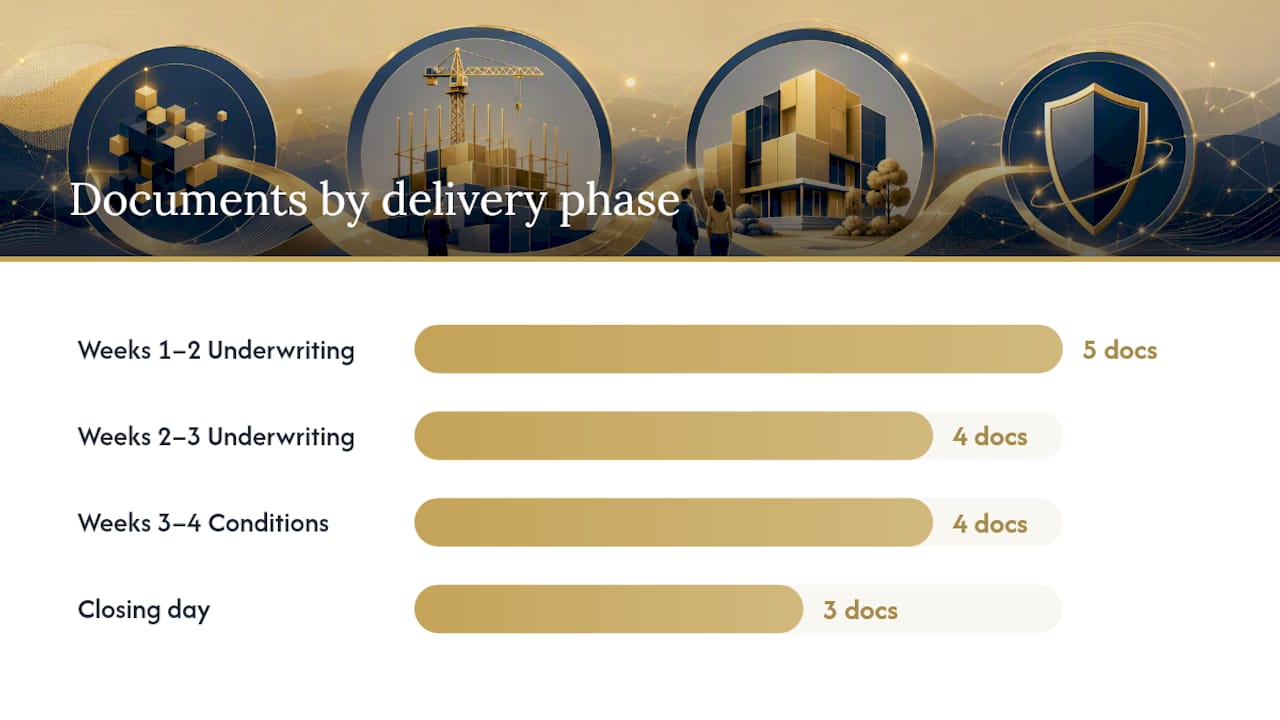
- Weeks 1–2 (underwriting): Formation documents, operating agreement, organizational chart, EIN confirmation, and 12 months of bank statements.
- Weeks 2–3 (underwriting completion): Operating statements, UCC search results, title commitment, and capital contribution records.
- Week 3–4 (conditions precedent): Independent director documentation, executed DACAs, bank account resolutions, and tax returns.
- Closing day: Bring-down certificates, officer’s certificates confirming no SPE covenant breaches, and any required lender consents.
Fannie Mae’s single-asset entity rules and what they mean for your deal
Fannie Mae requires the borrower to be a domestic single-asset entity formed solely to own the financed property, and its multifamily guide provides the most detailed publicly available checklist of what agency lenders expect. Sponsors and counsel working on agency multifamily transactions should treat Fannie Mae’s requirements as the floor, not the ceiling.
Key Fannie Mae proof points:
- The entity has been a single-asset entity since its formation, not converted from a multi-purpose entity
- Complete formation documents and all amendments and restatements are delivered for review
- When the borrower is ultimately owned by foreign persons or entities, at least one domestic tier of ownership exists between the foreign owner and the borrower
- The entity cannot acquire additional real property or participate in other businesses
- Assets and funds are not commingled with any other person or entity
- Separate accounting records are maintained and not consolidated with any affiliate
- The entity has not guaranteed or become obligated for the debts of any other person or entity
For multi-asset borrowers, Fannie Mae adds operating statements for each property, proof of no existing secured debt other than permitted mortgage debt, and written confirmation that no equity interest is subject to mezzanine financing.
Agency vs. private lender vs. CMBS: Fannie Mae’s rules are more prescriptive than most balance-sheet lender requirements, particularly on foreign ownership tiers and the prohibition on multi-asset ownership. CMBS lenders follow similar structural requirements but focus more heavily on the independent director mechanics and rating agency criteria. Balance-sheet lenders often accept a narrower separateness package, though the core requirements — separate accounts, limited purpose, no additional debt — remain consistent across all institutional lenders. For a detailed breakdown of agency financing eligibility and documentary requirements, Brookmont Capital Ventures has published a dedicated multifamily guide.
Common negotiation points and drafting strategies
The six most-contested SPE items in institutional CRE financings are independent director scope, amendment thresholds, debt carveouts, cash sweep mechanics, audit and inspection rights, and recourse carveout triggers. Knowing where lenders hold firm and where they will negotiate saves time and preserves sponsor flexibility.
Drafting strategies for each contested item:
- Independent director scope: Lenders want a broad blocking vote covering bankruptcy, dissolution, and any material asset transfer. Sponsors negotiate to limit the blocking vote to voluntary bankruptcy filings only, preserving the ability to make operational decisions without independent director consent.
- Amendment thresholds: Lenders prefer unanimous member consent for any amendment to SPE provisions. Sponsors negotiate for a supermajority threshold (typically 80–90%) with independent director consent as a substitute for full unanimity on non-material amendments.
- Debt carveouts: Lenders start with a zero-tolerance prohibition. Sponsors negotiate narrow carveouts for ordinary-course trade payables (capped at 60 days), security deposits, and pre-approved supplemental mortgage debt, with recourse tying to demonstrable lender loss rather than any technical breach.
- Cash sweep mechanics: Lenders prefer a daily sweep with no discretionary release. Sponsors negotiate for a monthly or weekly sweep cycle with a defined operating account floor that covers 30–60 days of approved operating expenses before the sweep activates.
- Audit and inspection rights: Lenders want annual audit rights and the ability to inspect records on 5 business days’ notice. Sponsors negotiate for 10–15 business days’ notice, a cap on the frequency of unscheduled inspections (typically one per year absent a default), and a requirement that inspections occur during normal business hours.
- Recourse carveout triggers: SPE covenant breaches in non-recourse loans often trigger full-recourse carveouts; borrowers commonly negotiate bifurcated remedies tying recourse to demonstrable lender loss or a court finding of substantive consolidation, rather than any technical SPE covenant breach.
Negotiation checklist for counsel and sponsors:
- Confirm which SPE covenants are cross-referenced in the recourse carveout schedule and narrow the list to material covenants only
- Request a materiality threshold for trade payable violations before a default is declared
- Negotiate a cure period (typically 10–30 days) for non-monetary SPE covenant breaches
- Confirm that the independent director’s fee is disclosed to and approved by lender counsel before closing
- Verify that the operating agreement’s amendment mechanics match the loan agreement’s consent requirements exactly
- Request a limited-scope consent right for the lender on post-closing operating agreement amendments that do not affect SPE provisions
Lenders share common concepts across SPE packages, but specifics vary by transaction and lender, so expect negotiation and customized operational mechanics rather than a standardized template.
Ongoing compliance after closing
SPE compliance does not end at closing. It is a recurring governance program that runs for the life of the loan, and lenders test it at periodic reviews, on loan assumption requests, and in any workout or enforcement scenario.
Recurring obligations lenders typically require:
- Monthly: Bank reconciliations confirming no commingling; operating account statements delivered to lender or servicer per the cash management agreement
- Quarterly: Operating statements for the property, including rent rolls and vacancy reports, delivered within 45–60 days of quarter-end
- Annually: Audited or reviewed financial statements (depending on loan size and lender requirements); officers’ certificates confirming no SPE covenant breaches; updated organizational chart if ownership has changed; renewal of any expiring affiliate agreements
- On-demand: Copies of any proposed operating agreement amendments for lender review and consent; notice of any change in the independent director; notice of any proposed transfer of membership interests
Notification triggers: Most loan agreements require the borrower to notify the lender within 5–10 business days of any proposed amendment to the operating agreement, any change in the independent director, any proposed transfer of a membership interest, or any event that could constitute an SPE covenant breach.
Pro Tip: Map each SPE covenant in the loan agreement to a named internal owner and a calendar reminder. Treat the covenant schedule as a compliance checklist, not a legal formality. Lenders who discover unreported covenant breaches during a routine review are far less flexible than lenders who receive proactive notice and a remediation plan.
Risks and lender remedies when SPE requirements are breached
Breach of SPE covenants carries consequences that extend well beyond a technical default notice. In non-recourse financings, an SPE covenant breach can convert a limited-liability loan into a full-recourse obligation against the sponsor personally.
Consequences of SPE covenant breach:
- Event of default: Most loan agreements treat material SPE covenant breaches as events of default, triggering acceleration rights, lockbox activation, and the lender’s right to appoint a receiver.
- Recourse carveout activation: Sponsors who breach SPE covenants risk triggering the “bad boy” carveout provisions that convert the non-recourse loan to full recourse. This is the most financially severe consequence and the one most frequently litigated.
- Substantive consolidation exposure: Operational breaches — commingled accounts, undocumented affiliate transactions, shared employees — are exactly the facts bankruptcy courts use to justify consolidating the SPE’s assets with those of an affiliated debtor.
- Rating agency action: In CMBS transactions, material SPE covenant breaches can trigger servicer notifications, special servicing transfer, and, in severe cases, rating agency review of the affected bond class.
Remediation: Lenders typically accept a cure package that includes a written remediation plan, evidence that the breach has been corrected (restated operating agreement, corrected bank account structure, new independent director appointment), and an officers’ certificate confirming no further breach. The window for cure is narrow — most loan agreements allow 10–30 days for non-monetary breaches — so early detection and proactive lender communication are critical.
Brookmont’s practical SPE closing checklist and 21–30 day timeline
The following timeline reflects the sequencing Brookmont Capital Ventures uses when packaging a deal for institutional lender review. It is organized by deliverable owner and day-range to keep the process on track.
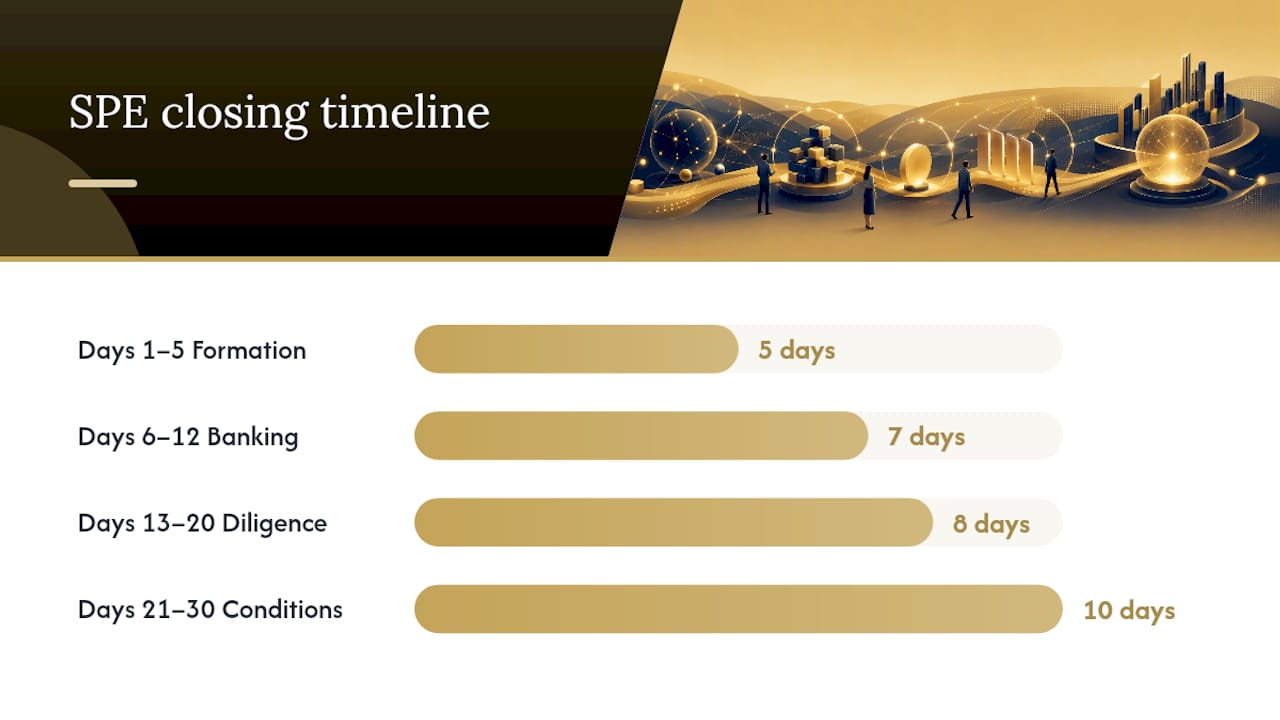
Days 1–5: Formation and document assembly
- Confirm entity type and state of formation with counsel; file certificate of formation if not yet formed.
- Draft or restate operating agreement to include all required SPE provisions; run side-by-side against lender’s form SPE covenant schedule.
- Obtain EIN from the IRS; confirm entity has no prior tax liabilities or open returns.
- Prepare organizational chart mapping all ownership tiers from the SPE to ultimate beneficial owners.
- Engage independent director; confirm qualifications, fee arrangement, and availability for closing.
Days 6–12: Banking and cash management setup
- Open entity bank accounts at the designated depository; obtain account resolutions and signature authority matrices.
- Initiate DACA negotiations with the depository bank; confirm the bank will execute the lender’s form without material modification.
- Draft lockbox and cash management agreements; circulate to lender counsel for review.
- Confirm sweep mechanics and operating account floor with lender’s cash management team.
Days 13–20: Diligence package assembly
- Compile 12–24 months of bank statements, operating statements, and rent rolls.
- Order UCC searches and title commitment; confirm no unauthorized liens or encumbrances.
- Prepare capital contribution records and pro forma reserve schedule.
- Deliver complete diligence package to lender counsel; address any initial comments within 48 hours.
Days 21–30: Conditions precedent and closing
- Obtain independent director’s executed consent and appointment documentation.
- Execute DACAs and deliver to lender counsel as a condition precedent.
- Deliver officers’ certificates confirming no SPE covenant breaches as of closing.
- Confirm all post-closing obligations are calendared and assigned to named owners.
Brookmont’s prioritized closing checklist:
- Must-have for underwriting: Formation documents, operating agreement (all amendments), EIN, organizational chart, 12 months of bank statements, operating statements
- Conditions precedent to closing: Independent director documentation, executed DACAs, bank account resolutions, UCC search results, title commitment, officers’ certificates
- Post-closing obligations: Monthly bank reconciliations, quarterly operating statements, annual officers’ certificates, notification protocols for amendments and transfers
Pro Tip: Engage an outside service provider for independent director placement and bank account setup assistance early in the process. Delays in independent director onboarding and DACA execution are the two most common causes of closing timeline slippage on SPE-structured deals.
For sponsors who need support packaging their deal for lender review, Brookmont Capital Ventures’s advisory services cover deal structuring, lender matching, and institutional-grade document packaging from formation through closing.
What Brookmont Capital Ventures sees most often in SPE deals
The most persistent SPE failures we observe in commercial real estate transactions are not drafting failures. They are operational failures that develop quietly after closing, when the urgency of the loan process has passed and day-to-day property management takes over.
The pattern we see most often is entity activity creep: a sponsor begins routing a small affiliate expense through the SPE’s operating account, then a management fee gets paid from the wrong account, then an intercompany loan appears on the books without a written agreement. Each step seems minor in isolation. Collectively, they produce exactly the fact pattern a bankruptcy court uses to justify substantive consolidation. The fix is not a better operating agreement; it is a governance calendar with named owners and monthly sign-offs.
The second pattern is misaligned cash sweep timing. Sponsors who negotiate a monthly sweep cycle sometimes fail to account for the gap between when tenant rents are collected and when the sweep activates, leaving funds in an account that lacks a perfected DACA. That gap, if it persists, is both a covenant breach and a security interest deficiency.
The recommendation is straightforward: treat SPE compliance as an internal control program, not a legal formality. Assign owners, set calendars, and review the covenant schedule quarterly against actual operations. The deals that close cleanly and stay clean are the ones where the sponsor treats the operating agreement as a living governance document, not a closing deliverable to be filed and forgotten.
Sources
The following primary sources and practitioner guides are the ones lenders, rating agencies, and counsel cite most frequently when evaluating single purpose entity requirements.
- Single-Asset Entity | Fannie Mae Multifamily Guide
- Bankruptcy-Remote Structuring (American Bankruptcy Law Journal article)
This article is general information, not a substitute for advice from a qualified lawyer. Consult a qualified legal professional about your own circumstances before acting on anything here.
FAQ
What is a single-purpose entity in real estate financing?
A single-purpose entity (SPE) is a legal entity formed exclusively to own, operate, and finance one identified real property asset, with no other business activities, assets, or obligations. Lenders require this structure to ring-fence collateral and reduce substantive consolidation risk in bankruptcy.
What documents do lenders require from an SPE at closing?
Lenders typically require the certificate of formation, operating agreement with all amendments, EIN confirmation, 12–24 months of bank statements and operating statements, UCC search results, title commitment, independent director appointment documentation, and executed deposit account control agreements.
Can an SPE file for bankruptcy even with an independent director blocking vote?
Yes. The General Growth Properties litigation established that a bankruptcy court may permit an SPE to file for bankruptcy even when blocking-vote mechanics exist, particularly when the independent director’s fiduciary duties to the entity support the filing. “Bankruptcy remote” reduces the risk of a voluntary filing; it does not eliminate it.
What triggers full recourse on a non-recourse SPE loan?
Breaching SPE covenants — such as incurring unauthorized debt, commingling funds, or filing for bankruptcy without independent director consent — commonly triggers the “bad boy” recourse carveout provisions in non-recourse loan agreements, converting the loan to full personal recourse against the sponsor.
How does Fannie Mae’s single-asset entity requirement differ from typical lender requirements?
Fannie Mae is more prescriptive than most balance-sheet lenders: it requires the entity to have been a single-asset entity since formation, mandates at least one domestic ownership tier when the borrower is foreign-owned, and requires specific proof points for multi-asset borrowers including operating statements for each property and written confirmation of no mezzanine financing on any equity interest.