
The Role of Survey in Real Estate Lending: A Lender’s Guide

A property survey is the lender’s technical map of the collateral: it confirms legal boundaries, reveals easements and encroachments, and gives the title company the evidence it needs to delete the standard survey exception from the loan policy. Without that deletion, lenders carry unquantified title risk that most institutional programs will not accept.
The survey serves three core functions in underwriting:
- Boundary confirmation: Establishes the legal perimeter of the collateral, which directly supports the loan-to-value calculation and foreclosure enforceability.
- Encumbrance identification: Locates easements, encroachments, and restrictions that may limit use, reduce marketability, or trigger redesign costs.
- Title insurance enablement: Provides the surveyor’s certification that ALTA/NSPS minimum standards were met, allowing the title company to remove the survey exception and issue the endorsements lenders require.
The borrower typically orders and pays for the survey; the lender and title company specify the required standard in the loan conditions, and the survey becomes a formal underwriting deliverable before closing.
Table of Contents
- What survey types do lenders actually rely on?
- How surveys interact with title insurance and loan closing
- Which loan types typically require a survey?
- When will a lender accept an existing survey?
- What do surveys cost, and how long do they take?
- Common survey problems and how transactions resolve them
- What are ALTA Table A items, and which endorsements do lenders request?
- Borrower and lender checklist for survey-required transactions
- How Brookmontcapital coordinates surveys in deal packaging
- Key Takeaways
- Why surveys deserve more attention than they get in deal packaging
- Brookmontcapital helps you manage survey and title requirements from day one
- Useful sources and further reading
What survey types do lenders actually rely on?
A property survey is a licensed professional’s measurement and depiction of a parcel’s physical and legal characteristics. It is not an appraisal, which confirms value, and it is not a Phase I environmental assessment, which evaluates contamination risk. All three run in parallel during underwriting, and none substitutes for the others.
ALTA/NSPS Land Title Survey is the institutional standard. Prepared under the joint Minimum Standard Detail Requirements published by the American Land Title Association and the National Society of Professional Surveyors, it is the only survey format that gives a title company sufficient basis to delete the standard survey exception and issue lender endorsements. Commercial lenders, CMBS programs, and agency multifamily guides almost universally require it.
The other types serve narrower purposes:
- Boundary survey: — Establishes property lines and corners; used for residential transactions and simpler commercial deals where full ALTA scope is not required.
Pro Tip: When you’re preparing a commercial deal package, specify ALTA/NSPS from the outset — even if the lender hasn’t yet confirmed it’s required. Upgrading from a boundary survey to a full ALTA mid-underwriting adds cost and time that can break a rate lock.
How surveys interact with title insurance and loan closing
The standard survey exception is language in Schedule B of a title commitment that excludes coverage for matters a survey would disclose. Every commercial lender’s title policy carries this exception by default. The lender’s job is to get it deleted.
Deleting the survey exception requires the title company to review an ALTA/NSPS survey that meets current minimum standards and to confirm that no unacceptable matters appear, as explained in detail in The Role of Property Survey Permit Packages in Miami‑Dade. If the survey reveals issues, the title company either adds specific Schedule B exceptions for those items or requires them to be cured before deletion. This is why the American Land Title Association and its NSPS counterpart maintain the Minimum Standard Detail Requirements: a survey that doesn’t meet those standards gives the title company no basis to remove the exception.
Common endorsements lenders request alongside survey exception deletion include:
- ALTA 9 (Restrictions, Encroachments, Minerals): — Covers loss from violations of restrictions or encroachments shown on the survey.
An inadequate survey produces one of two outcomes: the title company retains the survey exception in the policy, or it issues the policy with specific exceptions for items it cannot insure. Both outcomes force the lender to either accept residual risk, require a cure, or restructure closing conditions. For CMBS loans, where the loan will be securitized and reviewed by multiple parties, an undeleted survey exception is typically a hard stop.
Which loan types typically require a survey?
Survey requirements vary by loan type, lender category, and program rules. The table below summarizes typical expectations.
| Loan Type | Survey Typically Required? | Standard | Recertification / Age Rule |
|---|---|---|---|
| Commercial (office, retail, industrial) | Yes | ALTA/NSPS | Varies; many lenders require survey dated within 6 months or recertified |
| Multifamily (5+ units, agency) | Yes | ALTA/NSPS | Fannie Mae MF Guide references a 360-day recency expectation for certain workflows |
| Construction / bridge | Yes (as-built + staking) | ALTA/NSPS or as-built | New survey typically required; recertification at each draw milestone |
| DSCR / non-QM investment | Conditional | Boundary or ALTA | Lender-specific; rural, larger, or mixed-use parcels more likely to require ALTA |
| Conventional residential (1–4 units) | Varies by state and lender | Mortgage/location | Some states require; others accept title insurance without survey |
Fannie Mae’s Multifamily Selling and Servicing Guide sets specific survey acceptability criteria for agency multifamily transactions, including as-built survey requirements and recency standards. Portfolio lenders and debt funds often apply overlays that are stricter than agency minimums, particularly for value-add or transitional assets.
For DSCR and specialty loan products, survey requirements depend on property type, parcel size, and lender appetite. A single-family rental on a platted suburban lot may close without a new survey; a rural mixed-use property with five acres will almost certainly require one. Understanding how commercial real estate financing works helps borrowers anticipate which diligence items their specific loan type will trigger.
When will a lender accept an existing survey?
Lenders and title companies may accept a dated survey under specific conditions, but acceptance is never automatic. The key variables are survey age, property complexity, and whether the title company will concur.
Common acceptance conditions include:
- Age limits: — Many commercial lenders set an informal ceiling of six months to one year for survey recency. Fannie Mae’s Multifamily Guide references a 360-day recency expectation for certain agency workflows, which has become a widely cited benchmark.
Accepting a dated survey is a risk-management decision, not a paperwork shortcut. A no-change affidavit permits temporary acceptance but does not eliminate risks from post-survey encroachments, new easements, or changes in property conditions. The affidavit shifts contractual liability; it does not change the physical reality of the property.
As Amundsen Davis notes, lenders and title companies that accept dated surveys carry residual risk for post-survey changes that a new survey would have revealed. The Federal Reserve’s Senior Loan Officer Opinion Survey consistently shows that lenders tighten collateral documentation standards when credit conditions tighten — and survey acceptance is one of the first places that tightening shows up.
What do surveys cost, and how long do they take?
Survey costs vary widely based on several factors, and borrowers who budget a flat number without understanding those drivers routinely face surprises.
Key cost drivers:
- Survey type: — An ALTA/NSPS survey costs more than a boundary survey because it requires more research, more fieldwork, and a more detailed plat. The cost difference is material for complex commercial parcels.
Typical turnaround for a commercial ALTA survey runs two to four weeks for a straightforward urban or suburban parcel, and four to eight weeks for rural, large-acreage, or complex properties. Fieldwork usually takes one to three days; the bulk of the timeline is record research and plat drafting.
To reduce both cost and time: finalize the Table A item list before engaging the surveyor, provide all prior surveys and recorded easement documents at engagement, and confirm the required certification language with the title company before the surveyor finalizes the plat.
Common survey problems and how transactions resolve them
Survey findings that create underwriting conditions fall into a predictable set of categories. JDSupra notes that the cost of a survey is small relative to the litigation, redesign, or title losses it prevents — a point that becomes concrete when you see how these issues play out at the closing table.
Encroachments
- Resolution: Obtain a recorded boundary-line agreement or easement from the neighboring owner; cure by removing the encroaching structure; or negotiate a price adjustment and accept a title exception with lender approval.
- Lender implication: An unresolved encroachment can impair foreclosure and resale, reducing collateral value.
Unrecorded or missing easements
- Resolution: Record the easement; obtain a title endorsement covering the easement; or restructure the deal to reflect reduced usable area.
- Lender implication: An unrecorded easement that surfaces post-closing can restrict use and trigger litigation.
Gap or gore (boundary discrepancy)
- Resolution: Quiet title action; corrective deed; or boundary-line agreement with adjacent owners.
- Lender implication: A gap between parcels in a multi-parcel collateral pool breaks contiguity and may prevent cross-collateralization.
Access issues
- Resolution: Record an access easement; obtain an ALTA 17 endorsement; or, if no legal access exists, restructure or decline the transaction.
- Lender implication: A landlocked parcel has severely impaired marketability and foreclosure value.
Steps a borrower should take when a problem is identified:
- Notify the lender and title company immediately — do not wait for the next scheduled call.
- Engage legal counsel to evaluate cure options and timeline.
- Obtain a written cost estimate for the cure and present it to the lender with a proposed closing timeline.
- Confirm with the title company whether the cure, once completed, is sufficient to delete the exception or issue the required endorsement.
- Document the cure (recorded instrument, survey revision, or affidavit) and deliver it to the title company before the scheduled closing date.
What are ALTA Table A items, and which endorsements do lenders request?
Table A is the optional scope menu attached to the ALTA/NSPS Minimum Standard Detail Requirements. Clients and lenders select items from Table A to add specific deliverables to the survey beyond the base standard. Each item adds cost and fieldwork scope; lenders should specify required items early so the surveyor can price them accurately.
| Table A Item | What It Adds | Lender Purpose |
|---|---|---|
| Item 1 (Monuments) | Confirmation that boundary monuments are set | Supports boundary certainty for title endorsements |
| Item 4 (Parking) | Count and configuration of parking spaces | Supports zoning compliance and ALTA 3.1 zoning endorsement |
| Item 6 (Zoning) | Zoning classification and setback requirements plotted | Required for ALTA 3.1 zoning endorsement |
| Item 11 (Utilities) | Location of utilities and service connections | Confirms access to services; supports construction feasibility |
| Item 18 (Wetlands) | Delineation of wetland boundaries | Identifies regulatory restrictions on development |
| Item 19 (Topography) | Contour lines and elevation data | Supports construction loan feasibility and grading design |
Lenders commonly request the following endorsements, each of which depends on survey evidence:
- ALTA 9: — Requires the survey to show no encroachments or restriction violations; protects the lender from loss due to those matters.
For land acquisition financing, Table A items 6, 11, 18, and 19 are frequently required because raw land carries development risk that improved properties do not. Specifying those items at engagement avoids a second mobilization.
Borrower and lender checklist for survey-required transactions
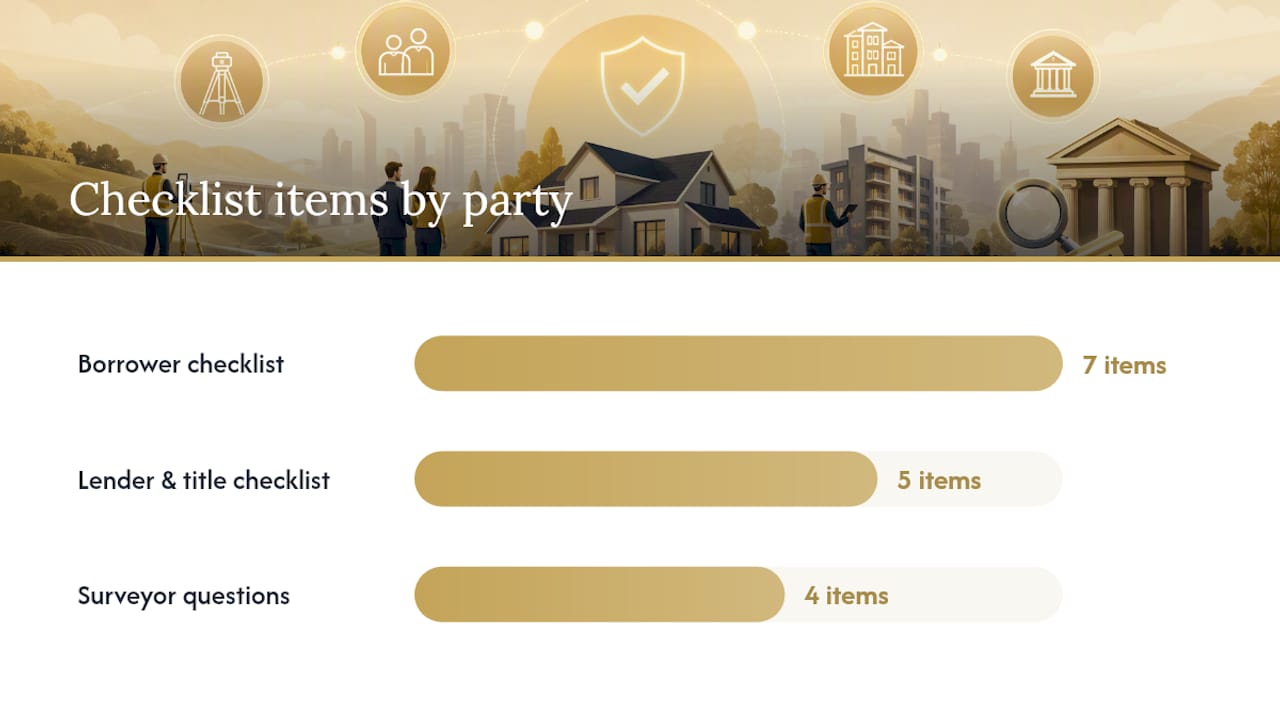
A survey that arrives late, incomplete, or in the wrong format can delay closing by weeks. The checklist below keeps the process on track.
Borrower checklist:
- Obtain the current title commitment (Schedule A and B) before engaging the surveyor.
- Order the survey immediately after the term sheet is signed — not after the appraisal.
- Provide the surveyor with all prior surveys, as-built plans, and recorded easement documents.
- Confirm site access with the property manager or seller and provide written authorization to the surveyor.
- Confirm required Table A items with the lender and title company before the surveyor begins fieldwork.
- Verify the required certification language (lender name, title company name, loan amount) with the title company before the plat is finalized.
- Deliver the final plat to the title company and lender simultaneously.
Lender and title company checklist:
- Specify ALTA/NSPS standards (or applicable program standard) in the loan commitment letter.
- List required Table A items and endorsements in the title conditions.
- Set a survey delivery deadline that allows at least ten business days for title review before the scheduled closing date.
- Confirm acceptable survey age and recertification policy with the title company before issuing the commitment.
- If accepting a dated survey, obtain a no-change affidavit and title company concurrence in writing.
Questions to ask the surveyor at engagement:
- What is your estimated delivery date for the final plat?
- Will you certify to the lender and title company by name, and in what format?
- Do you have experience with ALTA/NSPS surveys for this property type and jurisdiction?
- What additional information would reduce your research time or fieldwork scope?
How Brookmontcapital coordinates surveys in deal packaging
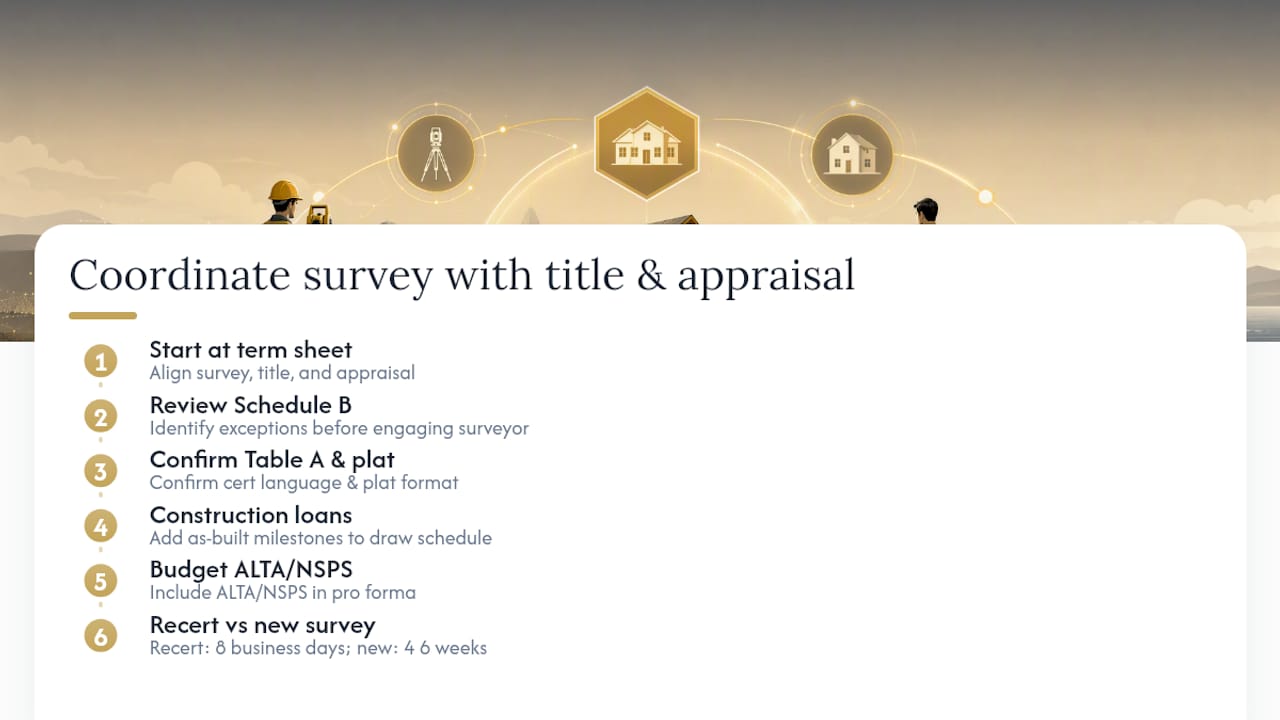
At Brookmontcapital, survey coordination is built into the deal packaging process from the term sheet stage. When we structure a financing assignment, we align the survey order with the title commitment and appraisal engagement so all three deliverables arrive within the same underwriting window. That parallel-track approach is the single most effective way to avoid the closing delays that survey-related conditions create.
Our standard practice includes reviewing the title commitment’s Schedule B exceptions before the surveyor is engaged, identifying which Table A items the target lender will require, and confirming the certification language with the title company upfront. For transactions involving construction lender underwriting criteria, we also build as-built survey milestones into the draw schedule so disbursements are not held up by survey delivery.
Pro Tip: Budget for an ALTA/NSPS survey in your initial deal pro forma, not as a contingency. Treating it as a line item from day one prevents the cost from becoming a negotiating point when the lender conditions letter arrives.
Pro Tip: Confirm with your title company, before engaging the surveyor, that the surveyor’s certification language and plat format meet their requirements. A plat delivered in the wrong format or missing a required certification can require a revision cycle that costs two weeks.
In one recent transaction, a borrower came to us with a dated survey on a mixed-use acquisition. The survey was 14 months old, and the title company would not concur on deletion of the survey exception without recertification. We coordinated directly with the original surveyor, confirmed no physical changes had occurred, and obtained a recertification within eight business days. The lender accepted it, the title company deleted the exception, and the transaction closed on schedule. The alternative, a new ALTA survey, would have taken four to six weeks and likely broken the rate lock.
For commercial versus residential loan transactions, the survey standard and coordination complexity differ materially. Knowing which standard applies before the lender issues conditions is where advisory value shows up most clearly.
Key Takeaways
The survey is the lender’s primary tool for confirming collateral boundaries, identifying encumbrances, and enabling the title insurance coverage that commercial loans require.
| Point | Details |
|---|---|
| ALTA/NSPS is the institutional standard | Commercial, multifamily, and CMBS lenders require ALTA/NSPS surveys to delete the standard survey exception and obtain endorsements. |
| Order early, not after the appraisal | Survey delivery is on the critical path; ordering it at term sheet stage prevents rate-lock exposure and closing delays. |
| Dated surveys carry residual risk | No-change affidavits and recertification reduce but do not eliminate risk from post-survey encroachments or newly recorded easements. |
| Common findings have defined remedies | Encroachments, access issues, and boundary gaps each have standard cure paths; identifying them early keeps transactions on schedule. |
| Brookmontcapital coordinates survey timing | Brookmontcapital aligns survey, appraisal, and title engagement in parallel to prevent survey-related conditions from delaying loan closing. |
Why surveys deserve more attention than they get in deal packaging
Most borrowers treat the survey as a commodity item: order it, pay for it, deliver it. That approach works until it doesn’t. The deals that run into survey-related closing delays almost always share one characteristic: the survey was ordered too late, or the scope was not confirmed with the title company before fieldwork began.
The deeper issue is that a survey is not just a lender requirement. It is the document that tells you, as a borrower, whether the asset you are acquiring or refinancing is legally and physically what you think it is. An encroachment you discover at closing is a problem. An encroachment you discover before you sign the purchase agreement is a negotiating point. That distinction has real dollar value in any transaction above $1 million.
Lenders who tighten credit standards, as the Federal Reserve’s Senior Loan Officer Opinion Survey periodically documents, almost always tighten collateral documentation first. Survey acceptance standards are among the first overlays to change. Borrowers who understand the survey’s role in the lending process are better positioned to anticipate those overlays and prepare accordingly.
The ACREL Land Title Survey handbook makes clear that the surveyor’s responsibilities extend beyond drawing lines on a plat: the surveyor must research record documents, identify conflicts, and certify findings to named parties. That certification is what gives the title company the basis to act. Treating the survey as a formality rather than a substantive diligence deliverable is the mistake that creates conditions, delays, and, in the worst cases, post-closing litigation.
Brookmontcapital helps you manage survey and title requirements from day one
Navigating survey requirements across commercial loan types, title companies, and lender programs is one of the more technical coordination tasks in a real estate transaction. Brookmontcapital’s advisory services include deal packaging that integrates survey timing, Table A scope confirmation, and title endorsement planning into the underwriting process from the term sheet stage.
For borrowers pursuing commercial real estate financing across bridge, construction, DSCR, CMBS, or preferred equity structures, we align every diligence deliverable with lender requirements before conditions are issued. That means fewer surprises, tighter timelines, and loan packages that institutional lenders can underwrite with confidence. If you are preparing a transaction and want to confirm what your target lender will require on the survey and title side, contact Brookmontcapital for a confidential consultation.
Useful sources and further reading
The sources below were used to build this guide and are worth consulting directly for program-specific rules and technical standards.
| Source | What It Covers | Why Consult It |
|---|---|---|
| American Land Title Association (ALTA) | ALTA/NSPS Minimum Standard Detail Requirements and Table A | Primary standard for survey scope and title insurance interaction |
| Fannie Mae Multifamily Selling and Servicing Guide | Agency survey acceptability criteria and recency rules | Program-level rules for multifamily and agency transactions |
| ACREL Land Title Survey Handbook | Surveyor responsibilities, Schedule A/B references, and Table A detail | Technical reference for practitioners and counsel |
| Amundsen Davis: When Is a Survey Too Old? | Dated survey acceptance, no-change affidavits, and residual risks | Practical legal guidance on survey age and lender risk |
| JDSupra: Surveys in Commercial Real Estate | Cost-benefit case for current surveys in commercial deals | Supports the business case for early survey investment |
| DSCR Calculator: Property Surveys for DSCR Loans | Survey requirements for DSCR and specialty loan products | Useful for non-QM and investment property transactions |
| FindLaw: Top 10 Reasons to Have Your Property Surveyed | Common survey findings and borrower-level context | Accessible overview of practical survey issues |
| Federal Reserve: Senior Loan Officer Opinion Survey | Lender credit standards and collateral documentation trends | Context for how market conditions affect survey acceptance standards |
For questions about survey coordination within a specific financing structure, contact Brookmontcapital directly at brookmontcapital.net.
This article provides general information about property surveys in real estate lending and does not constitute legal, financial, or professional advice. Consult a licensed surveyor, title attorney, or qualified lender for guidance specific to your transaction.
Recommended
- How Does Commercial Real Estate Financing Work? | Brookmont Capital Ventures
- Commercial vs. Residential Real Estate Loans: Key Differences | Brookmont Capital Ventures
- Types of Commercial Lenders Explained for Real Estate Pros | Brookmont Capital Ventures
- Why Lenders Require Feasibility Studies: A Developer’s Guide | Brookmont Capital Ventures