
The Role of a Debt Broker in Syndication: A Sponsor’s Guide

A debt broker acts as the borrower’s market-facing intermediary in a syndicated loan, sourcing lender interest, shaping the offering, negotiating terms, and managing deal logistics on the borrower’s behalf. The practical outcome: faster access to a competitive lender pool, better pricing through structured competition, and a professionally packaged credit story that institutional capital committees can act on quickly. Unlike an arranger bank, which represents the syndicate’s interests, a debt advisor works exclusively for you.
When to hire a debt broker:
-
Your deal size or complexity exceeds a single lender’s appetite or internal hold limits
-
You are operating in a specialty sector (construction, bridge, CMBS, preferred equity) where lender appetite varies sharply by institution
-
Your team lacks direct relationships with institutional debt funds, regional banks, or credit companies active in your asset class
-
Internal bandwidth is constrained and you need a dedicated resource to manage lender outreach, Q&A, and documentation coordination
Table of Contents
- What is the role of a debt broker in syndication?
- What a debt broker actually does during syndication
- How the syndication timeline maps to broker activity
- How a debt broker differs from an arranger, and why conflicts matter
- Understanding broker and arranger fees in U.S. syndications
- What a good debt broker should deliver to you
- How Brookmontcapital runs a syndication mandate: an illustrative workflow
- Key Takeaways
- What Brookmontcapital recommends for borrowers entering syndication
- Brookmontcapital’s capital markets advisory for CRE syndications
- Useful sources and further reading
What is the role of a debt broker in syndication?
Understanding who does what in a syndicated loan prevents costly misalignments. Loan syndication involves multiple lenders sharing a single credit exposure under common documentation, with one institution typically acting as the lead or syndicate agent responsible for overseeing documentation and repayment distribution. A debt broker sits outside that bank-side structure entirely, representing the borrower.
Mandated Lead Arranger (MLA) / Bookrunner: The bank or financial institution that wins the mandate to organize and underwrite the syndicate. The MLA markets the deal to potential lenders, collects indicative terms, and is ultimately responsible for syndication success. Its primary client is the transaction itself, not the borrower in a fiduciary sense.
Administrative Agent / Syndicate Agent: The institution that manages the loan post-closing, handling drawdown mechanics, repayment distribution to lenders, covenant monitoring, and amendment coordination. One institution acts as the lead or syndicate agent and is responsible for overseeing documentation and repayment distribution to member lenders.
Participating Lenders / Syndicate Members: Banks, debt funds, insurance companies, or other institutional investors that take a portion of the exposure. They review the Information Memorandum (IM), conduct their own credit analysis, and commit to a share of the facility.
Debt Broker / Debt Advisor: The borrower’s representative. The broker does not hold credit risk, does not underwrite the loan, and does not act as agent. The broker’s mandate is to position the borrower competitively, access the widest appropriate lender pool, and negotiate terms that serve the borrower’s capital objectives.

| Role | Core Responsibility | Primary Client | Typical Fee Basis |
|---|---|---|---|
| Mandated Lead Arranger | Structures, underwrites, and syndicates the loan | Transaction / lenders | Arrangement fee (% of facility) |
| Administrative Agent | Post-closing loan administration and distributions | Lender group | Agency fee (annual flat or bps) |
| Participating Lenders | Fund their allocated share of the exposure | Own balance sheet | Spread + commitment fee |
| Debt Broker / Advisor | Borrower-side sourcing, packaging, and negotiation | Borrower | Advisory / placement fee |
What a debt broker actually does during syndication
The broker’s work begins before a single lender sees the deal and continues through closing. Debt advisory can cover everything from introductory referrals to full-service transaction coordination and documentation support, but a full-scope engagement typically follows this sequence:
-
Mandate intake and deal assessment. The broker reviews the sponsor’s business plan, pro forma, loan-to-value position, and debt service coverage ratio projections to determine the most credible financing structure before any lender contact.
-
IM preparation support. The broker works with the sponsor’s team to assemble the Information Memorandum, a document that contains the company or project overview, financial model, collateral details, and risk mitigants. A professionally prepared IM is typically the single most important pre-marketing input in debt syndication and materially affects lender appetite.
-
Lender targeting and outreach. Using their active lender network, the broker identifies institutions with the right risk appetite, sector comfort, and ticket-size parameters for the deal. In specialty sectors such as construction, staffing, or asset-based lending, debt advisors add value by identifying lenders with the proper regulatory comfort and by preparing the collateral and quality-of-earnings detail those lenders require.
-
Managing Q&A and indicative term collection. The broker fields lender questions, coordinates site visits or management presentations, and collects indicative term sheets from interested parties.
-
Negotiating borrower-favorable terms. With multiple term sheets in hand, the broker uses competitive tension to push on pricing (spread, floor), fees (origination, exit), covenants (DSCR thresholds, LTV maintenance), and prepayment flexibility.
-
Documentation logistics coordination. The broker tracks open items across legal counsel, the arranger, and the borrower’s internal team, maintaining a due-diligence tracker to prevent stalls.
-
Closing support. The broker confirms that all conditions precedent are satisfied, coordinates final signatures, and ensures drawdown mechanics are in place.
Deliverables you should expect: a documented lender outreach list with contact names and status, IM inputs and financial model review, term-sheet comparison matrix, meeting summaries, due-diligence tracker, and a closing logistics plan.
Pro Tip: Before signing a mandate letter, ask the broker to name the specific credit officers they plan to contact at each target institution. A credible advisor brings not just introductions but a network of active credit officers and insight into which institutions are pricing and deploying capital for your sector and ticket size. If the answer is vague, treat that as a signal about the depth of their network.
How the syndication timeline maps to broker activity
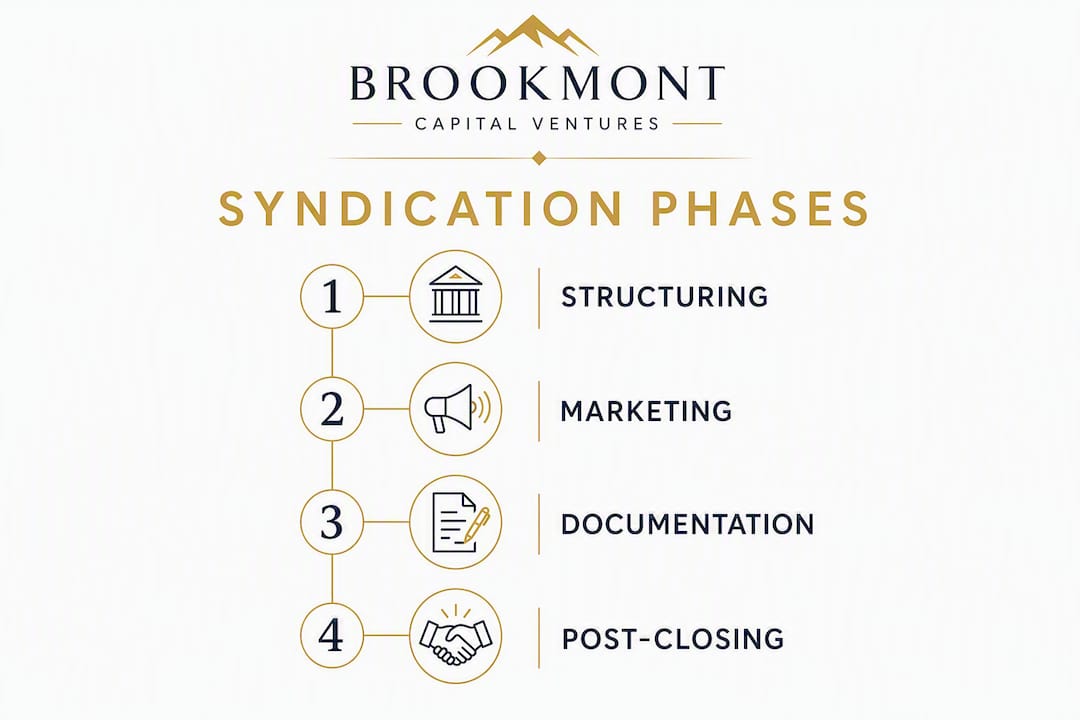
Loan syndication proceeds through four principal phases, with the typical timeline from mandate to closing running anywhere from 4 to 12 weeks depending on deal complexity and market conditions.

Phase 1: Structuring (Weeks 1–2) The arranger and the borrower’s advisor agree on deal parameters: facility size, tenor, security package, and preliminary pricing guidance. The broker is most active here, stress-testing the structure against current lender appetite and flagging terms that will create friction in syndication. Borrower decisions on collateral, guarantees, and covenant thresholds are needed early.
Phase 2: Marketing and Syndication (Weeks 2–6) The arranger markets the IM to multiple banks and institutional investors simultaneously, collecting indicative terms and leveraging competition to improve pricing. The broker manages the borrower’s side of this process: coordinating lender Q&A, preparing management for roadshow presentations, and tracking which institutions are moving toward commitment using platforms like Send Offers on MLS Listings with State Approved Contracts. This phase is where broker network quality shows most clearly.
Phase 3: Documentation and Closing (Weeks 4–10) Credit approvals are obtained, loan agreements are negotiated, and conditions precedent are satisfied. Documentation and inter-creditor negotiations are often the slowest part of a syndication; a broker that coordinates legal priorities and maintains a diligence tracker reduces closing friction materially. The borrower’s internal approvals (board resolutions, entity documents, insurance certificates) are typically needed in this window.
Phase 4: Post-Closing Administration (Ongoing) The administrative agent takes over. The broker’s active role ends at closing, though some advisors remain available for amendment or waiver negotiations.
Factors that push timelines toward the 12-week end: complex cross-jurisdictional collateral, construction or staged-disbursement structures, specialty-sector regulatory review, or a borrower’s first institutional syndication requiring deeper lender education.
How a debt broker differs from an arranger, and why conflicts matter
The distinction between a debt broker and a mandated lead arranger is not just structural; it determines whose interests are being served at every decision point.
An arranger’s primary obligation runs to the syndicate it is building. Its fee is tied to successfully placing the loan with lenders, which means its incentives align with lender-friendly terms when those terms make the deal easier to sell. A debt broker’s fee, by contrast, is paid by the borrower and tied to securing financing on terms the borrower accepts. That alignment difference is consequential in negotiations over covenants, prepayment penalties, and pricing floors.
The most important question to ask any broker is: “Are you receiving any compensation from lenders in connection with this transaction?” A broker that earns a split fee or referral commission from the lender it places you with has a divided loyalty, regardless of how the engagement letter is framed. Require full written disclosure of all compensation sources before signing.
Common conflicts to watch for:
- Undisclosed lender commissions: Some brokers receive a referral fee or yield-spread premium from the lender. This is not inherently disqualifying, but it must be disclosed in writing.
- Introducer-only scope: A broker whose engagement letter limits their role to “introductions” is not negotiating for you. Confirm that the scope includes active term negotiation and documentation coordination.
- Vague performance milestones: If the engagement letter does not specify what constitutes a successful placement, the broker can collect a fee for delivering a term sheet you cannot accept.
- No kill-fee clause: Without a defined kill fee, you may owe compensation even if the broker fails to deliver acceptable terms within a reasonable timeframe.
Fee transparency and a clear engagement scope are the simplest levers a borrower has to reduce conflicts. Require a fee schedule, a list of potential lender commissions, and a kill-fee clause in the engagement letter before proceeding.
Understanding broker and arranger fees in U.S. syndications
Fee structures in U.S. syndicated lending vary by deal type, ticket size, and the broker’s scope of work, but the general market conventions are consistent enough to benchmark against.
Broker / Advisory Fees:
- Upfront retainer: A non-refundable engagement fee covering initial structuring work and IM preparation support. Common in commercial real estate advisory mandates.
- Success fee: A percentage of the total facility amount, earned at closing. For commercial real estate syndications, this typically falls in a range that reflects deal complexity and the broker’s scope.
- Lender-originated commissions: Some brokers receive additional compensation from lenders. This must be disclosed; when it is not, it represents a conflict.
Arranger Fees:
- Arrangement fee: Paid by the borrower to the MLA for organizing and underwriting the syndicate. This is separate from the broker’s advisory fee.
- Underwriting fee: Paid when the arranger commits to hold the full amount before syndication, bearing the risk of a failed placement.
Lender Economics:
- Spread: The margin above a benchmark rate (SOFR in U.S. dollar facilities) that lenders earn on their allocated exposure.
- Commitment fee: Paid on undrawn amounts during an availability period.
- Origination / exit fees: Common in bridge and construction facilities.
| Fee Type | Paid By | Paid To | Timing |
|---|---|---|---|
| Advisory / placement fee | Borrower | Debt broker | At closing (success fee) or upfront (retainer) |
| Arrangement fee | Borrower | Lead arranger / MLA | At closing or signing |
| Agency fee | Borrower | Administrative agent | Annual, post-closing |
| Spread | Borrower | All lenders | Ongoing (quarterly or semi-annual) |
| Commitment fee | Borrower | All lenders | On undrawn amounts during availability |
When reviewing a broker proposal, request a full fee disclosure schedule that separates the advisory fee from any lender-originated compensation. A broker that resists this request is telling you something important.
What a good debt broker should deliver to you
A well-run broker engagement produces a specific set of outputs at each stage. Use this checklist when evaluating proposals and holding your advisor accountable.
Pre-marketing deliverables:
- Written deal assessment and recommended structure (facility type, sizing, tenor, security)
- Documented target lender list with institution names, contact names, and rationale for inclusion
- IM inputs: financial model review, collateral summary, risk-mitigant narrative
During syndication:
- Lender outreach log showing contact dates, responses, and status for each institution
- Term-sheet comparison matrix mapping pricing, covenants, fees, and prepayment terms across all indicative offers
- Meeting summaries from lender calls and site visits
- Due-diligence tracker listing open items, responsible parties, and target resolution dates
At closing:
- Conditions-precedent checklist confirming all items are satisfied
- Closing logistics plan coordinating legal counsel, title, insurance, and drawdown mechanics
Questions to ask a prospective broker:
- Which specific lenders will you target, and have you closed transactions with them in the past 18 months?
- Can you share two or three anonymized mandates you have closed in a similar asset class and ticket size?
- What is your typical timeline from mandate acceptance to first term sheets?
- How is your fee structured, and do you receive any compensation from lenders?
- What happens if we do not accept any of the terms you deliver?
Red flags if items are missing: A broker who cannot produce a documented lender list before outreach begins, who declines to provide a term-sheet comparison, or whose engagement letter contains no performance milestones is operating as an introducer, not an advisor.
How Brookmontcapital runs a syndication mandate: an illustrative workflow
The following workflow reflects how Brookmontcapital approaches a commercial real estate debt syndication engagement, from mandate acceptance through closing. Steps and deliverables are representative of a mid-market CRE transaction.
-
Kick-off and mandate acceptance (Day 1–5). Brookmontcapital reviews the sponsor’s pro forma, capital stack, and asset-level financials. A preliminary lender appetite check is conducted against the firm’s active institutional relationships before the engagement letter is signed.
-
Deal structuring and IM preparation (Days 5–15). The advisory team works with the sponsor to finalize the financing structure, including loan-to-value, debt service coverage ratio parameters, and collateral package. IM inputs are assembled: project overview, financial model, collateral detail, market comparables, and risk-mitigant narrative. Brookmontcapital’s institutional-grade deal packaging is designed to reduce lender committee cycle times.
-
Lender targeting and outreach (Days 10–25). A documented target list of institutional lenders, debt funds, and bank credit groups is prepared, segmented by appetite, ticket size, and sector comfort. Outreach is conducted with the IM and a structured Q&A process. Brookmontcapital’s approach to sourcing institutional debt prioritizes active credit officers over passive distribution lists.
-
Term collection and comparison (Days 20–35). Indicative term sheets are collected, organized into a comparison matrix, and reviewed with the sponsor. Pricing, covenant structure, prepayment terms, and fee economics are benchmarked against current market conditions.
-
Negotiation and lender selection (Days 30–45). Brookmontcapital uses competitive tension across multiple term sheets to negotiate borrower-favorable adjustments on spread, origination fees, DSCR covenant thresholds, and prepayment flexibility. The sponsor selects a preferred lender or syndicate structure.
-
Documentation and closing (Days 40–70). The advisory team maintains a due-diligence tracker, coordinates with legal counsel on loan agreement negotiation, and manages conditions-precedent satisfaction. Measurable outcomes in representative engagements include reduced time-to-term-sheet, improved pricing relative to initial lender indications, and a higher number of committed lenders than the sponsor could have accessed independently.
Key Takeaways
A debt broker’s core value in syndication is borrower-side representation: sourcing competitive lender interest, packaging the credit story, and negotiating terms that the arranger bank has no structural incentive to optimize for you.
| Point | Details |
|---|---|
| Broker vs. arranger alignment | A debt broker is paid by and works for the borrower; an arranger’s incentives align with lender-friendly terms that make syndication easier. |
| Timeline expectations | Mandate to closing typically takes a few weeks, with documentation and inter-creditor negotiations often causing the greatest delays. |
| Fee transparency is non-negotiable | Require a written fee schedule and full disclosure of any lender-originated commissions before signing an engagement letter. |
| Broker value is highest where relationships are thin | Brokers reduce execution risk most when the borrower lacks direct institutional lender relationships or operates in a specialty sector. |
| Brookmontcapital’s advisory approach | Brookmontcapital provides full-scope capital markets advisory for CRE syndications, from IM preparation and lender targeting through closing coordination. |
What Brookmontcapital recommends for borrowers entering syndication
Three practices consistently separate sponsors who close on favorable terms from those who do not. First, engage your advisor before you need the capital, not after a lender has already declined. The earlier a broker can shape the credit narrative and test lender appetite, the more negotiating leverage you retain. Second, treat the Information Memorandum as a competitive document, not a compliance exercise. Lenders see dozens of IMs; the ones that move to committee fastest are those that anticipate objections and present risk mitigants clearly. Third, insist on written fee disclosure from any advisor or arranger before the engagement begins. Undisclosed compensation arrangements are the single most common source of misaligned incentives in the broker-borrower relationship.
Brookmontcapital publishes detailed guides on how lenders assess multifamily syndications and on bridge loan syndication mechanics for sponsors who want to go deeper on specific asset classes before engaging an advisor.
Brookmontcapital’s capital markets advisory for CRE syndications
Sponsors who need institutional debt arranged efficiently, on terms that reflect genuine market competition, benefit most from an advisor whose fee is tied to their outcome, not the lender’s. Brookmontcapital provides full-scope commercial real estate financing advisory, covering deal structuring, IM preparation, institutional lender matching, term negotiation, and closing coordination for bridge loans, construction financing, DSCR facilities, CMBS, and preferred equity transactions across the U.S.
The firm’s process begins with a preliminary lender appetite check, conducted confidentially before any formal outreach, so sponsors understand realistic pricing and structure before committing to a timeline. Engagements are structured around the sponsor’s capital objectives, with full fee transparency from day one. To discuss your transaction and get a preliminary read on lender appetite, contact Brookmontcapital through the advisory services page.
Useful sources and further reading
The following sources support the claims in this article and provide additional depth for sponsors, CFOs, and treasury teams who want to verify market norms or explore specific aspects of the syndication process.
- Loan Syndication Process: From Term Sheet to Closing (LegalClarity) — U.S.-focused process primer covering the four syndication phases and timeline expectations; best used to verify timing norms and documentation sequencing.
- Understanding Loan Syndication: Definition, Process, and Key Roles (Investopedia) — Widely cited definitional reference for syndicate structure, agent-bank responsibilities, and lender economics; international in scope but applicable to U.S. market conventions.
- Federal Reserve: Syndicate Structure Reference (Federal Reserve) — Primary source on how syndicates are formed, how lead banks compete for mandates, and how common loan documentation is structured; U.S.-focused and authoritative on structural norms.
- What Do Debt Brokers Do? The Process and Fees — (LegalClarity) — Covers broker function, fee mechanics, and process overview; note that this source focuses on consumer debt settlement contexts, so apply its fee and process guidance selectively to commercial syndication mandates.
Recommended
- How Syndicators Source Institutional Debt in 2026 | Brookmont Capital Ventures
- Bridge Loan Acquisition Syndication Guide for Investors | Brookmont Capital Ventures
- DSCR vs Conventional Loan Syndication: 2026 Guide | Brookmont Capital Ventures
- How to Get Your CRE Deal Funded in 2026: What Lenders Actually Want to See | Brookmont Capital