
Role of Appraisal in Construction Lending Explained

An appraisal determines the collateral value lenders rely on to size, price, and control a construction loan. Without a credible, independent valuation, no federally regulated institution can legally advance funds on a construction project, and no disciplined private lender should. The appraisal is not a formality you clear on the way to closing. It is the analytical foundation on which every major underwriting decision rests.
The core outputs and how lenders use them:
- Loan sizing via LTV on as-completed value. The lender’s maximum loan amount is typically calculated as a percentage of the appraiser’s prospective as-completed value. If the as-completed value comes in below your pro forma, the loan ceiling drops accordingly.
- Draw control through holdbacks and inspections. Lenders tie each draw release to construction progress verified against the appraised scope. Draws cannot exceed the proportional value added at each milestone.
- Permanent financing assumptions via as-stabilized value. For income-producing projects, the as-stabilized value governs take-out or CMBS sizing. A weak stabilized value can make the exit financing unworkable before a shovel breaks ground.
- Initial collateral coverage via as-is value. The as-is (land plus any existing improvements) establishes the lender’s collateral floor at origination, before construction begins.
One critical mechanic: when interagency appraisal guidance requires lenders to use “the lesser of” applicable value metrics, a low as-is value can constrain the initial advance even when the as-completed value looks strong.
Table of Contents
- What is a construction appraisal and what valuation types do lenders require?
- How does the construction appraisal process work step by step?
- How lenders translate appraisal outputs into underwriting and draw administration
- What regulatory rules govern appraisals in construction lending?
- What are your options when a construction appraisal comes in low?
- Common appraisal mistakes developers make and how to avoid them
- How long does a construction appraisal take and where does it fit in the loan timeline?
- Brookmont Capital’s approach to managing appraisal risk in construction deals
- Key Takeaways
- Why appraisal risk is the most underestimated variable in construction finance
- Brookmontcapital can structure your construction financing from appraisal to close
- Useful sources and references
What is a construction appraisal and what valuation types do lenders require?
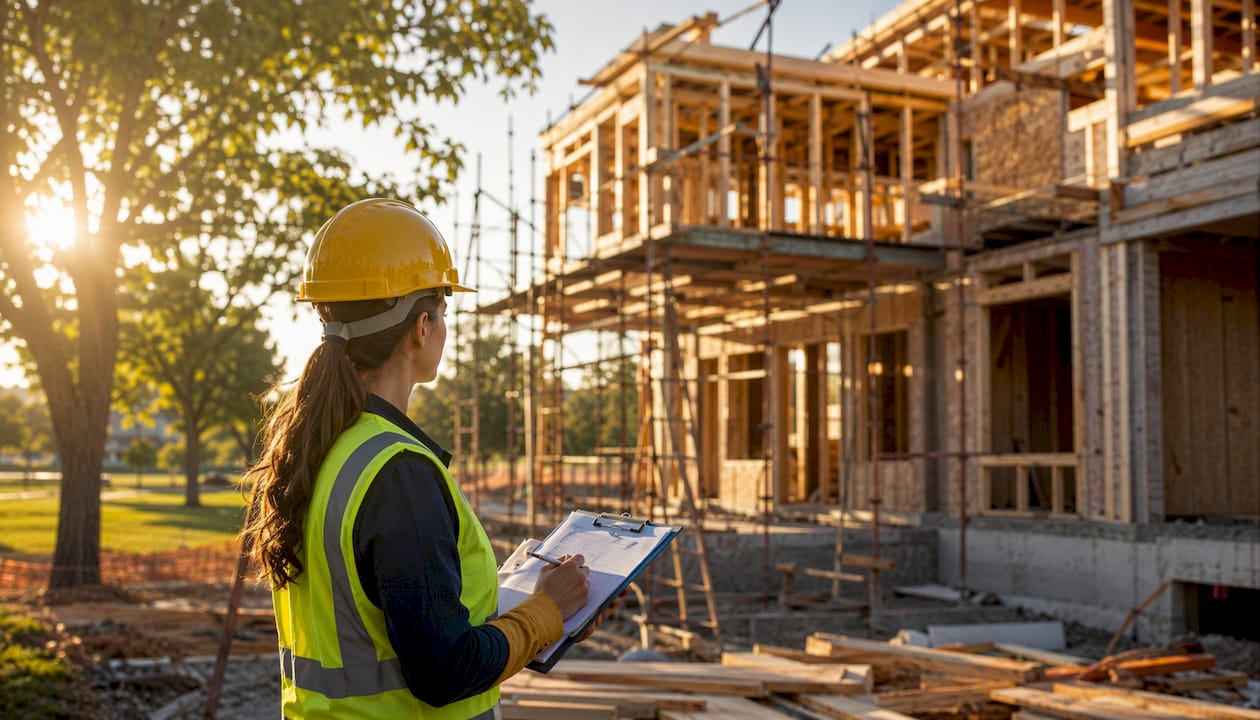
A construction appraisal differs from a standard residential appraisal in one fundamental way: the subject property does not yet exist. The appraiser works from architectural plans, specifications, and a detailed builder’s cost breakdown to project what the finished property will be worth in the open market. That forward-looking requirement makes the analysis more complex, more document-intensive, and more sensitive to market-absorption assumptions than a simple sales-comparison on an existing home.
New-construction appraisals rely on plans, specifications, and builder costs to project a finished-market value, and commonly use the Uniform Residential Appraisal Report (URAR) combined with cost and sales-comparison approaches. When finished-product comparables exist in the market, appraisers reconcile both methods; when they do not, the cost approach carries more weight.
The three valuation types lenders request:
- As-is value. The current market value of the land (and any existing improvements) as of the appraisal’s effective date. This governs initial collateral coverage and the lender’s exposure before construction begins.
- As-completed (prospective) value. The estimated market value of the finished project, assuming construction is completed per the submitted plans and specifications. This is the primary driver of maximum loan sizing. Per OCC guidance, prospective value opinions must be tied to current and reasonably expected market conditions and an explicit time frame.
- As-stabilized value. For income-producing properties (multifamily, retail, office), this is the value after the project reaches stabilized occupancy. Lenders use it to size take-out financing and to stress-test debt-service coverage ratios under a permanent loan structure.
How LTV on as-completed value determines maximum loan amount:
| Metric | Example |
|---|---|
| Maximum loan amount | $2,600,000 |
If the developer’s total project cost is $3,200,000, the $2,600,000 loan ceiling leaves a $600,000 equity gap the developer must fund before the lender advances a dollar. That math is driven entirely by the appraisal.
How does the construction appraisal process work step by step?
The appraisal workflow for a construction project follows a defined sequence. Delays at any stage typically push the loan closing timeline, so both developers and lenders benefit from understanding exactly what is required and when.
Step-by-step appraisal process:
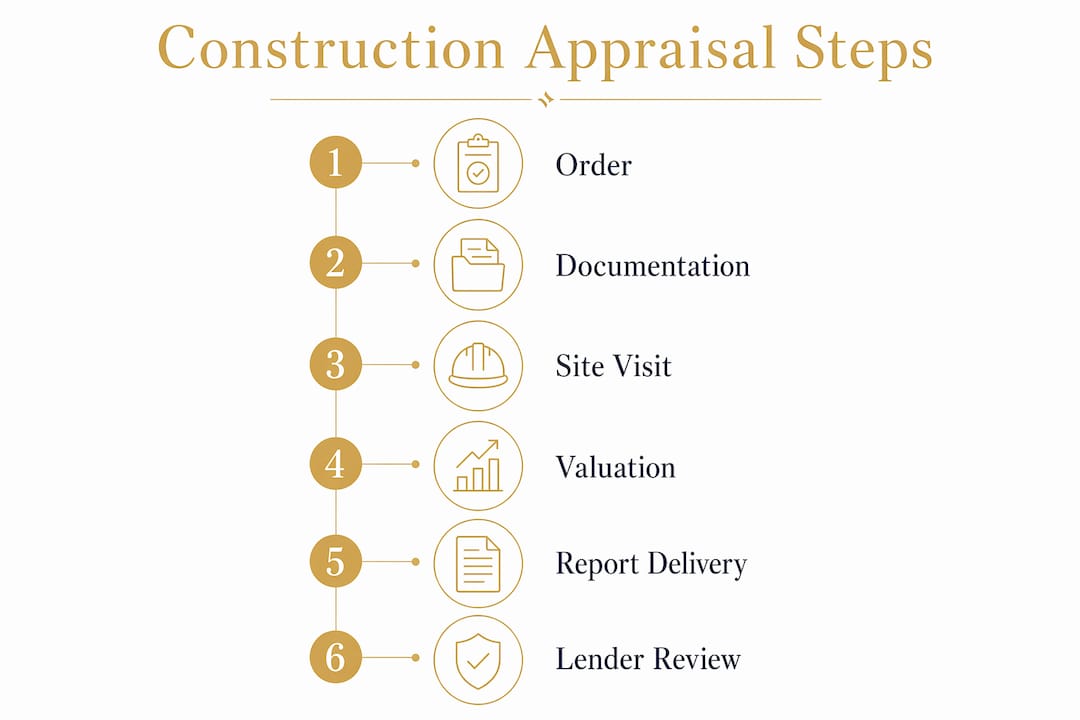
- Engagement and scope of work. The lender orders the appraisal from an independent, qualified appraiser. The scope of work is defined based on project complexity, loan size, and the valuation types required (as-is, as-completed, as-stabilized).
- Developer documentation submission. The appraiser requests the full documentation package from the developer (see checklist below). Incomplete submissions are the single most common cause of appraisal delays.
- Site inspection. The appraiser visits the site to assess current conditions, confirm lot dimensions, evaluate location factors, and document any existing improvements.
- Comparable sales and market analysis. The appraiser identifies comparable completed sales in the market area, analyzes absorption rates, and applies adjustments for differences in size, quality, location, and finish level.
- Cost and replacement analysis. The appraiser develops an independent cost estimate for the proposed improvements and reconciles it against the builder’s budget. A significant variance between the appraiser’s replacement-cost estimate and the builder’s budget is a recognized red flag that lenders typically require to be reconciled before advancing funds.
- Reconciliation and report preparation. The appraiser reconciles the cost and sales-comparison approaches, documents assumptions and limiting conditions, and states the prospective value with an explicit effective date and time frame.
- Lender review. The lender’s appraisal review function (or a third-party review appraiser) evaluates the report for USPAP compliance, adequacy of scope, and support for the value conclusion.
- Final inspection and completion report. At project completion, the appraiser (or a designated inspector) conducts a final inspection to confirm the property was built per the approved plans and issues a certificate of completion or updated appraisal.
Documentation developers must provide at order time:
- Architectural plans and specifications (full set, stamped where required)
- Builder’s line-item cost breakdown, including hard and soft costs
- Subcontractor bids or executed contracts
- Plot survey and site plan
- Zoning confirmation and any variances or entitlements
- Market study or absorption analysis (required for larger or income-producing projects)
- Pro forma operating statement (for income-producing properties)
Pro Tip: Deliver a complete documentation package at the time of appraisal order. Every back-and-forth request for missing plans or cost data adds days to the timeline and can push the appraisal’s effective date past a lender’s rate-lock or commitment expiration.
How lenders translate appraisal outputs into underwriting and draw administration
Once the appraisal report is in hand, lenders use it across multiple underwriting checkpoints, not just for the initial loan-sizing calculation. Understanding these mechanics helps developers anticipate where appraisal values create binding constraints.
Key underwriting uses of the appraisal:
- Maximum loan amount. Calculated as the lesser of LTV applied to as-completed value or LTC (loan-to-cost) applied to total project cost. The appraisal governs the LTV side of that calculation.
- Debt-service coverage assumptions. For income-producing projects, the appraiser’s stabilized income and cap rate assumptions feed directly into the lender’s DSCR analysis for the permanent or take-out loan.
- Holdbacks and reserves. Lenders structure holdbacks (funds withheld until specific milestones are verified) based on the appraiser’s cost allocation across project phases. The construction loan requirements a lender imposes typically mirror the appraisal’s phased cost breakdown.
- Interest reserve sizing. The projected construction timeline in the appraisal affects how the lender sizes the interest reserve, since a longer build period requires more carry.
- Covenant and eligibility thresholds. Some lenders set minimum as-completed value thresholds for loan eligibility. A project that falls below those thresholds may be declined regardless of borrower creditworthiness.
Draw schedule mechanics:
| Construction milestone | Appraisal linkage | Draw release condition |
|---|---|---|
| Foundation complete | As-is value confirmed | Site inspection + lien waiver |
| Framing and rough-in | Cost allocation per appraisal | Progress inspection (typically $100–$150) |
| Mechanical, electrical, plumbing | Proportional value added | Inspector sign-off on scope |
| Drywall and finishes | Finish-level assumptions in appraisal | Inspection confirming spec compliance |
| Substantial completion | As-completed value triggered | Certificate of completion or final inspection |

Progress inspections, which borrowers pay for individually, are the mechanism lenders use to verify that construction progress matches the appraisal’s cost and scope assumptions before releasing each draw. Failure to document change orders can force a full reappraisal rather than a simple completion report, stalling the draw process entirely.
For larger commercial construction projects transitioning to permanent financing, the as-stabilized value also determines CMBS loan sizing and covenant structures at the take-out stage.
What regulatory rules govern appraisals in construction lending?
The compliance framework for construction loan appraisals is not optional, and the consequences of non-compliance extend well beyond a delayed closing. Federally regulated institutions operate under Title XI of the Financial Institutions Reform, Recovery, and Enforcement Act (FIRREA), which establishes the baseline requirement for independent, USPAP-compliant appraisals on federally related transactions.
The interagency appraisal and evaluation guidelines require institutions to obtain an as-is value and, where applicable, a prospective market value tied to an explicit time frame and market conditions. For construction transactions, this typically means both an as-completed value and, for income-producing projects, an as-stabilized value. The FDIC’s construction and land development examination guidance requires appraisals to conform with USPAP, reflect appropriate scope for the transaction’s risk and complexity, and analyze deductions and discounts for proposed construction and partially leased buildings.
Appraiser independence requirements:
- The lender must order the appraisal. Federal guidance explicitly prohibits borrower-ordered appraisals for federally related transactions.
- The appraiser must have no direct or indirect financial interest in the transaction or the property.
- Loan production staff may not select, approve, or compensate appraisers in ways that could influence the value conclusion.
- Lenders must maintain a documented appraisal review function separate from the origination team.
Pro Tip: Developers can and should communicate project details to the appraiser through the lender, not directly. Providing a well-organized documentation package to the lender at order time, with a cover memo explaining the project’s market positioning and comparable sales rationale, sets an appropriate scope without creating undue influence. Direct developer-to-appraiser communication outside the lender’s oversight is a compliance risk.
Institutions that fail to maintain a sound appraisal program consistent with supervisory guidance face examination criticism and may be cited for unsafe and unsound banking practices, per OCC supervisory policy. For developers, this means lenders cannot waive appraisal requirements even when a project looks strong on paper.
What are your options when a construction appraisal comes in low?
A low appraisal is one of the most disruptive events in a construction loan process, but it is not automatically fatal. The response depends on the magnitude of the shortfall, the project’s fundamentals, and the lender’s flexibility.
Immediate consequences of a low appraisal:
- The maximum loan amount drops to the LTV-constrained figure, regardless of the developer’s project cost.
- Lenders will not advance funds that exceed LTV thresholds calculated against the appraised as-completed value; developers must cover any gap in cash before construction funds are released.
- Draw restrictions may tighten, with lenders requiring additional equity contributions at each milestone rather than at closing.
Options checklist for responding to a low appraisal:
- Cash injection. The most straightforward remedy: the developer contributes additional equity to bring the loan-to-value ratio back within the lender’s threshold. This preserves the deal but reduces developer returns.
- Scope reduction or redesign. If the appraisal reveals that specific finishes or features are not supported by comparable sales, reducing scope to align with market expectations can close the value gap. This requires updated plans, revised cost breakdowns, and often a revised appraisal.
- Documented change orders and cost reconciliation. If the low value stems from a cost-versus-value mismatch rather than a market problem, a detailed reconciliation of the builder’s budget against the appraiser’s replacement-cost analysis may resolve the discrepancy without a full reappraisal.
- Appraisal review or second appraisal. If the developer believes the appraisal contains factual errors (incorrect comparable selection, missing adjustments, incorrect square footage), a formal review appraisal or a second independent appraisal is an option. This is rarely fast and rarely cheap, but it is appropriate when the original report has identifiable deficiencies.
- Renegotiate loan terms. Some lenders will adjust LTV thresholds, increase equity requirements, or restructure the loan at a lower principal amount rather than lose the deal entirely.
- Seek a different lender. Lender appetite for construction risk varies. A deal that does not pencil at one institution’s LTV threshold may work at a debt fund or private lender with different underwriting criteria.
- Walk away. When overbuilding is the root cause and the market simply will not support the project’s cost structure, the most disciplined response is often to exit rather than inject equity into a deal with a structurally negative return.
Documentation lenders typically require to accept a remediation:
- Updated project budget reflecting scope changes
- Revised architectural plans (if scope was modified)
- New or updated market comparables supporting the revised value
- Written explanation of the cost-to-value reconciliation
- Lender’s internal credit memo approving the modified structure
Common appraisal mistakes developers make and how to avoid them
Most appraisal-related funding shocks are predictable and preventable. The root causes tend to cluster around a handful of recurring mistakes, each of which has a concrete corrective action.
Frequent pitfalls:
- Overbuilding for the neighborhood. When a project’s finish level or size exceeds what comparable sales in the immediate market area support, the appraiser cannot justify the cost in value. No amount of documentation fixes a market that simply does not pay for the product being built.
- Insufficient comparable sales. Thin or geographically distant comps force the appraiser to make larger adjustments, which reduces confidence in the value conclusion and often produces a lower result. Developers in emerging markets or infill locations should compile their own comparable evidence before the appraisal is ordered.
- Incomplete or inconsistent cost breakdowns. A builder’s budget that lacks line-item detail, omits soft costs, or conflicts with the architectural plans creates reconciliation problems the appraiser flags as a deficiency.
- Undocumented change orders. Change orders that materially increase finishes or alter scope can trigger a full reappraisal rather than a completion report if they were not pre-approved and documented. This delays draws and adds cost.
- Ignoring highest-and-best-use issues. Appraisers must consider highest and best use and zoning. If the highest and best use differs from the current use, demolition or site-preparation costs may be deducted from the as-is value, reducing initial collateral coverage.
Preparation checklist to maximize credible valuation:
- Reconcile the builder’s budget to the appraiser’s likely replacement-cost methodology before submission
- Compile at least three to five comparable completed sales with documented adjustments for your project’s specific features
- Supply a clean, current site survey and zoning confirmation
- Document all subcontractor bids and material specifications in writing
- Pre-approve and document any anticipated change orders before construction begins
Pro Tip: When your project includes upgraded finishes (premium cabinetry, high-end mechanical systems, custom millwork), prepare a written finish schedule with manufacturer specifications and installed costs. Appraisers who can verify finish quality against documented specs are far more likely to accept those upgrades without requiring a full reappraisal. Undocumented upgrades are routinely adjusted downward.
For spec builders specifically, understanding what lenders scrutinize in speculative construction before the appraisal is ordered can prevent the most common valuation surprises.
How long does a construction appraisal take and where does it fit in the loan timeline?
Timing is one of the most underestimated dimensions of the construction appraisal process. Developers who treat the appraisal as a parallel-path item rather than a critical-path item routinely find themselves holding a rate lock with no appraisal in hand.
Typical lead times and validity windows:
- Initial appraisal for new construction generally takes several weeks from order to delivery, depending on market complexity, comparable availability, and documentation completeness.
- One-time-close (construction-to-permanent) structures: the appraisal must be completed before closing and typically carries a validity window of 120 days, after which a recertification or new appraisal may be required if construction has not started.
- Two-time-close structures: the construction phase appraisal is completed before the construction loan closes; a new or updated appraisal is typically required before the permanent loan closes at completion.
Progress inspection cadence:
- Lenders typically require multiple progress inspections over the construction period, timed to major milestones.
- Each inspection costs roughly $100–$150, paid by the borrower, and is a prerequisite for draw release.
- Inspections are conducted by the appraiser or a designated inspection service retained by the lender.
- For guidance on how new build appraisals are scoped and reviewed, the inspection scope typically mirrors the original appraisal’s cost allocation.
When a recertification or new appraisal is required:
- The appraisal’s validity window expires before construction begins or before the permanent loan closes.
- A material change in scope (significant change orders, redesign, or addition of units) alters the project enough that the original value conclusion is no longer supportable.
- Market conditions shift materially between the appraisal effective date and the loan closing date, triggering a lender-required update.
- The lender’s internal review identifies deficiencies in the original report that require a new engagement.
Brookmont Capital’s approach to managing appraisal risk in construction deals
At Brookmontcapital, the appraisal package is one of the first things we examine when a sponsor brings us a construction financing assignment. A well-prepared appraisal package shortens lender review time, reduces the probability of a value surprise at closing, and gives the sponsor credibility with institutional capital sources.
What Brookmontcapital assembles when preparing a construction loan package:
- A detailed, line-item cost breakdown reconciled to the appraiser’s likely replacement-cost methodology
- Market comparables with documented adjustments, sourced from MLS, CoStar, or local broker data
- An absorption analysis with explicit time-frame assumptions tied to current market conditions
- A project timeline that accounts for appraisal lead times, inspection cadence, and rate-lock windows
- Contingency layering that addresses both cost overruns and potential value shortfalls
We work with lenders to frame the appraisal scope appropriately, providing documentation through the lender’s ordering process rather than communicating directly with the appraiser. This preserves independence while ensuring the appraiser has the information needed to produce a credible, well-supported report.
Developers who treat the appraisal as a lender’s problem consistently get surprised. The sponsors who close on time and on budget treat the appraisal as a collaborative validation of their business plan — and they show up with the documentation to prove it. At Brookmontcapital, we counsel clients to engage us before the appraisal is ordered, not after a low value creates a funding gap that requires emergency restructuring.
When to bring Brookmontcapital in:
- Pre-order review: before the appraisal is ordered, to stress-test the project’s value assumptions against current market evidence and lender LTV thresholds
- Post-low-appraisal: to evaluate remediation options, restructure the capital stack, and identify alternative lenders whose underwriting criteria fit the revised project economics
Brookmontcapital serves developers and sponsors nationwide, connecting them with institutional lenders, banks, debt funds, and equity partners across the full construction financing spectrum.
Key Takeaways
The appraisal is the single most consequential document in a construction loan, governing loan size, draw controls, and permanent financing assumptions from origination through completion.
| Point | Details |
|---|---|
| Valuation types drive distinct decisions | As-is governs initial collateral; as-completed drives loan sizing; as-stabilized determines take-out and CMBS eligibility. |
| LTV is appraisal-constrained | Lenders apply LTV to as-completed value; a shortfall in appraised value directly reduces the maximum loan amount. |
| Appraiser independence is non-negotiable | Federal guidance prohibits borrower-ordered appraisals; lenders must order independently and maintain a separate review function. |
| Cost reconciliation prevents draw stalls | A variance of roughly 15% or more between the appraiser’s replacement-cost estimate and the builder’s budget typically triggers a lender hold. |
| Brookmontcapital structures lender-ready packages | Pre-order documentation review and capital-stack advisory reduce appraisal surprises and accelerate institutional lender approval. |
Why appraisal risk is the most underestimated variable in construction finance
Most developers I work with understand interest rate risk and construction cost risk. Far fewer have a clear-eyed view of appraisal risk, and that gap is where deals quietly fall apart.
The conventional wisdom treats the appraisal as a checkbox, something the lender handles after the term sheet is signed. That framing is backwards. The appraisal is where the lender’s underwriting model either confirms or contradicts the developer’s pro forma. When those two documents disagree, the lender’s document wins. Every time.
What I find consistently underestimated is the forward-looking nature of construction appraisals. The appraiser is not valuing what exists. They are valuing what you are promising to build, in a market that may look different in 18 months. That means the quality of your documentation, the credibility of your comparable sales, and the realism of your absorption assumptions carry enormous weight. A developer who submits a vague cost breakdown and expects the appraiser to fill in the gaps will get a conservative value. That conservatism is not a mistake. It is the appraiser doing their job.
The other underestimated variable is timing. Appraisal delays are the most common reason construction loan closings slip past rate-lock windows, and those slips are almost always avoidable with earlier engagement and a complete documentation package at order time.
Brookmontcapital can structure your construction financing from appraisal to close
Developers who have worked through a low appraisal or a draw dispute know how quickly a financing structure can unravel when the valuation foundation is weak. Brookmontcapital’s advisory work starts where most advisors stop: at the appraisal package itself.
Brookmontcapital structures and sources construction financing for developers and sponsors across the United States, with specific expertise in preparing lender-ready packages that hold up under institutional appraisal review. When you engage Brookmontcapital before the appraisal is ordered, we stress-test your value assumptions, reconcile your cost breakdown against likely appraiser methodology, and identify the lenders whose LTV thresholds and underwriting criteria fit your project. If you are already past a low appraisal, our capital stack advisory team evaluates your remediation options, from equity restructuring to lender replacement, and moves quickly.
For sponsors on ground-up construction, renovation, or mixed-use projects, the right time to call is before the appraisal is ordered. Contact Brookmontcapital to schedule a pre-order review and get your construction financing package built to close.
Useful sources and references
The following primary sources and practitioner references support the analysis in this article. Each covers a distinct dimension of the appraisal and construction lending framework.
| Source | What it covers |
|---|---|
| Interagency Appraisal and Evaluation Guidelines (Federal Reserve) | Regulatory baseline for valuation types, independence, and program requirements at federally regulated institutions |
| Appraisal Regulations FAQ (Federal Reserve) | Appraiser independence rules, borrower-ordered appraisal prohibition, and conflict-of-interest guidance |
| OCC Interagency Appraisal and Evaluation Guidelines (75 FR 77450) | Supervisory policy, scope of work requirements, and deductions/discounts for proposed construction |
| FDIC Construction and Land Development Lending Manual | Examination checklist for construction loan appraisals, documentation requirements, and monitoring standards |
| FDIC: Understanding Appraisals and Why They Matter | Plain-language explanation of how lenders use appraisals to determine loan terms, LTV, and approval |
| LegalClarity: Construction Loan Appraisal Process and Costs | Practical overview of progress inspection frequency, costs, and change-order documentation requirements |
| Construction Loan Center: Future Value Appraisal | Explanation of cost-variance red flags and reconciliation expectations in construction appraisals |
| Builder Finance: New Construction Appraisal Problems | Practitioner guidance on low-appraisal remediation options and overbuilding as a root cause |
| Brookmontcapital: Construction Financing for Developers | Brookmontcapital’s construction financing solutions and advisory services for developers and sponsors |
Recommended
- Construction Lender Underwriting Criteria: 2026 Guide | Brookmont Capital Ventures
- Construction Loan Requirements for Developers | Brookmont Capital Ventures
- Commercial vs. Residential Real Estate Loans: Key Differences | Brookmont Capital Ventures
- Construction Financing for Developers | Brookmont Capital