
Stop 5% Rent Gaps: Rent Roll Underwriting for Lenders

Rent roll underwriting is the process of verifying a property’s unit-level income, testing it against actual collections, and adjusting it into a defensible Year 1 NOI for debt sizing. The immediate move: pull a rent roll dated within 30 days and reconcile its totals to the T-12 before you build anything. From there, compute physical occupancy, economic occupancy (collections divided by gross potential rent), and loss-to-lease before touching a pro forma.
TL;DR:
- Accurate underwriting requires verifying rent roll data within 30 days and reconciling it closely against the trailing 12-month income to identify potential discrepancies.
- Loss-to-lease often accounts for about 8% of gross potential rent, with a seven-point gap between physical and economic occupancy indicating potential income bleed.
- Flags like outdated rent rolls, high month-to-month lease percentages, clustered expirations, and unreported concessions should trigger model adjustments or further due diligence.
- Building a dependable Year 1 NOI depends on sequencing steps like rent reconciliation, market re-leasing, applying floors, and verifying ancillary income with conservative assumptions.
- Lenders prioritize recent, well-documented rent rolls, verified tenant payment histories, and detailed lease information to accurately assess rent-roll risk and credit quality.
Table of Contents
- What Does Rent Roll Underwriting Actually Analyze?
- How Do You Calculate Occupancy, Loss-to-Lease, and GPR?
- Reconciling the Rent Roll to the T-12 and Bank Deposits
- What Rent Roll Red Flags Require an Underwriting Adjustment?
- How to Build an Underwritten Year 1 NOI From the Rent Roll
- Due-Diligence Checklist for Lender-Ready Rent Roll Packages
- Why Tenant Credit and Lease Quality Change the Underwriting Math
- Modeling Rent Escalations, Renewals, and Bumps
- Brookmont’s View on Underwriting Rent-Roll Risk Today
- How Brookmont Capital Ventures Supports Your Underwriting Process
- Sources
- FAQ
What Does Rent Roll Underwriting Actually Analyze?
A rent roll is the property’s tenant-by-tenant ledger, and reading it correctly means knowing which columns drive your model and which ones just describe the unit. Every usable rent roll should carry unit ID, unit type and bedroom count, square footage, tenant name, lease start and end dates, face rent, effective rent, concessions, security deposit, occupancy status, and ancillary charges billed separately from base rent.
The distinction between face rent, scheduled rent, and effective rent trips up more analysts than any other line item. Face rent is the rate printed on the lease. Scheduled rent is what the tenant is contractually obligated to pay this month, factoring in any step-ups already in effect. Effective rent nets out concessions over the lease term, and it’s the number that should drive your income projections, not the sticker price a leasing office quotes to make an occupancy report look better.
Before running any math, tag every unit as renovated or unrenovated. This single step protects the accuracy of your loss-to-lease calculation, because blending renovated and classic units into one average rent figure hides the real capture opportunity in the units still waiting for capital.
Practical prep steps for the raw file:
- Separate ancillary income (parking, pet fees, storage, utility reimbursement) into its own column rather than folding it into rent.
- Flag month-to-month leases distinctly from fixed-term leases with an end date.
- Confirm deposit amounts match lease terms, since a mismatch often signals an unrecorded concession.
How Do You Calculate Occupancy, Loss-to-Lease, and GPR?
Gross potential rent (GPR) is the sum of market or asking rent for every unit, occupied or vacant, annualized. Effective rent is GPR minus concessions and vacancy loss, expressed on a per-unit or property-wide basis. Loss-to-lease is the gap between what a unit could rent for today and what the current lease actually charges, and it should always be calculated by unit type first, then blended, because capture economics and renovation needs vary sharply across floor plans.
Here’s a compact worked example on a 100-unit property with a market rent of $1,500 across the board:
- GPR: 100 units × $1,500 × 12 months = $1,800,000 annualized.
- Loss-to-lease: If in-place rents average $1,380, the gap is $120 per unit per month, or $144,000 annually, roughly 8% of GPR.
- Physical occupancy: Occupied units divided by total units. Ninety-two occupied units out of 100 is 92%.
- Economic occupancy: Actual rent collected divided by GPR. If collections total $1,530,000 against $1,800,000 GPR, economic occupancy is 85%, seven points below physical occupancy.
That seven-point gap is the number that matters most to a lender, because it’s where concessions and bad debt hide. A property can run 95% physically occupied and still bleed 10% of GPR through concessions and delinquency that never show up on a leasing report. Annualizing correctly matters too: always multiply the current month’s scheduled rent by 12 rather than summing 12 different rent-roll snapshots, which smooths out timing noise from mid-month move-ins and lease turns.
Reconciling the Rent Roll to the T-12 and Bank Deposits
The T-12, the trailing 12-month operating statement, is the reality check on everything the rent roll claims. Multiply current scheduled rent by 12 and compare it against actual rental income on the T-12. When the rent-roll figure exceeds T-12 collections by more than roughly 5%, that gap almost always traces back to concessions, bad debt, or a timing mismatch that needs isolating before it flows into your NOI.
A 3% gap explained by a single unit’s late move-in is fine. A 4% gap with no explanation is a red flag hiding inside a green number.*
Confirm scheduled rent against a hierarchy of evidence, strongest to weakest:
- Bank deposit records showing actual cash received per month.
- Property management ledger exports (not summary reports, the underlying transaction detail).
- Executed leases and lease abstracts for the units generating the largest income swings.
- Delinquency and collections reports covering the trailing three months.
Whatever gaps survive this process belong on a written exceptions list, not a footnote. A usable format for an investment committee memo names the unit or income line, the dollar amount at risk, the underwriting treatment applied (excluded, discounted, reserved against), and the person responsible for following up before closing. That structure turns a vague concern into something an IC member can vote on.
What Rent Roll Red Flags Require an Underwriting Adjustment?
Some rent-roll patterns are cosmetic. Others should change your loan sizing conversation entirely. The most common flags, in roughly ascending order of severity:
- A rent roll dated more than 30 to 60 days before closing, which understates recent turnover and rent changes.
- Month-to-month leases exceeding 20% of units, which signals rollover exposure that a stabilized appraisal won’t capture.
- Lease expirations clustered in two or three consecutive months, which concentrates re-leasing risk into a narrow window.
- Concessions visible in the T-12 but absent from the rent roll’s stated rent figures.
- Below-market rents with no renovation program in place to justify eventual capture.
- Vacancy concentrated in a single unit type, often signaling a floor plan or amenity problem rather than random turnover.
Each flag maps to a specific model adjustment rather than a gut-feel haircut:
- Stale rent roll: Rerun the reconciliation once an updated file arrives; never underwrite off a document older than the lender’s own floor allows.
- High month-to-month share: Layer a vacancy overlay above the standard floor, often an additional 1 to 2 points, to reflect faster expected turnover.
- Lease clustering: Model a rollover reserve tied to the concentrated months rather than spreading turnover evenly across the year.
- Undisclosed concessions: Amortize the concession’s dollar value over the lease term and subtract it from effective rent, not just from cash flow in the month it’s given.
- Below-market rents with no capex plan: Discount your loss-to-lease capture assumption to reflect that the gap may be structural, not simply uncaptured.
Grade each item as a diligence item, a material concern, or a deal killer, and carry that grading straight into the IC memo so reviewers see severity, not just a list of issues.
How to Build an Underwritten Year 1 NOI From the Rent Roll
The sequence matters as much as the math. Skip a step and you’ll either overstate income the lender will catch anyway or understate it and lose the deal to a more disciplined competitor.
- Verify the rent roll’s date and confirm it falls inside the 30-day window most institutional buyers and Fannie Mae and Freddie Mac program guidance expect.
- Reconcile scheduled rent to T-12 collections and bank deposits, resolving anything outside the 5% tolerance.
- Build a 90-day rent-roll forward showing which leases expire, renew, or roll to market in that window.
- Mark current rents to market unit by unit, using the expiration schedule to sequence which units can realistically be repositioned first.
- Apply institutional floors, typically a vacancy and collection loss around 5%, matching or exceeding agency lender guidance.
- Amortize disclosed and undisclosed concessions over their lease terms rather than expensing them all in one month.
- Add ancillary income at a conservative, verified run rate, not the leasing office’s aspirational number.
- Sum to underwritten effective gross income, subtract operating expenses benchmarked against market data, and arrive at underwritten NOI.
On capture rates, conservative underwriting typically splits loss-to-lease recovery across two years rather than assuming full capture in Year 1, since renovation timelines and lease-up pacing rarely move as fast as a broker’s pro forma suggests. Many analysts benchmark against T-3 income when the T-12 includes a period of unusually low occupancy or a management transition, since a full trailing year can understate current momentum in a fast-improving asset.
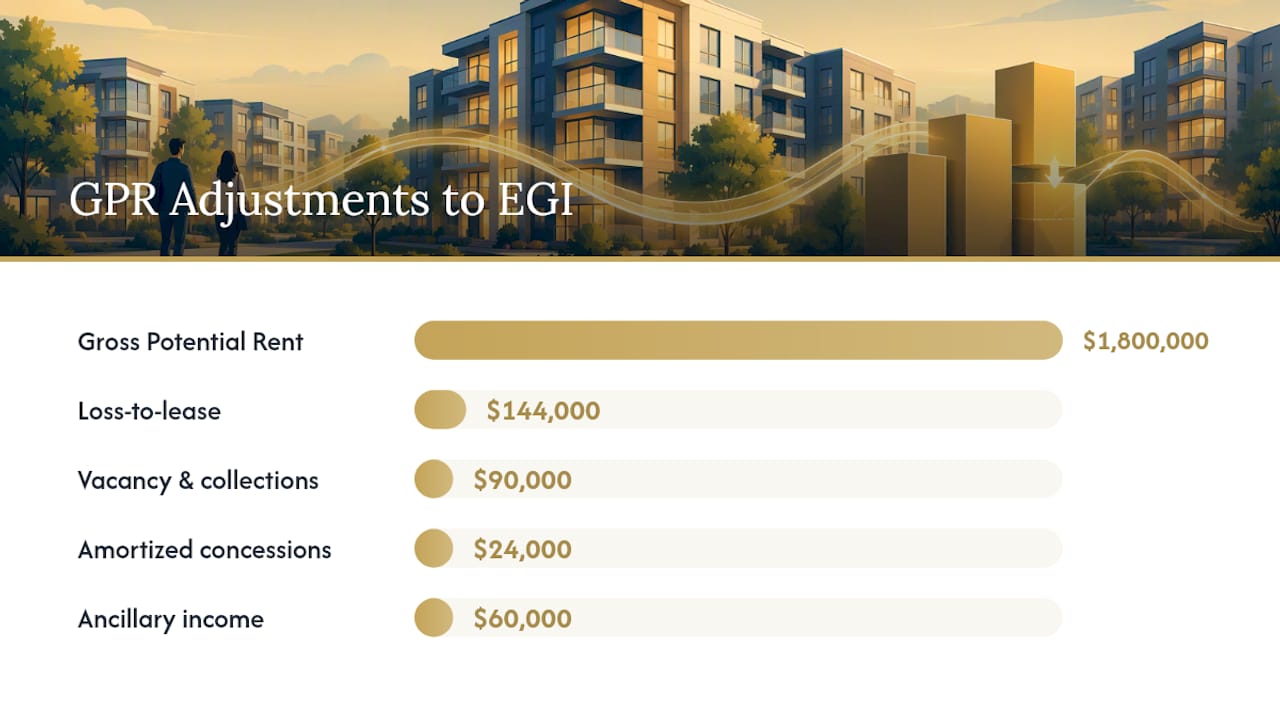
A short cascade: GPR of $1,800,000, less loss-to-lease of $144,000, less an institutional vacancy and collection floor of $90,000, less amortized concessions of $24,000, plus ancillary income of $60,000, lands at an underwritten effective gross income around $1,602,000. Subtract benchmarked operating expenses and you have a Year 1 NOI a lender can actually size debt against.
Due-Diligence Checklist for Lender-Ready Rent Roll Packages
Lenders want a specific document set, and missing one slows the process by weeks. Request a certified rent roll dated within 30 days, executed leases and abstracts for the top-income units, the full T-12, 90 days of bank statements, vendor invoices for major operating expense lines, and current property tax bills.
Brookmont Capital Ventures applies lessons from its DSCR loan portfolio work to calibrate capture and overlay assumptions in a higher-rate environment, where lenders lean harder on documented income than on trailing pro forma projections. That experience shapes how conservative a capture rate should be before an institutional lender will accept it.
- Sample-check five to ten units against their leases to confirm rent, deposit, and lease-end dates match the rent roll exactly.
- Verify renovation claims by requesting before-and-after unit photos or a capex ledger, not just a renovated-unit count.
- Reconcile the total unit count against the certificate of occupancy or a recent property tax assessment.
Pro Tip: Ask for the rent roll in its native export format, not a PDF. A native file lets you sort and filter by lease expiration and unit type in minutes instead of retyping 200 rows by hand.
Why Tenant Credit and Lease Quality Change the Underwriting Math
A rent roll full of on-time payments from stable tenants underwrites very differently from one carrying the same average rent but thin credit behind it. For multifamily, that means weighting income and employment verification documented at move-in, payment history over the trailing 12 months, and the share of tenants on month-to-month status versus locked into a 12-month term.
Commercial leases inside a mixed-use rent roll deserve even closer scrutiny, since a single anchor tenant’s credit quality can swing NOI more than a dozen residential units combined. Look at whether the lease is full-service gross, modified gross, or triple net, since that structure determines who absorbs operating expense increases and directly affects how durable the stated NOI really is.
Lease quality also shows up in the fine print: renewal options at fixed rates versus fair-market resets, co-tenancy clauses, and early termination rights all change how much rollover risk a given lease actually carries. A tenant with strong credit but a below-market renewal option locked in for five more years still represents real risk to your capture assumptions, just a different kind than a delinquent tenant on a month-to-month term. Underwriting that treats every signed lease as equally reliable income is underwriting that hasn’t read the lease.
Modeling Rent Escalations, Renewals, and Bumps
Contractual rent bumps, common in commercial leases and increasingly built into longer multifamily leases, should be modeled on their actual escalation schedule rather than smoothed into a flat annual growth assumption. A lease with a 3% annual bump built into year two should show that exact increase landing in the month it’s contractually due, not spread evenly across twelve months.
Renewal probability deserves its own line rather than an assumption buried in your vacancy overlay. Multifamily renewal rates vary by submarket and unit type, and a realistic model separates units likely to renew at a modest increase from units likely to roll to market rent (or roll vacant) at expiration. For commercial leases, factor in whether a renewal option exists at a fixed rate or at fair market value, since that single clause can determine whether a rollover event helps or hurts your NOI.
The lease expiration schedule you built during reconciliation becomes the backbone of this forecast. Match every escalation and renewal assumption to a specific month on that schedule, not to an annual average, and your Year 2 and Year 3 projections will hold up far better under an investment committee’s questions than a model built on a single blended growth rate.

Brookmont’s View on Underwriting Rent-Roll Risk Today
Higher rates have compressed the room for optimistic capture assumptions. Lender floors that once felt conservative now sit close to where actual performance lands, which means overlays need to widen, not shrink. Recent DSCR portfolio work reinforced two lessons: stale rent rolls hide rollover risk that surfaces within one loan cycle, and properties with clustered lease expirations need extra documentation before sizing debt at all.
— Jerry
How Brookmont Capital Ventures Supports Your Underwriting Process
Getting the rent roll math right is only half the job. Turning that analysis into a lender-ready package, and then actually securing the debt or equity to close, is where most sponsors lose weeks they don’t have. Some firms offer institutional-grade underwriting paired with national lender relationships, built for sponsors who need both discipline and speed.
Our underwriting and feasibility work applies the same reconciliation and overlay discipline covered above, then packages the file the way lenders actually want to see it. From there, our deal packaging and debt placement services connect your file to institutional lenders, banks, and debt funds who evaluate rent-roll risk daily. If your capital stack calls for DSCR financing specifically, our DSCR investor loan program is built around the exact capture and overlay assumptions this article walks through.
An engagement typically starts with a document review against the checklist above, moves through a lender-ready underwriting model, and ends with introductions to the institutional partners best suited to your deal. If you have a rent roll that needs a second set of eyes before it goes to committee, request a pre-underwrite through our financing solutions page.
Sources
- Multifamily Underwriting: The Complete Guide for 2026 | PropRise
- Multifamily underwriting: Rent Roll Fundamentals | APERS
FAQ
What Should a Rent Roll Include?
A complete rent roll lists unit ID, unit type, square footage, tenant name, lease start and end dates, face and effective rent, concessions, deposits, occupancy status, and any ancillary charges billed separately from base rent. Missing lease dates or blended rent figures without a concessions column are the most common gaps that slow down underwriting.
What Would You Likely Find on a Rent Roll?
Beyond basic tenant and lease data, a well-prepared rent roll for underwriting shows the split between market rent and in-place rent, which is where loss-to-lease calculations come from. You’ll also typically see whether a unit is renovated, its lease term structure, and flags for month-to-month status.
What Is the 2% Rule for Rentals?
It’s a quick filter for single-family and small multifamily deals, not a substitute for the unit-level reconciliation and NOI underwriting this article covers, and most institutional-grade multifamily deals in competitive markets won’t clear that threshold at all.
What Does a Rent Roll Report Look Like?
A rent roll report is typically a spreadsheet or property-management export with one row per unit and columns for tenant name, lease dates, rent figures, and status, often exported directly from software like Yardi or RealPage. Lenders generally want it dated within 30 days of closing, formatted in its native file rather than a flattened PDF, so it can be sorted by lease expiration and unit type during analysis.
How Does Brookmont Capital Ventures Help With Rent Roll Underwriting?
Brookmont Capital Ventures reviews and reconciles the rent roll against the T-12 and lease documents, applies institutional overlays, and packages the resulting underwriting into a lender-ready file. Current pricing and engagement details are available through Brookmont’s advisory services page.