
Reduce Construction Financing Costs: 2026 Builder’s Guide

Practical strategies to reduce construction financing costs
The most effective way to cut construction loan expenses is to attack costs on multiple fronts simultaneously: negotiate all-in pricing before you sign, manage your draw schedule with discipline, and lock your permanent takeout financing before the first shovel hits dirt. Developers who treat these as separate decisions rather than a coordinated strategy routinely leave money on the table.
- Compare all-in lender pricing. Request quotes from at least three lenders and evaluate origination fees, points, and rate locks together, not just the headline rate. On a $400,000 loan, one discount point equals $4,000 upfront; a 0.25% rate reduction saves roughly $62–$70 per month, breaking even only after 58–65 months.
- Use single-close construction-to-permanent loans. Consolidating both closings into one eliminates duplicated title insurance, escrow fees, appraisal updates, and a second round of origination charges.
- Negotiate points and fees directly. Banks have been reducing loan points for 2026 starts; use that trend as leverage. A one-point reduction on a $400,000 loan frees $4,000 in working capital during the critical early build phase.
- Align draw requests with verified milestones. Interest accrues only on drawn funds, not the full loan commitment, so every dollar you delay drawing is a dollar not accruing interest.
- Control soft costs before closing. Permits, architecture, engineering, and legal fees can consume a significant share of total project cost if left unbudgeted; plan for them explicitly in your pro forma.
- Improve your credit profile before applying. A stronger debt service coverage ratio and lower loan-to-value position you for better rate tiers and fewer restrictive covenants.
- Explore government programs and alternative capital sources. SBA 504 financing can reduce required developer equity to 10% for owner-occupied projects, freeing capital that would otherwise carry an interest cost.
How interest rates shape your total construction financing expense
Construction loans carry a risk premium over permanent financing because the collateral, the completed building, does not yet exist. Current ground-up construction rates run in the 8–9% range, while permanent takeout financing on stabilized assets typically prices 150–200 basis points lower. That spread is not arbitrary; it reflects the lender’s exposure to construction risk, cost overruns, and timeline uncertainty.
Construction rates carry a risk premium because the asset doesn’t exist yet. That’s why locking your permanent takeout up front is the whole game.
The dollar impact of that premium is often misunderstood. On a $400,000 construction loan at 12% over a 13-month build, total interest typically runs $25,000–$30,000 rather than the $52,000 a flat-rate calculation suggests, because draws fund progressively and the time-weighted average outstanding balance is roughly half the total loan size. Even so, a one-percentage-point rate increase on that same loan adds several thousand dollars to your financing cost, which is why rate negotiation and rate lock options deserve serious attention before you commit.
Variable-rate construction loans expose you to rate movement during the build. Fixed-rate or rate-locked structures cost slightly more upfront but eliminate that uncertainty. For projects with 18-month or longer timelines, the insurance value of a rate lock often outweighs its cost, particularly in a market where the Federal Reserve’s posture remains uncertain.
Securing your permanent takeout commitment before breaking ground also disciplines the construction lender’s pricing. When the exit is committed, the lender carries less residual risk and has less justification for a wider spread.
Techniques to manage and reduce interest costs during construction
The single most controllable variable in your interest expense is draw timing. Interest accrues only on funds in use, which means a disciplined draw schedule is a direct interest expense lever, not just an operational preference.
- Keep the build on schedule. Every week of delay extends the loan term and adds interest. Work with builders who have a documented track record of on-time delivery.
- Borrow only what each phase requires. Pulling draws faster than actual construction progress warrants increases the average outstanding balance and your total interest paid.
- Coordinate draw requests with completed milestones. Lenders release funds against verified work; aligning requests tightly with inspection-ready completions prevents idle capital sitting in your account accruing interest.
- Make occasional principal payments if cash flow allows. Most construction loans require interest-only payments during the build, but voluntary principal reductions lower the balance on which interest compounds.
- Negotiate rate locks upfront. Even a modest lock fee can pay for itself if rates move during a 12–18 month build.
- Choose lenders with fast draw processing. Digital draw turnaround within 48 hours versus the conventional 7–12 business day cycle materially reduces the working capital a builder needs to bridge between draws, which lowers indirect financing costs.
Pro Tip: Ask prospective lenders specifically about their draw turnaround time. A lender with digital draw processing can compress cumulative inspection delays from 35–60 business days down to under 10 across an entire build, which directly reduces your working capital carry cost.
Common construction financing costs and methods to mitigate them

Closing costs on construction loans typically run 2–5% of the loan amount and include origination fees, appraisal, title insurance, escrow, recording fees, and per-draw inspection charges. Unlike a standard purchase mortgage, construction loans trigger multiple inspection and title update events throughout the build, so the cost accumulates well past the initial closing date.
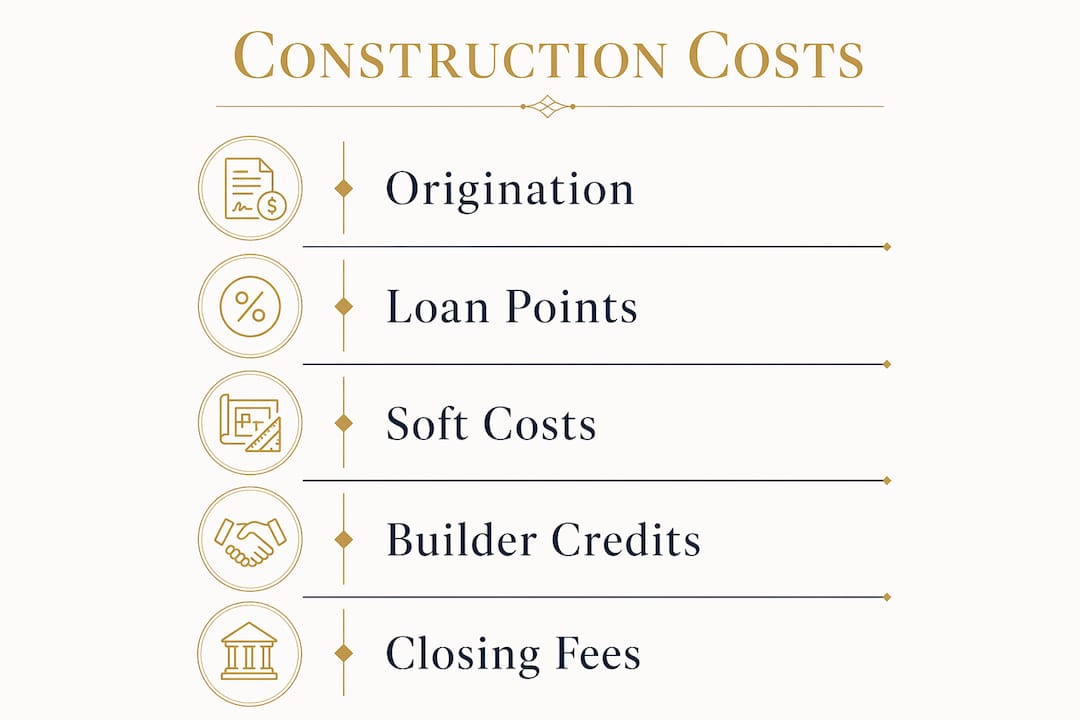
| Cost Category | Typical Range | Mitigation Strategy |
|---|---|---|
| Origination fees | 2–5% of loan | Negotiate directly; compare across lenders |
| Discount points | 0–2 points (on a $400,000 loan, one point equals $4,000) | Evaluate break-even carefully; 2026 lenders are reducing points |
| Per-draw inspections | — | Choose lenders with digital draws to reduce inspection frequency |
| Title updates per draw | Varies by state | Single-close loans reduce duplicate title charges |
| Soft costs (permits, engineering, legal) | Significant share of total project cost | Budget explicitly in pro forma; finance eligible items through draw schedule |
| Contingency reserve | substantial portion of total project cost | Maintain to avoid mid-project capital calls requiring costly refinancing |
Loan points deserve a careful break-even calculation before you pay them. Reducing points lowers upfront capital requirements and preserves cash flow during the build. However, some lenders respond by imposing stricter draw or milestone requirements. Understand the full trade-off before accepting a lower-point structure.
Soft costs catch developers off guard more consistently than any other line item. Architecture, structural engineering, civil engineering, permits, impact fees, legal work, and construction management can collectively represent a substantial portion of total project cost on complex builds. Underestimating them forces mid-project conversations with your lender about additional capital, which is a position that weakens your negotiating leverage and can trigger costly supplemental financing.
Builder and seller credits are preferable to lender credits when you need help covering closing costs. Lender credits reduce your out-of-pocket cash at closing but raise your interest rate, increasing your total cost over the loan term. Builder or seller credits offset fees without touching your rate.
Expert insights from Brookmontcapital on optimizing construction financing in 2026
Brookmontcapital structures and sources construction financing for real estate developers and sponsors nationwide, working across institutional lenders, banks, debt funds, and equity partners to secure terms that reflect actual market conditions rather than a single lender’s pricing sheet.
The developers who control their financing costs in 2026 are the ones who plan their full capital stack before breaking ground. That means soft costs, interest reserves, contingency, and permanent takeout committed upfront. Anything less is building on an incomplete foundation.
The firm’s current guidance for developers reflects several converging trends in 2026 lending:
- Secure single-close construction-to-permanent financing wherever the project qualifies. Eliminating the second closing removes duplicated fees and reduces execution risk during the conversion phase.
- Negotiate points aggressively. Banks have been reducing construction loan points for 2026 starts; developers who present clean pro formas with realistic contingency budgets and committed takeout financing have the strongest negotiating position.
- Plan your interest reserve into the loan structure. Building an interest reserve into the loan amount means you are not writing checks out of pocket during construction, which preserves working capital for contingencies.
- Understand lender underwriting criteria before you apply. Loan-to-cost ratios, debt service coverage requirements, and draw milestone standards vary significantly across lender types; knowing where you fit before you approach a lender saves time and prevents repricing surprises.
- Stack your capital sources deliberately. A construction lender handles the build, a permanent lender commits to the takeout, and mezzanine or preferred equity fills gaps in the capital stack. Structuring this upfront means you know your total cost before the first draw.
- Avoid common financing mistakes that inflate costs: underestimating soft costs, pulling draws ahead of verified milestones, and treating the draw schedule as an invoice schedule rather than a cash flow management tool.
Developers working with Brookmontcapital gain access to construction financing solutions structured around their specific project type, capital stack, and exit strategy, rather than a generic product off a rate sheet.
Tax implications and benefits related to construction financing costs
Construction loan interest is generally deductible as a business expense for developers and builders who hold property for sale or investment, though the specific treatment depends on how the project is classified under the Internal Revenue Code. Developers who capitalize costs during the construction period under IRC Section 263A must include interest as part of the asset’s basis rather than deducting it currently, which defers the tax benefit until the property is sold or depreciated.
For developers building rental or investment properties, interest incurred during the construction period typically gets capitalized into the property’s cost basis and then recovered through depreciation over the asset’s useful life once placed in service. The depreciation schedule for commercial real estate runs 39 years under current law, which means the interest cost you capitalize today produces a tax benefit spread across nearly four decades.
Soft costs, including architectural fees, engineering, and permit costs, follow a similar capitalization treatment for most developers. Planning these costs accurately in your pro forma matters not just for cash flow but for understanding your true tax basis and future depreciation deductions.
Developers using SBA 504 financing or other government-backed programs may access interest rates below conventional market pricing, which reduces both the cash cost and the capitalized basis of the project. Consulting a tax advisor who specializes in real estate development before structuring your capital stack can surface deduction timing strategies that meaningfully affect your after-tax return on a project.
Key Takeaways
The most effective way to reduce construction financing costs is to manage draw timing, negotiate all-in lender pricing, and commit your permanent takeout financing before breaking ground.
| Point | Details |
|---|---|
| Draw discipline cuts interest | Interest accrues only on drawn funds; pacing draws to actual milestones minimizes the average outstanding balance. |
| Single-close loans eliminate duplicate fees | Combining construction and permanent financing into one closing removes duplicated title, escrow, and origination charges. |
| Points require break-even analysis | On a $400,000 loan, one point costs $4,000 upfront; a 0.25% rate reduction saves about $62–$70 per month, with the break-even typically reached after 58–65 months. |
| Closing costs run 2–5% of loan amount | Budget for origination, appraisal, title, per-draw inspections, and soft costs before committing to a project pro forma. |
| Permanent takeout committed upfront | Locking your exit financing before construction starts reduces the lender’s risk premium and strengthens your negotiating position. |
Brookmontcapital advises real estate developers and sponsors on structuring construction financing, capital stacks, and permanent takeout solutions. Explore construction financing options or review capital stack advisory services to structure your next project with full cost visibility before you break ground.
Recommended
- Construction Lender Underwriting Criteria: 2026 Guide | Brookmont Capital Ventures
- Common Construction Financing Mistakes to Avoid in 2026 | Brookmont Capital Ventures
- The 2026 CRE Refinancing Wall: What Investors With $500K-5M Projects Need to Know Now
- Vertical Construction Financing: A Developer’s 2026 Guide | Brookmont Capital Ventures