Equity Partners for Real Estate: Term Sheet Lines Sponsors Must Nail

A real estate equity partner is a capital provider who takes an ownership stake in a project rather than lending against it, typically as a limited partner alongside a sponsor who runs the deal. Sponsors turn to equity partners when leverage alone can’t cover the capital stack or when senior lenders demand more sponsor skin in the game than the balance sheet allows. The immediate move: pull up a term sheet checklist before the first call, because the lines you fail to negotiate on paper are the ones that cost you control later.
TL;DR:
- Capital commitment amounts and capital call mechanics are the highest priority in negotiations, as they determine remedies if a partner fails to fund promptly.
- Owners should carefully negotiate ownership splits, preferred return rates, and decision rights before discussing promote tiers, to avoid veto power conflicts.
- Combining an IRR hurdle with an equity multiple test provides better protection for the capital partner than relying on a single metric.
- Most equity partnerships take six to twelve weeks from term sheet to first capital call, with longer timelines for programmatic joint ventures.
- Engaging advisors early ensures a thorough review of waterfall language, legal structures, and partner vetting, reducing risks of renegotiation mid-deal.
Table of Contents
- What Is a Real Estate Equity Partnership, and How Does It Work?
- Choosing the Right Legal Structure for Your Equity Partnership
- How Do Preferred Returns and Promotes Actually Work?
- Which Term Sheet Lines Matter Most to Sponsors?
- How Do You Vet an Equity Partner Before Signing?
- How Do Programmatic Joint Ventures Scale Beyond One Deal?
- Brookmont Capital Ventures’ Role in Structuring Equity Deals
- Where Sponsors Lose Ground at the Negotiating Table
- Ready to Structure Your Next Equity Partnership?
- Where to Go for Deeper Reading on Equity Structures
- Sources
- FAQ
What Is a Real Estate Equity Partnership, and How Does It Work?
A real estate equity partnership pairs a sponsor, often called the general partner or GP, with one or more capital partners, or limited partners, who fund most of the equity in exchange for a share of profits. The sponsor typically contributes 2% to 15% of total equity while the capital partner funds the rest, a split that industry practice notes attach to promotes and fee schedules designed to keep sponsor incentives tied to performance.
Sponsors choose equity over debt or mezzanine financing when a deal needs patient capital that shares in the upside, or when senior lenders cap loan-to-value low enough that a pure debt stack leaves a funding gap. The road from signed term sheet to first capital call usually runs six to twelve weeks, driven by:
- Legal drafting and negotiation of the operating agreement
- Lender coordination if senior debt is already in place
- Third-party diligence: appraisals, environmental reports, title work
- Investment committee approvals on the capital partner’s side
Choosing the Right Legal Structure for Your Equity Partnership
Most real estate joint ventures form around a single-purpose LLC or LP built solely to hold one asset, insulating the sponsor’s other projects from that deal’s liabilities. Legal and tax practitioners note that LLCs dominate one-off deals because of their flexibility and pass-through tax treatment, while LPs remain the default for institutional fund structures where a GP manages pooled LP capital across multiple assets.
The manager-managed versus member-managed distinction matters more than most first-time sponsors realize:
- Manager-managed LLCs concentrate day-to-day control with the sponsor, which lenders generally prefer
- Member-managed structures give capital partners direct voting rights, which can slow decisions but satisfies LPs wary of ceding control
- Securities law treatment shifts depending on how passive the capital partner’s role actually is, not just what the agreement calls it
- Lenders scrutinize the entity’s single-purpose restrictions closely before underwriting acquisition or construction debt
Get the wrapper wrong and you’ll be renegotiating with your senior lender at the worst possible moment, mid diligence, with a closing date already on the calendar.
How Do Preferred Returns and Promotes Actually Work?
A distribution waterfall answers one question: who gets paid first, and how much, once the property generates cash or sells. The FTI Consulting guide to waterfall structuring breaks the mechanics into a sequence sponsors should memorize before their first negotiation:
- Return of capital: both partners get their original investment back
- Preferred return: the capital partner earns a set annual return, often in the 6% to 10% range, before the sponsor sees promote dollars
- Catch-up: the sponsor “catches up” to a proportional share of profits already paid as preferred return
- Promote tiers: profits above the preferred return split at escalating percentages favoring the sponsor as performance improves
Statistic Callout: Combining an IRR hurdle with an equity-multiple test gives capital partners more complete protection than relying on a single threshold, since IRR alone can reward a fast exit that never delivers real dollar returns.
The traps live in the definitions. Ambiguous language around how IRR gets calculated, when clawback obligations trigger, and whether promote crystallizes at refinance or only at final sale has derailed more sponsor relationships than any market downturn. A drafting tip worth building into every waterfall clause is specifying whether IRR runs levered or unlevered, gross or net of fees, before the deal closes rather than after a dispute starts.
Which Term Sheet Lines Matter Most to Sponsors?
Not every line in a term sheet carries equal weight, and sponsors who treat them all as equally negotiable waste leverage on the wrong points. Prioritize in this order:
- Capital commitment amounts and the mechanics governing capital calls, including default remedies if a partner fails to fund
- Ownership split, preferred return rate, promote tiers, and any asset management or acquisition fees layered on top
- Major decision rights: what requires unanimous investor approval versus sponsor discretion alone
- Exit mechanics, including forced sale rights, buy-sell provisions, and transfer restrictions like a right of first offer
Pro Tip: Negotiate decision-rights language before you negotiate the promote split. A generous promote means nothing if your capital partner can veto every refinancing and leasing decision that would actually get you there.
Brookmont Capital Ventures built a nine-line term sheet checklist specifically because sponsors kept losing ground on the same handful of clauses, over and over, across otherwise well-run deals.
How Do You Vet an Equity Partner Before Signing?
Diligence on a capital partner runs in both directions, and too many sponsors skip it because they’re relieved someone said yes to funding the deal. Before you sign, confirm:
- Track record across full market cycles, not just the last bull run, and speak to sponsors who’ve exited deals with that partner
- Team stability and balance sheet strength, since a thinly capitalized capital partner can stall a capital call at the worst moment
- Governance provisions: an advisory committee, regular reporting cadence, and audit rights spelled out in the operating agreement
- Willingness to disclose fee structures plainly, without pushing back when you ask direct questions
The PREA plan sponsor toolkit offers model provisions built around exactly this kind of alignment and disclosure, and it’s worth reviewing before you draft your own governance language. Refusal to share references or opaque reserve policies are red flags no promote percentage should talk you past.
How Do Programmatic Joint Ventures Scale Beyond One Deal?
A programmatic JV extends the same capital partner relationship across multiple acquisitions instead of negotiating fresh terms every time, and the mechanics differ sharply from a single-asset deal. Capital partners generally want exclusivity; sponsors want room to move. Ropes & Gray documents the common middle ground: rights of first offer, strike-out provisions that let sponsors walk from deals the JV declines, and narrowly defined core investment criteria with hard timelines attached.
- Investment discretion usually splits between sponsor-led sourcing and capital partner veto rights above a defined dollar threshold
- Seed assets, an initial deal or two contributed at formation, often anchor the relationship and get allocated transaction costs differently than later acquisitions
- Capital partners frequently demand seed contributions precisely because a track record inside the JV structure means more than a track record outside it
Sponsors sourcing that first wave of acquisitions benefit from disciplined acquisition strategy frameworks that keep pipeline quality consistent once capital partner scrutiny tightens.
Brookmont Capital Ventures’ Role in Structuring Equity Deals
Advisors working across the full capital stack can handle term sheet negotiation with equity partners alongside senior financing, which is important when structuring preferred equity beneath construction loans without tripping intercreditor issues.
- A recent preferred equity gap financing engagement closed a funding shortfall between senior debt and sponsor equity without diluting the sponsor’s promote below levels that kept the deal worth pursuing
- Financial modeling support that stress-tests waterfall assumptions before a capital partner ever sees the pitch
- Deal packaging and lender or investor sourcing that keeps the process moving once the expanded advisory platform is engaged
Where Sponsors Lose Ground at the Negotiating Table
Sponsors most often lose ground on three fronts: accepting vague IRR definitions because the deal feels urgent, under negotiating decision rights while over focusing on promote splits, and skipping reference checks on a capital partner simply because the term sheet arrived fast. Fix all three by running the term sheet checklist before every call, not after. Handle straightforward equity structures in-house; bring in Brookmont or outside counsel the moment multiple investor classes or programmatic terms enter the conversation.
— Jerry
Ready to Structure Your Next Equity Partnership?
A team that structures both sides of the capital stack can help ensure preferred equity terms are negotiated with visibility into how they interact with senior debt, which is important when a deal has a funding gap that a straight equity raise alone won’t close cleanly.
If you’re heading into a capital raise, start with Capital Stack Advisory and term sheet negotiation support to pressure test your waterfall language before it reaches an investor’s desk. Sponsors who need modeling or deal packaging capacity without hiring full time can lean on the Fractional Deal Team, and anyone weighing preferred equity against a straight equity partner should review Brookmont’s preferred equity solutions alongside the broader menu of financing solutions. Submit your deal details and a member of the advisory team will walk through which structure actually fits your capital gap.
Where to Go for Deeper Reading on Equity Structures
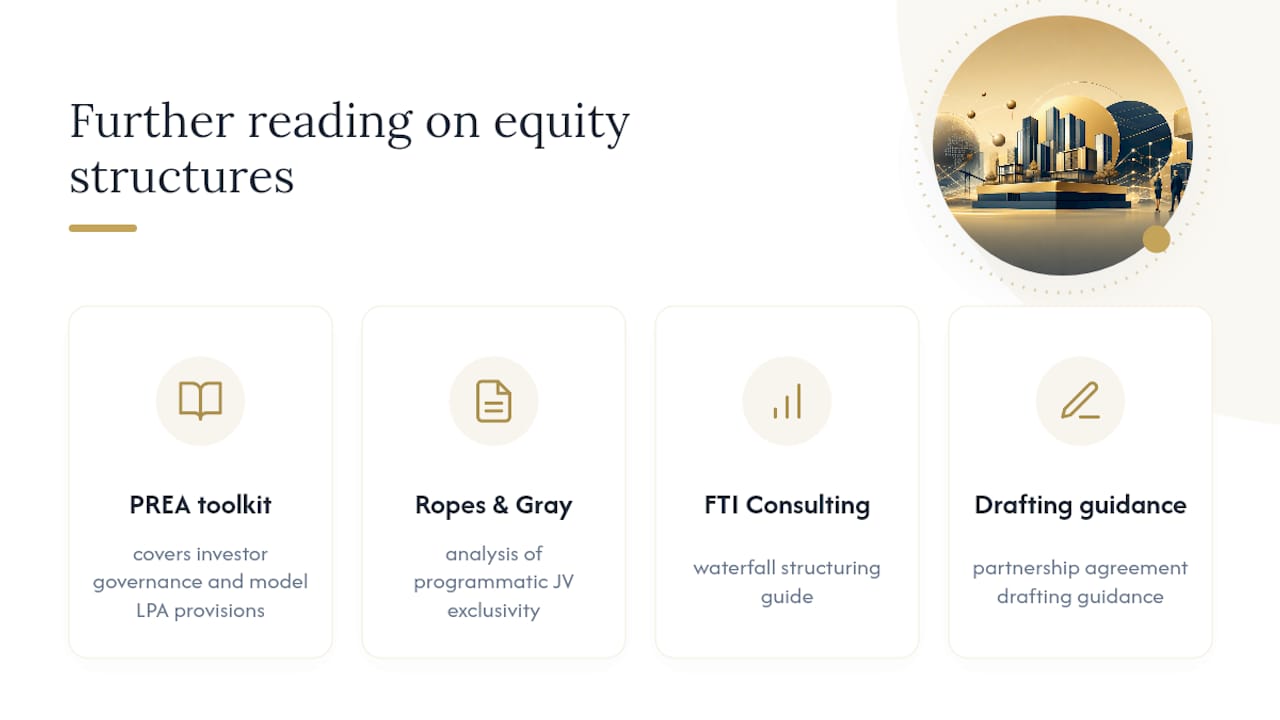
For sponsors who want to go straight to primary sources: the PREA plan sponsor toolkit covers investor governance and model LPA provisions in depth. Ropes & Gray’s analysis of programmatic JV exclusivity and FTI Consulting’s waterfall structuring guide both hold up as reference material long after a single deal closes. Sponsors drafting their own operating agreements should also review partnership agreement drafting guidance before finalizing language with counsel.
Sources
- PREA plan sponsor toolkit and model provisions
- Dealmaker’s guide: JV waterfall structuring | FTI Consulting
FAQ
What Is an Equity Partner in Real Estate?
An equity partner is an investor who contributes capital to a property deal in exchange for an ownership stake and a share of profits, rather than a fixed interest payment like a lender receives. In most sponsor-led deals, the equity partner acts as a limited partner while the sponsor, or general partner, manages the asset and earns a promoted interest tied to performance.
How Does a Promote Work in a Distribution Waterfall?
A promote is the sponsor’s disproportionate share of profits once the capital partner has received a return of capital and a preferred return, typically in the 6% to 10% range. It rewards the sponsor for performance above the hurdle rather than paying flat fees regardless of outcome.
What Should Go First on a Sponsor’s Term Sheet Checklist?
Capital commitment amounts and capital-call mechanics come first, since default remedies here determine what happens if a partner fails to fund on schedule. Decision rights and major-decision approval thresholds should follow immediately, before promote splits get finalized.
How Long Does It Take to Close an Equity Partnership?
Most equity partnerships move from signed term sheet to first capital call in six to twelve weeks, depending on legal drafting, lender coordination, and third-party diligence. Programmatic JVs covering multiple future deals can take longer at formation but move faster on each subsequent acquisition.
Can Brookmont Capital Ventures Help Negotiate My Equity Partnership Terms?
Yes. Brookmont Capital Ventures provides sponsor advisory and term sheet negotiation support alongside deal packaging and financial modeling, so equity terms get structured with full visibility into how they interact with any senior debt already in the capital stack.