Rate Lock on a Commercial Construction Loan: Developer’s Guide

A rate lock on a commercial construction loan guarantees your lender’s quoted interest terms for a defined window between commitment and conversion or closing. Lock when your sensitivity analysis shows that a 50-basis-point move would materially impair debt service coverage or equity returns; otherwise, float with explicit contractual protections in place. With weighted average construction loan rates near typical market levels and SOFR holding at moderate levels, even modest benchmark drift can shift your interest carry by tens of thousands of dollars on a mid-market deal. Brookmont Capital Ventures works with sponsors to run that sensitivity before a lock decision is ever made.

Table of Contents
- How does a rate lock work on a commercial construction loan?
- What do rate-lock fees and contract terms actually cost you?
- When should you lock, float, or use a hybrid strategy?
- How does locking the rate affect your pro forma and draw schedule?
- What should you ask a lender before signing a rate lock?
- Lock now vs float: a worked example
- Key Takeaways
- The rate lock decision most developers get wrong
- Brookmontcapital structures rate-lock strategy into every construction financing engagement
- Useful sources for further research
How does a rate lock work on a commercial construction loan?
A rate lock fixes either the lender’s spread over a benchmark or the full note rate for a defined period. The lock date is the day you pay the lock fee and receive written confirmation; the closing date is when loan documents are executed; the conversion date is when the construction note converts to permanent financing. These three dates rarely coincide, and the gap between them is where most lock risk lives.
Construction loans are priced as a fixed margin over a benchmark — typically SOFR or Prime — so lenders can offer either a spread hold (the margin is fixed, the benchmark floats) or a full rate lock (both components are fixed). Developers encounter several lock structures in practice:
- Short lock (30–90 days): Standard for deals near closing; lowest fee but leaves little room for schedule slippage.
- Forward lock: Rate is set weeks or months before the commitment letter is signed; useful when you expect rates to rise before your project is ready to close.
- Early rate lock / spread hold: The margin is fixed at application; the benchmark component is set later. Freddie Mac’s Early Rate-Lock (ERL) process formalizes this for multifamily, with hold periods typically ranging 60–120 days and defined post-lock delivery requirements.
- Float-to-lock: You float during construction and lock at a predetermined trigger point, such as a specific SOFR level or a project milestone.
- Float-down option: You lock but retain the right to reset to a lower rate once if the benchmark drops by a defined amount, usually for an additional premium.
A simplified timeline looks like this:
Commitment issued → Lock fee paid (lock window opens) → Draws funded monthly during construction → Conversion/perm lock or expiration → Closing or extension
Key events within that window: on lock day, the good-faith deposit is applied and fee is remitted; mid-lock, you must meet any conditions precedent the lender specified; at extension, an additional fee is due; at expiration, the rate reverts to market unless you extend or close.
Statistic: Weighted average construction loan rates are approximately 8.4% as of April 2026, with typical bank financing ranging from 7.3% to 8.8% and private or higher-risk structures often starting near 9%–12%+.
What do rate-lock fees and contract terms actually cost you?
The headline rate is only one cost. Locks typically involve points paid up-front, commitment or option fees, extension fees, float-down premiums, and potential forfeiture of the good-faith deposit if the loan does not close within the lock window.
Here is what each term means in practice:
- Points: Paid at closing or deducted from proceeds; 0.25–1.0 points is common on commercial construction locks.
- Commitment fee: Paid to hold the lender’s capacity; sometimes credited at closing, sometimes not.
- Extension fees: Typically 0.25%–1.0% of the loan amount per extension period, and frequently negotiable for strong sponsors with clean credit and low leverage.
- Float-down premium: An additional 0.125%–0.375% of the loan amount, depending on the lender and the option’s strike level.
- Good-faith deposit forfeiture: If you fail to close within the lock window and do not extend, the lender typically retains the deposit.
Borrower credit quality directly affects which of these terms are available and at what price. Sponsors with credit scores in the 700–740+ range generally access tighter margins and more favorable lock structures. A weaker credit profile not only raises the spread but can eliminate float-down and forward-lock options entirely, leaving you with a binary choice between a short lock and floating unhedged.
Statistic: Tightened underwriting in 2026 has generally pushed typical loan-to-cost ratios lower for multifamily and commercial deals, requiring notably more sponsor equity on many deals. That equity exposure makes the cost of a lock fee look modest by comparison.
When should you lock, float, or use a hybrid strategy?
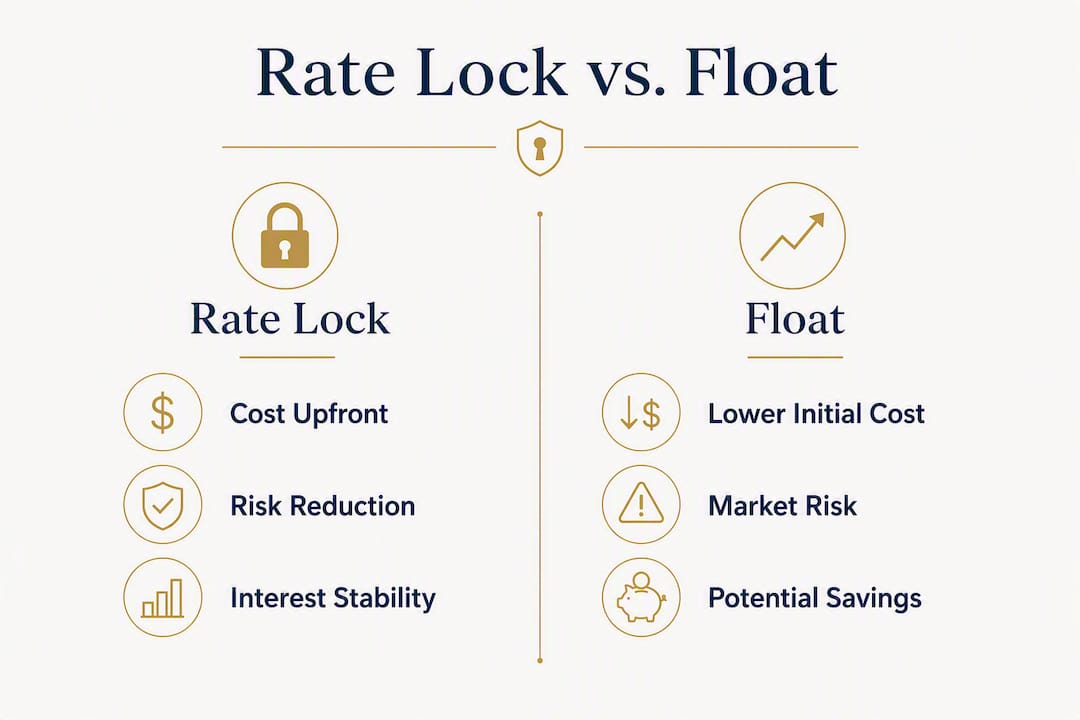
Choose a strategy that matches your project’s rate sensitivity, schedule certainty, and liquidity buffer. No single approach fits every deal profile.
-
Immediate lock: Best for pre-leased or pre-sold projects with fixed timelines. You pay the premium but eliminate benchmark volatility from your pro forma.
-
Float then lock (conditional lock): Appropriate when you expect rates to stabilize or fall, and your project has schedule flexibility. Define the trigger in writing before you start drawing.
-
Float-to-lock with float-down: Combines downside protection with limited upside participation. The float-down premium is worth modeling explicitly against your breakeven rate move.
-
Single-close construction-to-perm: Locks the permanent rate at construction closing, eliminating refinance risk entirely. Some lenders offer lock periods up to 12 months with one-time float-down provisions. This structure suits build-to-rent and stabilized multifamily where the exit is a hold, not a sale.
-
Partial hedge: Lock a percentage of projected draws and float the remainder. Reduces premium cost while capping exposure on the largest draw tranches.
Pro Tip: Negotiate extension and float-down terms before you sign the commitment letter, not after. Lenders are far more flexible on those provisions when they are competing for your business than when you are mid-construction and need an extension.
For speculative multifamily, a float-to-lock with a defined trigger tied to SOFR levels tends to outperform a full immediate lock when construction timelines are uncertain. For pre-leased office or NNN retail, an immediate lock or single-close structure is usually the cleaner choice because the income stream is predictable enough to model debt service precisely. Reviewing common construction financing mistakes before committing to a strategy can prevent costly missteps.
How does locking the rate affect your pro forma and draw schedule?
Locking the rate affects interest carry, interest reserve sizing, loan-to-cost net proceeds, and sometimes advance rates or contingency expectations. These are not abstract adjustments — they show up as hard line items on your budget.
During construction, draws are funded monthly or at defined milestones, and interest accrues only on the outstanding balance. Under a locked spread, your interest carry is predictable from day one. Under a floating benchmark, each draw’s carry cost depends on where SOFR sits at that point in the schedule.
Budget line items that shift with your lock decision:
- Interest reserve: A locked rate lets you size the reserve precisely. A floating assumption requires a buffer, typically 50–100 basis points above your base case, to avoid a reserve shortfall mid-construction.
- Extension fees: If your schedule slips, a locked loan triggers extension fees; a floating loan may not, but exposes you to rate risk during the extension period.
- Contingency: Lenders often require a larger contingency when the rate is floating, because cost overruns and rate increases can compound simultaneously.
- Additional equity: Tighter LTC standards mean that any cost increase — whether from rates or construction — may require additional sponsor equity rather than additional loan proceeds.
Understanding how financing milestones map to lock windows is the clearest way to size your interest reserve accurately before you commit.
What should you ask a lender before signing a rate lock?
Before you lock, get written answers to a defined set of questions so you can compare offers on equal terms. A verbal commitment on lock terms is worth nothing at the closing table.
| Question | Why It Matters | Negotiation Lever |
|---|---|---|
| What is the exact lock type and window? | Determines your schedule exposure | Request 90-day minimum; push for extension options |
| What are all fees: points, commitment, extension, float-down? | Total cost of the lock, not just the rate | Ask for fee credits at closing; cap extension fees |
| What is the good-faith deposit and forfeiture rule? | Defines your downside if the deal falls apart | Negotiate partial refund if lender causes delay |
| What conditions precedent must be met to close? | Unmet conditions void the lock | Get an exhaustive list in writing at commitment |
| How does conversion to permanent financing work? | Determines refinance risk and timing | Negotiate single-close or defined perm lock window |
| What are the timeline penalties for missed milestones? | Protects you from lender-imposed penalties | Cap penalties; define force majeure carve-outs |
Email template to request lock terms:
Subject: Rate Lock Term Sheet Request — [Project Name / Address]
Please provide written lock terms covering: (1) available lock types, windows, and associated fees; (2) good-faith deposit amount and forfeiture conditions; (3) extension fee schedule and maximum extension periods; (4) float-down option availability and premium. We are comparing proposals from multiple lenders and need these items to complete our underwriting.
Reviewing lender underwriting criteria before submitting this request helps you anticipate which terms a given lender is likely to offer based on your deal profile.
Lock now vs float: a worked example
Locking reduces downside when rates rise more than roughly 50 basis points and costs you approximately 0.50 points up-front. Here is how that plays out on a representative deal.
Scenario assumptions: $5,000,000 construction loan; SOFR at 4.8%; lender spread of 3.0%; base all-in rate of 7.3%–8.8% for typical bank financing; 18-month construction term; draws funded evenly over 12 months with 6 months of full balance outstanding. Weighted average rate of 8.4% as of April 2026 is used as the industry stress case.
| Item | Lock Now (7.8% fixed) | Float Then Lock (base 7.8%, stress 8.4%) |
|---|---|---|
| Up-front lock fee (0.50 points) | — | $0 |
| Extension fee (if 3-month slip) | $12,500 (0.25%) | $0 (floating, no lock) |
| Breakeven rate move | +50 bps above base | — |
Statistic: Practitioners should model at least three rate scenarios — lower, base, and higher — and quantify the impact on interest carry and minimum pricing before deciding on lock timing. Use a construction loan cost calculator to run those scenarios quickly.
The table shows that floating is cheaper in the base case by $37,500. The lock pays off only if rates rise more than 50 basis points and your schedule holds. A 3-month schedule slip under the locked structure adds $12,500 in extension fees, narrowing the lock’s advantage in the stress scenario. The decision is sensitive to schedule certainty, not just rate direction. For a deeper look at construction loan rate ranges in 2026, regional and deal-type variations are worth reviewing before finalizing your assumptions.
Key Takeaways
A rate lock on a commercial construction loan is a risk-management decision that must be evaluated against total cost of capital, schedule certainty, and lender terms, not the note rate alone.
| Point | Details |
|---|---|
| Lock when sensitivity is high | Run three rate scenarios; lock if a 50-bps move materially impairs DSCR or equity returns. |
| Budget all lock costs | Points, extension fees (0.25%–1.0%), and float-down premiums all affect pro forma carry and equity requirements. |
| Credit quality drives terms | Sponsors with 700+ credit scores access tighter spreads and more favorable lock structures, including float-down options. |
| Model total cost, not just rate | Advance rates (60–65% LTC for multifamily), draw mechanics, and contingency reserves are as consequential as the note rate. |
| Brookmontcapital advisory | Brookmontcapital structures scenario modeling, lender sourcing, and lock-term negotiation to help sponsors secure optimal construction financing terms. |
The rate lock decision most developers get wrong
The conventional wisdom says lock early and lock everything. That advice made sense when rates were rising sharply and unpredictably. In a high-but-stable rate environment, it often costs sponsors money they did not need to spend.
The more defensible position is this: the lock decision is a portfolio-risk call, not a line-item negotiation. A sponsor who locks a 7.8% rate on a speculative multifamily deal with an uncertain 18-month timeline has not eliminated risk. They have traded rate risk for schedule risk and paid a fee for the privilege. If the project slips three months, the extension fee erodes most of the lock’s value in the stress scenario, as the worked example above shows.
What actually matters is the full cost structure: the spread, the advance rate, the draw cadence, the extension terms, and the contingency reserve. Sponsors who negotiate all five simultaneously, rather than fixating on the note rate, consistently end up with better total economics. That is the framework Brookmontcapital applies on every construction financing engagement.
Brookmontcapital structures rate-lock strategy into every construction financing engagement
Securing favorable lock terms on a commercial construction loan requires more than a good credit score. It requires knowing which lenders offer forward locks, float-down provisions, and single-close structures for your deal type, and how to negotiate those terms before you sign a commitment letter.
Brookmontcapital works with developers and sponsors to model rate scenarios, source lender commitments with favorable lock language, and structure construction financing from the ground up. The firm’s capital stack advisory services cover scenario modeling, lender matching, extension and float-down negotiation, and construction-to-perm structuring, including CMBS takeout for qualifying stabilized assets. If your deal needs a bridge solution while the construction timeline resolves, bridge loan placement is part of the same advisory mandate. Contact Brookmontcapital to request a financing consultation and get a lender-ready term sheet that reflects your project’s actual risk profile.
Useful sources for further research
- What Is the Interest Rate on a Construction Loan? — LegalClarity
- Freddie Mac Early Rate-Lock (ERL) Product Documentation
- Construction Financing for Developers — Brookmontcapital
- Construction Loan Requirements for Developers — Brookmontcapital
- Construction Lender Underwriting Criteria: 2026 Guide — Brookmontcapital
- Development Project Financing Milestones — Brookmontcapital
This article provides general information about commercial real estate financing and is not professional financial, legal, or tax advice. Confirm current rates, terms, and eligibility with a qualified lender or capital markets advisor before making financing decisions.
Recommended
- Construction Lender Underwriting Criteria: 2026 Guide | Brookmont Capital Ventures
- Negotiate Commercial Loan Terms: A Developer’s Playbook | Brookmont Capital Ventures
- Construction Loan Requirements for Developers | Brookmont Capital Ventures
- Commercial vs. Residential Real Estate Loans: Key Differences | Brookmont Capital Ventures