
Predevelopment Costs and Lender Requirements: 2026 Guide

Predevelopment costs lender requirements are the specific financial criteria and documentation that real estate lenders demand before approving construction financing. These costs, which cover 3%–7% of total project cost, include land acquisition, site due diligence, architectural fees, market studies, and permitting. Lenders require this equity to be fully funded or clearly evidenced before a construction loan can close. Developers who understand these standards early avoid the most common reason deals fall apart: an underfunded, underdocumented predevelopment phase. Brookmontcapital works with developers daily to structure capital stacks that satisfy these requirements from the first submission.
What are the predevelopment costs lenders expect you to cover?
Predevelopment costs are every dollar spent before a shovel breaks ground. Lenders categorize these expenses carefully because they signal whether a developer has the financial depth to carry a project through to construction.
The core cost categories lenders scrutinize include:
- Land acquisition and earnest money deposits. The purchase price or option payment on the site is the single largest predevelopment line item for most projects.
- Site evaluation costs. Environmental Phase I and Phase II assessments, geotechnical reports, boundary surveys, and topographic studies all fall here.
- Architectural and engineering fees. Lenders expect fees through at least schematic design or design development, not just a concept sketch.
- Market studies, appraisals, and feasibility analysis. An independent appraisal and a credible market absorption study are non-negotiable for most institutional lenders.
- Legal, financing, and permit application fees. Attorney fees for title review, loan documentation, and zoning applications belong in this budget.
- Preliminary marketing costs. For owner-operators, early leasing commissions or pre-sales marketing expenses count as predevelopment soft costs.
A 5%–10% build cost contingency is a separate but equally critical budget line. Projects that omit this buffer are routinely declined. Lenders read a missing contingency as a sign the developer has not stress-tested the budget.
Pro Tip: Build your contingency into the predevelopment budget before you present it to any lender. Showing a fully loaded cost estimate with a named contingency line signals financial discipline and reduces underwriting friction.

What financial documentation do lenders require to approve predevelopment funding?
Lenders evaluate predevelopment loan applications against a defined set of financial thresholds and document requirements. Meeting these standards is not optional. Missing even one item delays approval or triggers a decline.
- Proof of equity funding. Lenders require written evidence that predevelopment costs are fully funded through equity before construction loan closing. Bank statements, equity commitment letters, or a funded escrow account all satisfy this requirement.
- Development appraisal with a 15%–20% profit margin on GDV. Lenders expect a minimum profit margin of 15%–20% on Gross Development Value. A project showing less margin is viewed as too thin to absorb cost overruns or a market correction.
- Competitive contractor quotes. Lenders require 2–3 contractor bids on the exact scope of work. A single-source quote with no independent cost validation delays approval. A quantity surveyor report resolves this issue cleanly.
- Debt service coverage ratio of 1.25x or higher. Post-construction, lenders underwrite to a minimum DSCR of approximately 1.25x. Your pro forma must demonstrate this coverage at stabilized occupancy using conservative rent assumptions.
- Liquidity reserves for 6–12 months of carrying costs. Non-income-producing land collateral triggers higher reserve requirements. Lenders want to see reserves covering property taxes, loan payments, and operating costs for at least six months, and often twelve.
- Contractor insurance and developer financial disclosures. General contractor certificates of insurance, developer personal financial statements, and entity organizational documents are standard submission requirements.
- Stress-tested draw schedules. Lenders stress-test draw schedules using conservative assumptions and expect an S-curve distribution of draws rather than flat monthly requests. This confirms that interest reserves remain adequate under construction delays.
Pro Tip: Prepare a single master loan package with all seven items indexed and tabbed before your first lender conversation. Lenders move faster on complete packages, and a well-organized submission signals that you manage projects with the same discipline.
How do lenders assess risk tied to early-stage project financing?
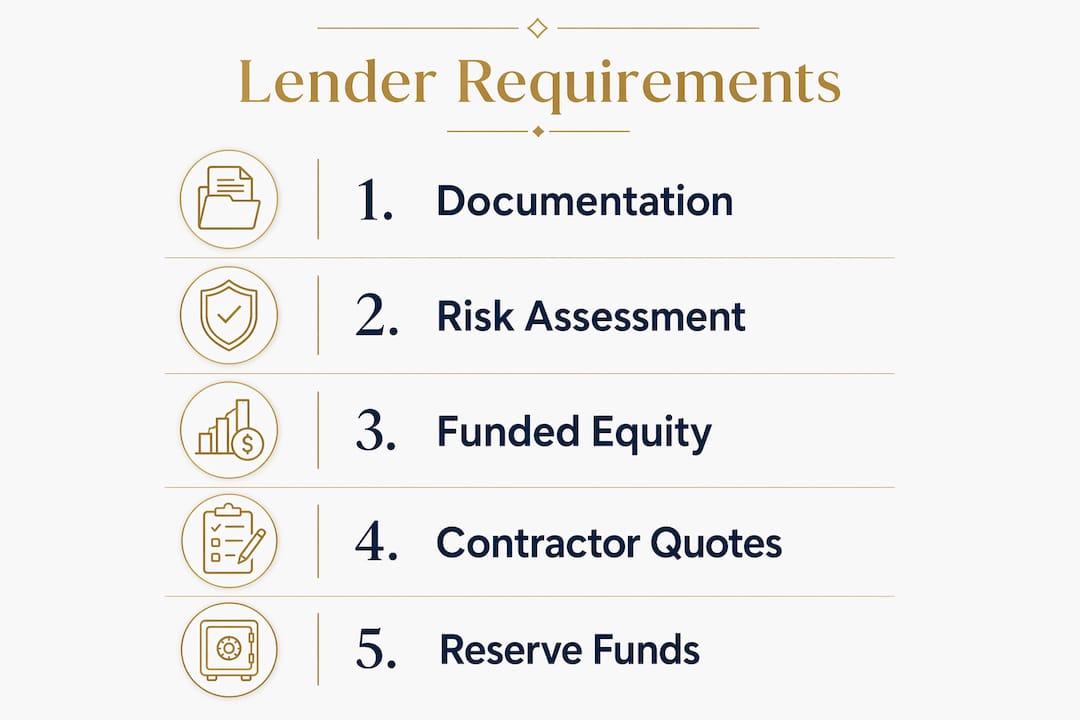
Lender risk assessment at the predevelopment stage focuses on four distinct risk categories. Understanding each one lets you address concerns before they become objections.
Collateral risk is the starting point. Raw land and pre-entitlement sites produce no income, which means lenders apply tighter loan-to-value ratios and higher reserve requirements than they would on stabilized assets. Demonstrating strong equity and cash reserves directly reduces the risk premium lenders price into the loan.
Planning risk is assessed through the status of entitlements. Full planning permission eliminates this risk category entirely. Outline permission reduces it. Pre-application advice from a local planning authority, which costs approximately $650–$2,600, provides written feedback from the authority and materially improves lender confidence even before formal approval is granted.
Construction risk centers on contractor experience and contract structure. Lenders favor fixed-price or guaranteed maximum price contracts with experienced general contractors who carry adequate insurance. A contractor with a thin track record on comparable project types raises underwriting flags regardless of the bid price.
Market risk is evaluated through the GDV and absorption assumptions in your pro forma. Lenders compare your rent or sale price assumptions against current comparable transactions. Aggressive assumptions that cannot be supported by recent comps will be marked down during underwriting, which compresses your apparent profit margin and may push the deal below the 15%–20% threshold.
Consistency across all documents is a separate but critical factor. Discrepancies between cost estimates, planning permissions, and sales schedules are one of the most common causes of lender questions and approval delays. A number that appears in three documents should be the same number in all three.
What steps should developers take to meet lender predevelopment requirements?
Preparation is the variable that separates developers who close quickly from those who spend months in underwriting. The following steps address the most common failure points.
- Establish a dedicated liquidity source for predevelopment expenses. Underbudgeting predevelopment costs is a leading cause of capital stack failures. A business line of credit or committed equity fund reserved exclusively for predevelopment prevents you from drawing on construction loan proceeds prematurely.
- Engage planning authorities before you apply for financing. Pre-application consultations reduce planning risk and produce written feedback you can include in your lender package. This step alone can shorten underwriting timelines.
- Build a thorough, consistent project appraisal. Your appraisal should incorporate build contingencies, realistic absorption timelines, and a clearly stated GDV with supporting comparable sales or lease data. Treat it as a legal document, not a marketing deck.
- Secure multiple contractor quotes and a quantity surveyor report. Two or three competitive bids on the exact scope validate your construction cost line. An independent quantity surveyor report adds a layer of credibility that single-source quotes cannot provide.
- Prepare complete financial disclosures upfront. Personal financial statements, entity documents, tax returns for the past two years, and bank statements covering at least three months should be ready before your first lender meeting. Incomplete disclosures are the most avoidable cause of delays.
- Work with advisors who understand lender scrutiny. Developers who engage experienced construction financing advisors early in the process submit cleaner packages and encounter fewer underwriting surprises. The cost of professional guidance is small relative to the cost of a delayed or declined loan.
- Build a milestone-based use-of-funds schedule. A detailed, milestone-based schedule aligned with project timelines increases lender confidence and facilitates smoother disbursements. Map every draw request to a specific deliverable, such as permit issuance, foundation completion, or framing inspection.
Pro Tip: Treat predevelopment as a distinct financing phase with its own budget, timeline, and funding source. Developers who separate predevelopment funding from construction loan proceeds avoid the refinancing gaps that stall projects at the worst possible moment.
Key Takeaways
Meeting predevelopment costs lender requirements demands fully funded equity, complete documentation, and consistent financial modeling before any construction loan can close.
| Point | Details |
|---|---|
| Predevelopment cost range | Budget 3%–7% of total project cost for predevelopment, plus a 5%–10% build contingency. |
| Equity must be fully funded | Lenders require written proof that predevelopment costs are covered by equity before construction loan closing. |
| Profit margin threshold | Your development appraisal must show a 15%–20% profit margin on GDV to pass lender underwriting. |
| Liquidity reserves required | Hold 6–12 months of carrying costs in reserve to satisfy lender requirements on non-income-producing collateral. |
| Document consistency is critical | Discrepancies across cost estimates, planning documents, and schedules are a leading cause of approval delays. |
What I’ve learned about predevelopment financing after years of watching deals stall
The most expensive mistake I see developers make is treating predevelopment as an afterthought. They focus all their energy on the construction loan and assume the early costs will sort themselves out. They rarely do.
The developers who close fastest share one habit: they build a complete, internally consistent loan package before they contact a single lender. Every number ties out. Every document references the same project timeline. The quantity surveyor report matches the contractor bids. The appraisal supports the GDV. When a lender opens that package, there are no loose threads to pull.
What surprises most developers is how much weight lenders place on planning risk. A pre-application consultation with the local planning authority costs a few thousand dollars and a few weeks. It produces written feedback that can cut weeks off your underwriting timeline and improve your loan terms. That is one of the highest-return investments in the predevelopment phase, and most developers skip it.
The other pattern I see consistently: developers who structure predevelopment financing as a separate, early funding phase avoid the dangerous gap between predevelopment completion and construction loan closing. Developers who blur the two phases often find themselves short of funds at exactly the moment lenders are doing their deepest scrutiny. Keeping the phases clean is not just good accounting. It is a signal to lenders that you understand how capital stacks work.
— Jerry
How Brookmontcapital helps developers satisfy predevelopment lender standards
Brookmontcapital structures financing for developers who need to meet rigorous predevelopment cost requirements without losing time to incomplete packages or mismatched lender expectations.
Brookmontcapital’s advisory team works with sponsors to organize equity documentation, stress-test pro formas, and source the right capital for each phase of a project. For developers who need short-term capital to cover early-stage expenses before a construction loan closes, bridge loan solutions provide the liquidity to keep the predevelopment phase funded and on schedule. For larger projects requiring permanent capital structures, CMBS loan options align with the long-term financing needs that follow a successful predevelopment phase. Brookmontcapital connects sponsors with institutional lenders, debt funds, and equity partners who understand development timelines and underwrite accordingly. Contact Brookmontcapital to structure your predevelopment capital stack before your next lender conversation.
FAQ
What percentage of total project cost are predevelopment expenses?
Predevelopment costs typically account for 3%–7% of total project cost. Lenders require this amount to be fully funded through equity before a construction loan can close.
What DSCR do lenders require for development loans?
Most construction lenders underwrite to a minimum debt service coverage ratio of approximately 1.25x at stabilized occupancy. Your pro forma must demonstrate this coverage using conservative rent or sale price assumptions.
How many contractor quotes do lenders require?
Lenders require 2–3 competitive contractor bids on the exact project scope. A single-source quote without an independent quantity surveyor report is a common cause of approval delays.
Why do lenders require 6–12 months of carrying cost reserves?
Raw land and pre-entitlement sites produce no income, which increases underwriting risk. Lenders require 6–12 months of reserves covering property taxes and loan payments to offset that risk.
What profit margin must a development appraisal show?
Lenders expect a minimum profit margin of 15%–20% on Gross Development Value. Projects showing thinner margins are viewed as unable to absorb cost overruns or a market downturn, and are typically declined.
Recommended
- Construction Lender Underwriting Criteria: 2026 Guide | Brookmont Capital Ventures
- How to Get Your CRE Deal Funded in 2026: What Lenders Actually Want to See | Brookmont Capital
- Construction Loan Requirements for Developers | Brookmont Capital Ventures
- The 2026 CRE Refinancing Wall: What Investors With $500K-5M Projects Need to Know Now