
Phased Construction Financing: A Developer’s Guide

Phased construction financing is defined as a funding structure where loan capital is released in predefined stages tied to verified construction milestones, rather than disbursed as a single upfront sum. Known formally as staged drawdown development finance, this method gives lenders controlled exposure while giving developers access to capital precisely when construction progress demands it. Staged drawdowns reduce total interest costs by 30%–40% compared to full upfront funding, because interest accrues only on disbursed funds. For real estate developers managing multi-phase builds, that difference compounds meaningfully across a 24–36 month loan term.
What is phased construction financing and how is it structured?
Phased development financing is structured in one of two ways: a single facility with multi-stage drawdowns tied to milestones, or separate loan facilities for each distinct phase of a project. The single-facility model is more common for mid-size developments. It keeps the capital stack cleaner and reduces legal costs, but requires a lender comfortable holding exposure across the full project timeline.
The drawdown schedule itself typically runs through 5–8 defined stages. These stages follow the physical progress of the build:
- Land acquisition or site preparation — Initial funds released at loan close, covering site costs and mobilization.
- Substructure completion — Foundations and below-grade work verified before release.
- Superstructure completion — Frame, floors, and roof structure signed off.
- First fix — Mechanical, electrical, and plumbing rough-in confirmed.
- Second fix and finishes — Interior fit-out and finishes inspected.
- Practical completion — Final certification triggers the last tranche and releases retention.
Each release requires sign-off from an Independent Monitoring Surveyor (IMS), a third-party inspector appointed by the lender to verify that work matches the approved program and cost plan. IMS fees typically run $600–$1,800 per visit. Lenders also commonly hold back 10% retainage until practical completion, so developers must plan for that gap in available funds.
The IMS certification process takes 10–14 days after a drawdown request is submitted. That window matters for cash flow planning, particularly when contractor payment terms are tight.

Pro Tip: Budget IMS fees into your project cost plan from day one. A project with seven drawdowns can accumulate $6,000–$12,000 in monitoring surveyor costs alone, and lenders will not absorb that expense.
What are the financial advantages of phased construction loans?
The most direct financial benefit of staged drawdown financing is interest cost reduction. Interest accrues only on drawn funds and compounds into the loan balance, payable at exit alongside principal. This rolled-up interest model preserves developer liquidity during the non-revenue construction phase, when no rental or sales income is flowing.
The key financial advantages of phased construction financing include:
- Lower total interest expense. Drawing $2 million in stages over 18 months costs far less in interest than drawing the full amount at close, even at the same rate. Typical construction loans are floating-rate at SOFR plus 275–400 basis points, structured for 24–36 months, and lend up to 65% of cost or 55% of gross development value (GDV).
- Reduced lender exposure per phase. Lenders limit their committed capital to verified progress, which tightens underwriting risk and often produces better loan terms for disciplined developers.
- Capital recycling across phases. Lenders now require developers to demonstrate how proceeds from early-phase sales will fund equity contributions for later phases. A well-structured capital recycling plan is no longer optional. It is a lender requirement.
- Preserved working capital. Because interest rolls up rather than requiring monthly cash payments, developers retain liquidity for contractor draws, contingency, and overhead during construction.
Pro Tip: When presenting your capital recycling plan to a lender, model at least two scenarios: one where Phase 1 sales hit 80% of pro forma, and one where they hit 60%. Lenders who see stress-tested capital flow between phases will move faster and offer better terms.
What are the common challenges in managing phased construction financing?
The most persistent operational problem in phased financing is timing misalignment. Drawdown release processes take 10–14 days after a request is submitted, but contractor payment terms rarely accommodate that lag. Developers who do not plan for this gap often bridge it with personal funds, which creates liquidity stress and can damage contractor relationships.
Beyond timing, lenders impose conditions that can pause or block funding entirely:
- Planning certainty requirements. Lenders will fund Phase 1 on outline planning permission, but subsequent phases require reserved matters approval before lender commitment is confirmed. If approvals are delayed, funding stops.
- Cross-phase dependency risk. Lenders require clear definitions of how early-phase infrastructure connects to later phases. If Phase 1 utilities or access roads are needed for Phase 2, that dependency must be documented and approved before Phase 2 funding is released.
- Cost overrun exposure. Phased structures do not automatically protect against budget creep. Developers must maintain a contingency reserve, typically 10%–15% of hard costs, to absorb overruns without triggering lender default provisions.
The best practice for managing these risks is proactive, documented communication with both the lender and the IMS. Do not wait for a drawdown request to surface problems. Flag delays, cost variances, and planning issues early. Lenders respond far better to advance notice than to surprises at the drawdown stage.
Pro Tip: Assign one person on your team as the dedicated lender liaison. Consistent, single-point communication reduces approval friction and builds the lender confidence that speeds up future drawdown releases.
How does phased financing compare to other construction financing options?
Phased construction financing is not the right structure for every project. Understanding where it fits relative to other methods helps developers select the right tool for each deal.
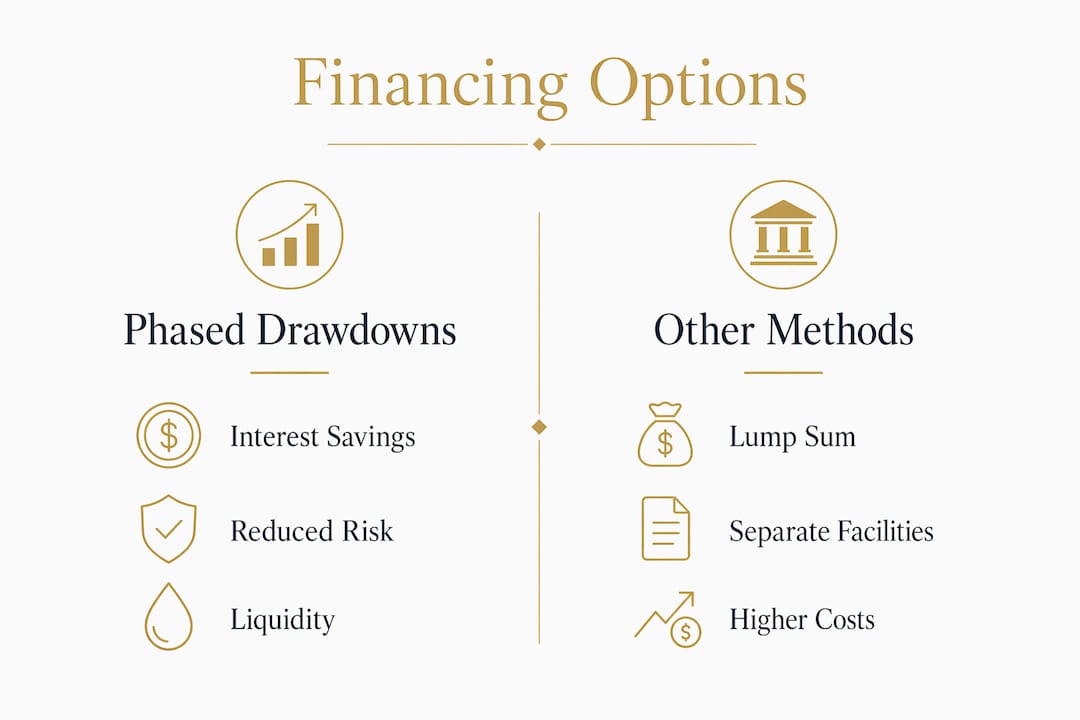
| Feature | Phased staged drawdowns | Lump-sum upfront disbursement | Separate facilities per phase |
|---|---|---|---|
| Interest cost | Lower (accrues on drawn funds only) | Higher (full balance from day one) | Moderate (reset per facility) |
| Lender risk exposure | Controlled per milestone | Full exposure at close | Segmented by phase |
| Monitoring requirements | IMS required at each stage | Minimal post-close monitoring | IMS required per facility |
| Best suited for | Multi-phase builds, 30+ units | Small single-phase builds | Large phased master plans |
| Planning certainty needed | All phases at commitment | Single phase only | Phase-by-phase as built |
| Capital recycling | Required by lenders | Not applicable | Structured per facility |
Lump-sum disbursement works for smaller, single-phase builds where the full scope is defined, the timeline is short, and the developer has the balance sheet to absorb full interest from day one. For larger multi-phase projects, that model is capital-inefficient and exposes the lender to risk they cannot monitor incrementally.
Separate facilities per phase offer the most flexibility for large master-plan developments, but they carry higher legal and structuring costs. Each facility requires its own underwriting, documentation, and IMS appointment. Developers who choose this path should work with an advisor experienced in construction financing for developers to sequence facilities correctly and avoid gaps in funding coverage between phases.
Key Takeaways
Phased construction financing reduces total interest expense, controls lender risk, and preserves developer liquidity by tying capital releases to verified construction milestones.
| Point | Details |
|---|---|
| Staged drawdowns cut interest costs | Interest accrues only on disbursed funds, reducing total cost by 30%–40% versus lump-sum funding. |
| IMS sign-off drives every release | Budget $600–$1,800 per visit and plan for 10–14 day approval windows before each drawdown. |
| Planning certainty is non-negotiable | Lenders require reserved matters approval for each phase before committing funds beyond Phase 1. |
| Capital recycling must be documented | Lenders require a formal plan showing how early-phase proceeds fund equity for subsequent phases. |
| Timing misalignment is the top operational risk | Build a cash buffer to cover contractor payments during the 10–14 day drawdown processing lag. |
What I’ve learned about phased financing that most guides won’t tell you
Most developers I speak with understand the mechanics of phased construction financing well enough. Where they consistently underestimate the complexity is in the lender relationship itself. Lenders have become far more forensic in how they analyze cross-phase dependencies. A vague reference to “Phase 2 infrastructure” in your appraisal no longer satisfies underwriting. You need a documented dependency map that shows exactly what Phase 1 must deliver for Phase 2 to proceed, and what happens to the capital plan if Phase 1 runs 90 days late.
The second blind spot is IMS management. Developers treat the monitoring surveyor as a lender-appointed obstacle. The smarter approach is to treat the IMS as a project ally. Brief them before each inspection. Walk the site with them. When the IMS understands your program and trusts your reporting, certifications move faster and drawdown delays shrink. That relationship is worth more than any legal clause you can negotiate.
The third issue is planning certainty. I have seen well-capitalized developers lose momentum on Phase 2 because they assumed outline permission was sufficient for lender commitment. It is not. Reserved matters approval for each phase is the threshold that unlocks funding. Build your planning timeline backward from your drawdown schedule, not the other way around. If you need Phase 2 funds in month 18, you need reserved matters approval by month 14 at the latest.
Phased financing rewards developers who plan with discipline and communicate with precision. The structure itself is not complicated. Executing it well requires treating every lender condition as a project milestone, not an administrative task.
— Jerry
Brookmontcapital’s approach to phased construction financing
Brookmontcapital works with real estate developers and sponsors nationwide to structure and source construction financing solutions tailored to phased development projects. Whether you need a single facility with staged drawdowns or separate facilities sequenced across a multi-phase master plan, Brookmontcapital connects you with institutional lenders, debt funds, and equity partners who understand the complexity of milestone-based funding.
From bridge loans that cover gaps between phases to CMBS loan structures for stabilized phases of larger developments, Brookmontcapital structures the capital stack to match your project timeline and lender requirements. Contact Brookmontcapital to discuss your phased development financing needs and get terms that reflect your project’s actual risk profile.
FAQ
What is phased construction financing in simple terms?
Phased construction financing is a loan structure where funds are released in stages as construction milestones are verified, rather than disbursed all at once. This reduces total interest costs because interest accrues only on the capital that has been drawn.
How many drawdown stages does a typical phased construction loan have?
Most phased construction loans involve 5–8 drawdown stages, covering key milestones from substructure through practical completion. Each stage requires Independent Monitoring Surveyor certification before funds are released.
Why do lenders require an Independent Monitoring Surveyor?
Lenders appoint an IMS to independently verify that construction progress matches the approved program and cost plan before releasing each tranche of funds. IMS fees typically run $600–$1,800 per visit and are a standard cost in development finance drawdowns.
What planning approvals do lenders require for phased projects?
Lenders will fund Phase 1 on outline planning permission, but reserved matters approval is required for each subsequent phase before lender commitment is confirmed. Delays in planning approvals directly pause funding for later phases.
How does capital recycling work in phased development financing?
Capital recycling means using proceeds from early-phase sales to fund the equity contribution required for later phases. Lenders now require a formal capital recycling plan that demonstrates how cross-phase capital flows sustain the project through completion.