
Negotiate Commercial Loan Terms: A Developer’s Playbook

To secure materially better commercial-loan economics and structural protection, enter negotiations with a prioritized list of 3–4 high-impact concessions, at least two competing term sheets as your BATNA, and clearly defined walk-away points established before you sit across from any lender.
Your immediate next steps:
- Run a 3–5 lender RFP before engaging any single lender in substantive negotiations. Competing term sheets are the single most critical factor in creating negotiation leverage — without alternatives, you have minimal bargaining power.
- Set walk-away terms in writing — rate ceiling, maximum fees, guaranty structure, and minimum extension conditions — before your first call with a lender’s credit team.
- Prepare redlines and market comps to present at the term-sheet stage, not after the commitment letter is issued.
- Prioritize in this order: IO period and amortization structure, extension conditions, prepayment structure, guaranty carve-out scope, reserves, then rate. Focused asks preserve political capital and close deals faster than negotiating every line.
The term sheet is where your leverage peaks. Once a lender issues a formal commitment letter, your ability to extract structural concessions drops sharply — and most developers discover this too late.
Table of Contents
- Which loan provisions should developers negotiate first?
- How do you build real leverage before signing a term sheet?
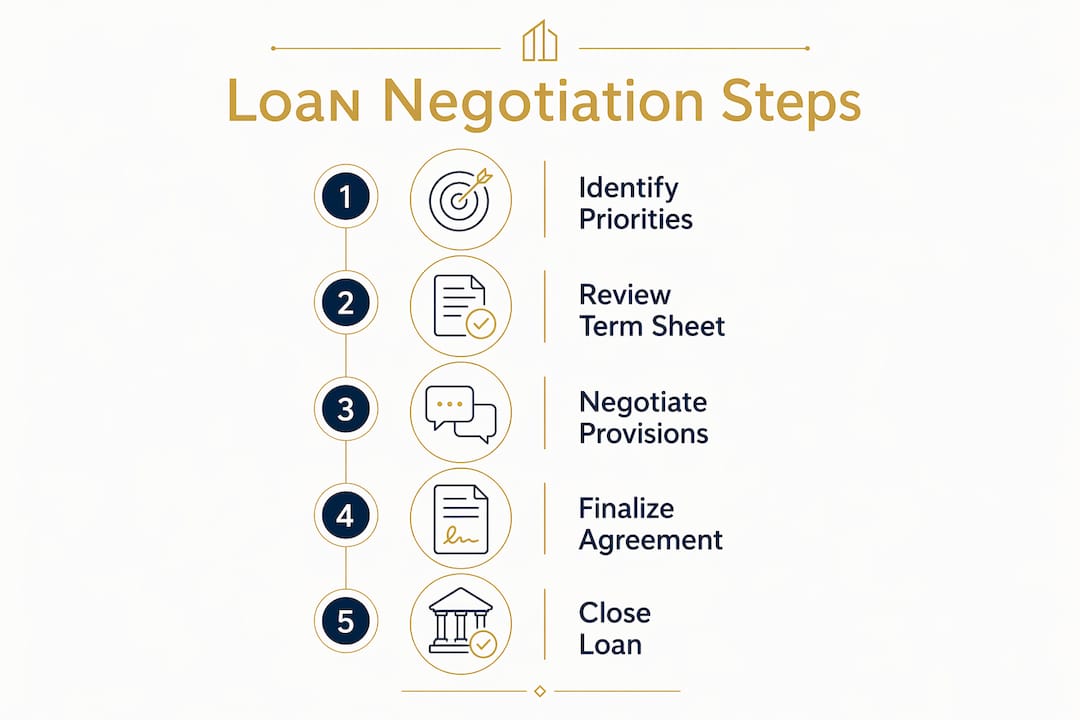
- What is the right tactical sequence for loan negotiations?
- Sample redline language developers can propose to lenders
- What red flags should developers watch for in loan negotiations?
- What does a realistic negotiation timeline look like?
- What closing and post-closing obligations should developers prepare for?
- Key Takeaways
- The terms that actually determine your outcome
- Brookmontcapital helps developers secure better loan terms faster
- Authoritative sources and further reading
Which loan provisions should developers negotiate first?
Understanding which clauses actually move the needle separates experienced developers from those who spend political capital on basis points while conceding the provisions that will cost them six figures over the loan’s life.
Interest pricing and spreads
Lenders price commercial loans off a benchmark — typically SOFR for floating-rate products or the corresponding Treasury for fixed — plus a spread reflecting credit risk, property type, and market conditions. The spread is negotiable, but the realistic range is narrower than most developers expect. A stronger negotiating position comes from demonstrating a clean pro forma, conservative loan-to-value, and a credible exit strategy rather than simply demanding a lower number. Current commercial interest rates directly affect both approval thresholds and payment calculations, so know the market before you walk in.

Fees and origination
Origination fees, application fees, processing fees, and commitment fees all compound the effective cost of capital. Push for a single, clearly defined origination fee and eliminate duplicative processing or underwriting charges. Commitment fees are often non-refundable; negotiate the terms and the conditions under which they are credited toward closing costs.
Prepayment structure
This is where developers routinely leave money on the table. Yield maintenance and defeasance are lender-friendly structures that can make early repayment prohibitively expensive — particularly on opportunistic value-add or development projects with uncertain exit timing. Push for a step-down prepayment schedule (e.g., 5-4-3-2-1% declining annually) or, ideally, open prepayment after a lock-out period. For construction and bridge loans, negotiate for open prepayment after stabilization.
Maturity, extensions, and extension conditions
Extension options are worth more than most developers realize, especially in a volatile rate environment. The key is the trigger for exercising the extension. Push for occupancy-based or executed-lease tests instead of trailing DSCR tests, which may not reflect actual asset performance during lease-up. For bridge loan extensions, negotiate the extension fee (typically 0.25%–0.50%) and the notice period simultaneously.
Amortization and IO periods
An interest-only period at loan origination materially improves early cash flow and reduces the risk of a DSCR covenant breach during stabilization. Lenders will grant IO periods more readily when LTV is conservative and the sponsor’s track record is strong. Prioritize the IO period ahead of rate negotiations — the cash-flow impact is often larger.
Covenants: financial, reporting, and construction
Financial covenants (minimum DSCR, minimum liquidity, maximum LTV) should include appropriate cushions above the actual projected performance. A DSCR covenant set at 1.20x when your pro forma shows 1.22x is a technical default waiting to happen. Negotiate cushions of at least 10%–15% above projected performance. Reporting covenants — frequency of financial statements, rent rolls, and inspection rights — should be limited to what the lender genuinely needs to monitor credit quality, not a blanket right to demand any document at any time.
Guaranty and recourse structure
Personal guarantees are the most powerful borrower lever in commercial real estate lending — often saving more money and risk than any rate movement. The standard lender position is a full recourse guaranty during construction, burning off to a “bad-boy” carve-out guaranty upon stabilization. Push for a defined burn-off: full recourse converts to limited recourse upon certificate of occupancy, and the limited guaranty itself burns off entirely upon achieving a specified DSCR (e.g., 1.25x for two consecutive quarters). Bad-boy carve-outs should be narrowly defined — fraud, intentional misrepresentation, voluntary bankruptcy, and environmental contamination — not broad catch-all language that converts the loan to full recourse on a technical default.
Pro Tip: Negotiate the guaranty burn-off at the term-sheet stage. Once a commitment letter is issued, lenders treat the guaranty structure as settled, and reopening it in loan documents is an uphill battle.
Reserves, escrows, and construction draws
Reserve requirements — tax and insurance escrows, replacement reserves, operating reserves — represent real capital that is locked up and unavailable for project operations. Negotiate the funding schedule (upfront vs. monthly contributions), the release conditions, and the lender’s approval rights over disbursements. For construction loans, the draw schedule and inspection milestone language are often more consequential than the headline rate. Push for objective, pre-agreed inspection milestones, clear draw windows of a reasonable duration from submission, and a contingency line of a moderate percentage of hard costs that you control without triggering a lender “balancing” call.
Transfer, assignment, and change-of-control provisions
Lenders routinely include broad restrictions on transfers of ownership interests, changes in the managing member or general partner, and assignments of the loan. These provisions can block recapitalizations, equity raises, or sponsor succession events. Negotiate carve-outs for transfers among existing principals, transfers to affiliates or controlled entities, and transfers upon death or incapacity of a key principal. Change-of-control definitions should be limited to transfers that actually change day-to-day management control, not passive equity transfers.
Environmental indemnities, title, and insurance
Environmental indemnities in lender-form documents are often broader than the underlying risk warrants. Negotiate to limit the indemnity to conditions that arise from the borrower’s own operations, exclude pre-existing conditions identified in the Phase I or Phase II report, and cap the indemnity at the loan amount. Title endorsements and insurance requirements should be reviewed by counsel to eliminate redundant or unavailable endorsements that create closing risk without adding real protection.
How do you build real leverage before signing a term sheet?
Leverage in commercial loan negotiations is not manufactured at the negotiating table — it is built in the weeks before you engage any single lender seriously.
- Run a structured RFP to 3–5 lenders simultaneously. A financing sources checklist helps you identify the right lender mix: balance-sheet banks, debt funds, bridge lenders, and CMBS conduits each have different risk appetites and structural preferences. Competing term sheets give you a credible BATNA and force each lender to sharpen their terms.
- Use relationship banking as a non-rate lever. Moving operating deposits, committing future origination pipeline, or consolidating a portfolio of loans with a single balance-sheet lender can unlock structural concessions or faster underwriting that a pure rate negotiation cannot achieve. Relationship banking levers — deposits, portfolio volume, future deal flow — are particularly effective with community banks and regional institutions.
- Offer speed and underwriting transparency. Lenders value certainty of close. A borrower who delivers a clean, well-organized loan package — current rent rolls, audited financials, a detailed construction budget with contingency, and a credible exit analysis — reduces the lender’s underwriting risk and earns goodwill that translates into structural flexibility.
- Map the lender’s decision-making hierarchy before negotiations begin. Know whether the credit committee, a regional manager, or a portfolio officer has final authority over structural terms. Relationship officers often cannot grant structural concessions without credit committee approval; directing your redlines to the right person saves time and avoids the frustration of negotiating with someone who lacks authority to say yes.
Pro Tip: Set your internal walk-away point — maximum rate, minimum IO period, guaranty structure, and extension conditions — before your first substantive conversation with any lender. Pressure-driven concessions made at the table are almost always regretted. The ABA’s borrower negotiation guidance consistently identifies pre-defined limits as the single most effective protection against unfavorable outcomes.
Understanding lender types — and how each one’s balance-sheet constraints, securitization requirements, and credit culture affect their flexibility — lets you target the right institutions for your specific project and negotiate from a position of informed confidence rather than guesswork.
What is the right tactical sequence for loan negotiations?
A focused negotiation playbook — sequencing the most important terms first, leading with data, and bundling minor concessions — keeps the process efficient and raises the probability of a favorable outcome.
Stage 1: Term-sheet negotiation (structural terms first)
- Negotiate recourse structure, extension conditions, transfer restrictions, and prepayment structure at the term-sheet stage. These are the provisions where your leverage is highest and where lender flexibility is greatest before a commitment fee is paid.
- Present redlines as a prioritized package, not a line-by-line list. Frame each ask with a market comp: “Our comparable transactions show step-down prepayment is standard for bridge loans of this profile” carries more weight than a bare request.
- The term-sheet stage is when the borrower has the most leverage; once a commitment letter is issued, that leverage drops significantly. Treat the term sheet as the deal, not a preliminary document.
Stage 2: Economic terms
- Once structural protections are agreed, negotiate rate, fees, and reserve requirements. Bundling several smaller economic asks into a single package — “We’ll accept the origination fee as proposed if you reduce the replacement reserve to $X per unit and extend the IO period to 24 months” — increases the lender’s willingness to concede without opening the door to incremental reversal.
- Use strategic silence after making a request. Stating your position and waiting — rather than immediately softening or elaborating — is one of the most effective negotiation techniques available, and one of the least used.
Stage 3: Loan document negotiation
- Bring experienced real estate finance counsel into the process before the commitment letter is issued, not after. Counsel who reviews the commitment letter can identify provisions that will become entrenched in loan documents and flag issues that are far easier to resolve at the term-sheet stage.
- When presenting redlines to underwriters or credit committees, organize comments by materiality: lead with the two or three provisions that are genuine deal points, and separate them clearly from conforming or clarifying edits. A redline that buries material asks in a sea of minor comments signals inexperience and slows the process.
- Know when to invoke the BATNA. If a lender refuses to move on a structural provision that is material to your business plan, a brief, factual reference to a competing term sheet — “We have a competing proposal that addresses this differently” — is more effective than repeated argument.
Who to involve at each stage:
- Capital advisor: RFP management, lender selection, term-sheet comparison, and redline strategy
- Real estate finance counsel: commitment letter review, loan document negotiation, and closing coordination
- Sponsor/principal: walk-away decisions, relationship calls with senior lender contacts, and final approval of material concessions
Sample redline language developers can propose to lenders
These clause templates give you a starting point for instructing counsel or framing an email to a lender’s credit team. Adapt them to your specific transaction and have counsel review before use.
Limited guaranty burn-off language:
- “The Guaranty shall automatically convert from a full recourse guaranty to a limited recourse guaranty (covering only the Carve-Out Obligations defined herein) upon the earlier of: (i) issuance of a final certificate of occupancy for the Project, or (ii) achievement of a Debt Service Coverage Ratio of not less than 1.25x for two consecutive calendar quarters, as certified by Borrower and confirmed by Lender within 30 days of receipt of supporting documentation.”
Step-down prepayment language (borrower-friendly alternative to yield maintenance):
- “Prepayment of the Loan shall be permitted at any time upon not less than 30 days’ prior written notice, subject to a prepayment premium equal to: (i) 3% of the outstanding principal balance if prepaid during Loan Year 1; (ii) 2% if prepaid during Loan Year 2; (iii) 1% if prepaid during Loan Year 3; and (iv) no premium thereafter. Yield maintenance and defeasance provisions shall not apply.”
Extension condition language (occupancy/lease test replacing trailing DSCR):
- “Borrower’s right to exercise the Extension Option shall be conditioned upon: (i) no Event of Default then existing; (ii) physical occupancy of not less than 85% of the net rentable area of the Project as of the Extension Date; and (iii) executed leases covering not less than 80% of the net rentable area, with terms extending at least 12 months beyond the Extended Maturity Date. The trailing DSCR test shall not apply as a condition to the exercise of the Extension Option.”
Construction draw / inspection milestone language:
- For construction financing, push for: “Lender shall approve or deny each Draw Request within 10 Business Days of receipt of a complete Draw Package. Inspection milestones shall be pre-agreed in the Construction Schedule attached hereto as Exhibit A and shall not be modified without Borrower’s written consent. The Contingency Line shall be available to Borrower for cost overruns without triggering a Lender balancing call, provided total project costs do not exceed the Approved Budget by more than 10%.”
Reserve reduction / lender approval timeframe language:
- “Operating Reserve deposits shall be reduced by 50% upon achievement of a Debt Service Coverage Ratio of 1.20x for one full calendar quarter. Lender approval of any Borrower request under this Section shall be deemed granted if Lender fails to respond in writing within 15 Business Days of receipt of a complete request package.”
What red flags should developers watch for in loan negotiations?
Structural traps and process warning signs are easier to avoid when you know what to look for before you’re deep into a deal.
Structural red flags:
- Yield maintenance or defeasance on a short-term or bridge loan. These exit-cost structures are appropriate for long-term fixed-rate CMBS or agency debt, not for opportunistic or value-add strategies where the exit timeline is uncertain. A CMBS loan with defeasance provisions can make an early sale or refinance economically irrational.
- Overly broad bad-boy carve-out language. Carve-outs that convert the loan to full recourse upon any “material” default — rather than the standard enumerated events — expose the sponsor to unlimited personal liability on a technical breach.
- Punitive cash-sweep triggers. A cash management structure that sweeps all property income into a lender-controlled account upon a DSCR test failure — even a temporary one during lease-up — can starve the project of operating capital and accelerate a default spiral. Negotiate a cure period and a minimum operating account balance before any sweep activates.
- Rising CRE loan delinquency trends in certain asset classes mean some lenders are tightening covenant packages mid-cycle; understanding current delinquency trends helps you anticipate where lenders will be least flexible.
Process red flags:
- A lender unwilling to provide term-sheet comparables or market context for their pricing is either inexperienced or pricing above market.
- Rushed exclusivity requests — “sign this term sheet by Friday or we move on” — before you have had time to run a proper RFP are a pressure tactic designed to eliminate your BATNA before you build one.
- Opaque underwriting timelines with no defined credit committee schedule make it impossible to plan your closing window and give the lender unilateral control over your timeline.
Negotiation mistakes:
- Negotiating every line item. Lenders track which borrowers fight over every comma; it signals inexperience and consumes goodwill you need for material asks.
- Ignoring extension conditions until closing. Extension triggers are almost always negotiable at the term-sheet stage and almost never negotiable once the commitment letter is signed.
- Failing to set a walk-away point. Counsel and advisors consistently identify this as the most common and costly negotiation mistake developers make.
Pro Tip: Common construction financing errors — including inadequate contingency lines and vague draw mechanics — are detailed in Brookmontcapital’s construction financing mistakes guide. Review it before finalizing any construction loan term sheet.
What does a realistic negotiation timeline look like?
Planning your closing window around a realistic timeline prevents the time pressure that erodes leverage at the worst possible moment.
| Phase | Typical Duration | Key Activities |
|---|---|---|
| RFP and lender outreach | 1–2 weeks | Distribute loan package to 3–5 lenders; collect initial indications |
| Term-sheet receipt and comparison | 1–2 weeks | Evaluate competing term sheets; select preferred lender(s) |
| Term-sheet negotiation | 1–3 weeks | Redline structural terms; confirm walk-away points; finalize term sheet |
| Commitment letter and diligence | 3–5 weeks | Appraisal, environmental report, title search, survey, lender underwriting |
| Loan document negotiation | 2–4 weeks | Counsel-led document review; resolve open items with lender counsel |
| Closing preparation | 1–2 weeks | Final title endorsements, insurance certificates, payoff letters, draw docs |
| Total (typical range) | 9–15 weeks | Varies by lender type, asset complexity, and market conditions |
Typical costs to budget:
- Legal fees (borrower’s counsel) vary depending on deal complexity and document volume
- Appraisal costs vary depending on property type and size
- Phase I environmental report costs vary; Phase II reports, if triggered, are more expensive
- Survey costs vary depending on property and location
- Origination fee: typically 0.5%–1.5% of loan amount
- Commitment fee: often a percentage of the loan amount, sometimes non-refundable
- Extension fees (if exercised) often represent a small percentage of outstanding balance per extension.
Time pressure is a lender’s most underrated negotiating tool. When a developer is racing against a purchase contract deadline or a construction start date, the lender knows it — and structural concessions become harder to extract. Build a 2–4 week contingency buffer into your closing timeline and begin the RFP process earlier than feels necessary.
What closing and post-closing obligations should developers prepare for?
Closing is not the finish line — it is the beginning of a monitoring relationship that lasts the life of the loan.
Closing checklist (key deliverables):
- Payoff letters and lien releases for any existing debt on the property
- ALTA survey certified to lender, title company, and borrower
- Title insurance commitment with all required endorsements (ALTA 3.1, 9, 22, and others as specified)
- Insurance certificates naming lender as additional insured and loss payee
- Construction draw package (for construction loans): executed contracts, budget, schedule, architect’s certificate
- Organizational documents, good-standing certificates, and authority resolutions for all borrower entities
- Environmental indemnity agreement, executed by all required indemnitors
- Executed guaranty agreements with all required guarantors
Post-closing monitoring obligations:
- Financial reporting: most commercial loans require quarterly rent rolls, annual operating statements, and annual financial statements for the borrower entity and guarantors. Negotiate the format (GAAP vs. cash-basis), the delivery deadline (typically 60–90 days after period end), and the consequences of late delivery.
- Reserve funding: confirm the schedule for funding tax and insurance escrows, replacement reserves, and any operating or debt service reserves. Understand the conditions under which reserves are released and the lender’s approval rights over disbursements.
- DSCR testing: know the testing frequency (quarterly or annually), the calculation methodology (trailing 12 months vs. annualized current period), and the cure period if a test is failed. A 30–60 day cure period with a right to inject equity or pay down principal is standard and worth negotiating explicitly.
- Lender inspection rights: limit inspection rights to reasonable advance notice (typically 48–72 hours) and reasonable frequency (no more than twice annually absent an event of default). Broad, unannounced inspection rights create operational disruption and should be narrowed in loan documents.
Negotiate cure periods and notice windows for potential covenant breaches before closing, not after a breach occurs. A 30-day notice period followed by a 30-day cure period — with an additional 60-day extension for breaches that require third-party action to cure — is a reasonable and achievable standard in most commercial loan negotiations.
Key Takeaways
Developers who negotiate commercial loan terms with a prioritized list of structural concessions, competing term sheets, and pre-defined walk-away points consistently secure materially better outcomes than those who focus primarily on rate.
| Point | Details |
|---|---|
| Prioritize structural terms over rate | Negotiate IO period, extension conditions, prepayment structure, and guaranty carve-outs before spending capital on basis points. |
| Build your BATNA before engaging | Run a 3–5 lender RFP to generate competing term sheets; without alternatives, your bargaining power is minimal. |
| Term sheet is your peak leverage point | Structural protections secured at the term-sheet stage are far harder to extract after a commitment letter is issued. |
| Set walk-away points in advance | Define rate ceiling, maximum fees, and minimum guaranty structure before negotiations begin to prevent pressure-driven concessions. |
| Brookmontcapital sources competing term sheets | Brookmontcapital’s advisory team structures the RFP process, compares lender proposals, and advises on redlines to help developers secure optimal terms. |
The terms that actually determine your outcome
Most developers I work with come into a loan negotiation focused on rate. That instinct is understandable — rate is visible, easy to compare, and feels like the primary cost of capital. But in practice, the provisions that determine whether a deal succeeds or fails over a three-to-five year hold are almost never the rate. They are the guaranty burn-off, the extension conditions, the draw mechanics, and the prepayment structure.
The reason is straightforward: rate affects your monthly debt service by a predictable, calculable amount. A bad guaranty structure, on the other hand, can expose a sponsor to unlimited personal liability on a technical default that has nothing to do with the asset’s performance. An extension condition tied to a trailing DSCR test can force a costly refinance — or a distressed sale — during a lease-up period when the asset is physically performing well but the income hasn’t yet stabilized. A yield maintenance provision on a bridge loan can make an otherwise profitable exit economically irrational.
The developers who consistently negotiate better outcomes do three things differently. They enter the process with a written, internally agreed list of the 3–4 provisions they will not concede. They run a real RFP — not a courtesy call to their existing bank — before engaging any single lender seriously. And they bring counsel into the process at the term-sheet stage, not after the commitment letter is signed and the lender considers the deal done.
The term-sheet stage is genuinely the moment of maximum leverage. A lender who has not yet received a commitment fee is still competing for your business. That window is shorter than most developers realize, and the structural concessions available in that window are not available later.
Brookmontcapital helps developers secure better loan terms faster
When you are managing a complex construction or bridge financing, the difference between a good outcome and a great one often comes down to how many lenders you are talking to and how well your redlines are framed. Brookmontcapital’s advisory team does exactly that work: sourcing 3–5 competing term sheets from institutional lenders, debt funds, and balance-sheet banks; structuring the capital stack to optimize leverage and minimize guaranty exposure; and advising on redline strategy so your counsel is working from a position of market knowledge, not guesswork.
Developers working on multi-lender processes, ground-up construction, or deals where they need leverage fast benefit most from engaging Brookmontcapital early — before the RFP goes out, not after a single lender has already set the terms of the conversation. The firm’s financing solutions span bridge loans, construction financing, DSCR loans, CMBS, preferred equity, and full capital stack advisory — which means the team can evaluate your entire capital structure, not just the senior debt. Submit your project details for a consultation and get a structured view of your financing options and negotiation position before you sign anything.
Authoritative sources and further reading
Before redlining any loan document, share these resources with your counsel and capital advisor:
- ABA — Negotiating the Loan Agreement: The Borrower’s Perspective: The American Bar Association’s practitioner-level guide to commercial loan negotiation from the borrower’s side. Essential reading for counsel preparing commitment letter redlines.
- Practical Law — Commercial Real Estate Loan Agreement Toolkit (Thomson Reuters)): A comprehensive legal toolkit covering standard loan agreement provisions, negotiation notes, and drafting guidance. Particularly useful for counsel reviewing CMBS and construction loan documents.
- Best Practices in Commercial Real Estate Financing: The Borrower’s Agenda in Negotiating Loan Documents: A detailed practitioner paper covering the full spectrum of borrower negotiation issues from commitment letter through closing — one of the most thorough single-document resources available.
- Land Development Loans: The Complete Financing Guide for Developers and Builders: Practical guidance on extension provisions, prepayment structures, and draw schedule negotiation for land and development loans.
- Brookmontcapital Insights: The firm’s blog covers construction financing mechanics, lender types and their negotiation tendencies, and how commercial real estate financing works — useful context to share with your capital advisor before the RFP goes out.
This article provides general information about commercial loan negotiation strategies and is not legal or financial advice. Confirm current market terms, legal requirements, and loan provisions with qualified real estate finance counsel and a licensed capital advisor for your specific transaction.
Recommended
- Commercial vs. Residential Real Estate Loans: Key Differences | Brookmont Capital Ventures
- Bridge Loan Benefits for Developers: 9 Key Advantages | Brookmont Capital Ventures
- How Lenders Underwrite Mixed Use Projects: A Developer’s Guide | Brookmont Capital Ventures
- How to Get Your CRE Deal Funded in 2026: What Lenders Actually Want to See | Brookmont Capital