
Land Acquisition Financing Strategies: 2026 Expert Guide

Effective land acquisition financing strategies come down to one decision made early: matching your financing structure to the land type, development stage, and your own borrower profile before you ever approach a lender. The wrong instrument costs you time, equity, or the deal itself. The right one positions you to close efficiently, preserve liquidity, and carry the asset through entitlement or development on terms you can actually service.
The primary categories available to investors and developers in 2026 are:
-
Direct bank loans: Conventional land loans requiring strong credit and a substantial down payment, suited for improved or entitled parcels.
-
SBA 504 and 7(a) loans: Government-backed programs for owner-occupant business expansions, offering lower equity requirements
-
Hard money and private bridge loans: Asset-based, short-term financing with relatively high interest rates for time-sensitive acquisitions
-
Seller financing: Negotiated directly with the landowner, typically requiring a moderate down payment with flexible terms
-
Equity partnerships: A partner funds the purchase in exchange for a profit split at sale or refinance.
Each path carries a distinct cost of capital, approval timeline, and risk profile. The sections below break down how each structure works, what lenders require, and how to position your deal for the best possible outcome.
Land acquisition financing strategies: types and structures
The financing instrument you choose shapes every downstream decision, from your debt service coverage ratio to your exit timeline. Understanding the structural mechanics of each option is the foundation of any sound property acquisition plan.
SBA 504 Loans are built for owner-occupant business acquisitions. The SBA 504 structure splits financing with 50% from a conventional lender, up to 40% from a Certified Development Company backed by the SBA, and as little as 10% borrower equity if the business occupies at least 51% of the property. Terms run up to 25 years, fully amortizing, with rates near prime. The trade-off is a slow approval process requiring extended government review.

SBA 7(a) Loans offer more flexibility. The 7(a) program can finance land acquisition alongside construction costs and working capital in a single package, making it well-suited for franchise operators or businesses building a new facility from the ground up.
Conventional bank land loans sit in the middle of the risk spectrum. Lenders require strong credit and a 20–50% down payment, a documented land use plan, and a clean appraisal. Rates in 2026 run roughly 8%–12% depending on land type and borrower profile, as detailed in the Construction Loan Interest Rates 2026 Guide. Approval takes 45–90 days.

Hard money and private bridge loans prioritize speed over cost. These instruments close in as few as 7–21 days, secured primarily by the property’s value rather than the borrower’s credit history. The cost reflects that speed: rates between 10% and 18% with loan-to-value ratios of 50%–65%. They work best as a bridge to conventional or construction financing once entitlements are secured.
Seller financing keeps the transaction between buyer and seller. The landowner carries the note, typically at rates below bank levels, with down payments of 10%–30% and faster closings than any institutional lender can offer. Terms are negotiable, which is the primary advantage for raw or unimproved parcels where banks are reluctant to lend.
Equity partnerships eliminate monthly debt service entirely. A capital partner funds the full purchase price and closing costs, takes title, and splits the profit at sale, often on a 60/40 or 70/30 basis. This path suits investors with strong deal-sourcing ability but limited liquidity.
What lenders actually require: qualification criteria and loan terms
Lenders treat undeveloped land as a non-performing asset. No income is generated, no structure secures the collateral, and entitlement risk is real. That risk calculus drives every qualification threshold you will encounter.
The baseline for conventional land loans is a credit score of 680 or higher, along with verified income, a documented land use plan, and a professional appraisal. SBA programs carry similar credit expectations but allow lower equity contributions for qualifying owner-occupants. Hard money lenders focus almost entirely on the asset’s value, making credit score less determinative, though a clear exit strategy is non-negotiable.
| Loan Type | Min. Credit Score | Typical Down Payment | Interest Rate Range | LTV |
|---|---|---|---|---|
| Conventional bank loan | 680+ | 20%–50% | 8%–12% | 50%–65% |
| SBA 504 / 7(a) | 680+ | As low as 10% | Near prime, competitive | Up to 90% |
| Hard money / bridge | Flexible | 20%–50% | 10%–18% | 50%–65% |
| Seller financing | Negotiable | 10%–30% | Negotiable, often below bank | Negotiable |
Land loans typically carry short-term terms with balloon payments at maturity, unlike the 30-year amortization of a residential mortgage. SBA loans are the exception, offering longer terms. Planning your exit before you sign is not optional; a balloon payment with no refinancing path or sale in place is how deals go sideways.
To improve your creditworthiness before applying, pay down revolving balances to reduce your debt-to-income ratio, resolve any outstanding liens, and compile at least two years of personal and business tax returns. Lenders want to see that your financial position supports the carry, not just the down payment.
Best practices for financing land acquisitions successfully
Preparation separates investors who close on favorable terms from those who accept whatever the first lender offers. The deals that get done efficiently share a common thread: the borrower arrived with a complete package and a clear narrative.
- Prepare a detailed land use plan before approaching any lender. Zoning designation, intended use, development timeline, and exit strategy all belong in this document.
- Order a professional boundary survey and title insurance early. Institutional and private lenders will not close without confirmed legal access and clear chain of title, and discovering a title defect late in the process kills deals.
- Structure your proposal around phased drawdowns. Developers who propose tailored loan structures with interest-only periods aligned to entitlement timelines consistently secure better terms than those accepting off-the-shelf products.
- Balance equity contribution with liquidity. Tying up all available capital in a single cash purchase limits your ability to pursue multiple acquisitions simultaneously. Financing preserves optionality.
- Record seller financing contracts immediately. Failing to record the contract with a licensed title company exposes you to third-party liens and ownership disputes, a risk that experienced investors eliminate on day one.
- Negotiate balloon payment timing to align with your entitlement or sale milestone, not the lender’s default schedule.
Pro Tip: Engage a capital advisory firm before you submit a loan application. A firm with institutional lender relationships can identify the right product for your specific deal, structure the proposal to match your entitlement timeline, and often secure pricing that a direct bank approach will not produce.
Real-world scenarios: how financing structure affects deal outcomes
Numbers make the trade-offs concrete. Consider a $200,000 rural parcel with $7,000 in soft costs, held for 24 months and sold for $290,000.
- All cash: $207,000 deployed, no interest cost, full profit retained. The buyer keeps approximately $83,000 at sale, but capital is fully tied up for two years.
- Bank land loan (30% down): $60,000 down plus $7,000 soft costs, $140,000 borrowed at 9.5%. Interest over 24 months runs approximately $25,500. Net profit at sale: approximately $57,500.
- Seller financing (15% down): $30,000 down plus $7,000 soft costs, $170,000 carried at 8%. Interest over 24 months runs approximately $25,800. Net profit: approximately $57,200.
- Equity partnership: Zero capital deployed. The partner funds the full $207,000, takes title, and splits profit 60/40 at sale. The investor’s share: approximately $33,200 with no monthly carry and no capital at risk.
The all-cash path maximizes absolute profit but concentrates capital. Financing preserves liquidity at the cost of interest. The equity partnership produces the lowest dollar return but requires nothing out of pocket, making it the right structure for an investor with strong sourcing ability and limited capital. Your borrower profile and pipeline depth determine which path fits.
For development projects, phased drawdown structures deserve serious consideration. Rather than drawing the full loan at closing, you draw capital in tranches tied to entitlement milestones, paying interest only on deployed funds. This approach reduces carry cost during the entitlement period and aligns debt service with actual project progress.
Why location and entitlements drive lender decisions
Location and entitlement status are not soft factors. They are the primary variables lenders use to assess collateral risk on undeveloped land, and they directly influence the rate, LTV, and term you will be offered.
Entitled land, meaning parcels with approved zoning, confirmed utility access, and road frontage, qualifies for materially better loan conditions than raw, unimproved acreage. Lenders view entitlements as de-risked collateral because the path to development is legally confirmed. Raw land, by contrast, carries zoning uncertainty, utility extension costs, and approval timelines that can stretch 6–18 months, all of which compress LTV and push rates higher.
Key factors lenders verify before committing to any land loan:
- Zoning status: Current designation and any pending reclassification
- Utility access: Water, sewer, and electrical availability at the parcel boundary
- Road access: Legal ingress and egress, confirmed by survey
- Environmental status: Phase I environmental assessment for any commercial acquisition
- Comparable sales: Recent arm’s-length transactions in the submarket to support appraisal
Research local planning department timelines before you underwrite the deal. A jurisdiction with an 18-month entitlement backlog changes your carry cost calculation entirely. Build that timeline into your pro forma before you negotiate the purchase price.
Preparing your documentation and repayment plan
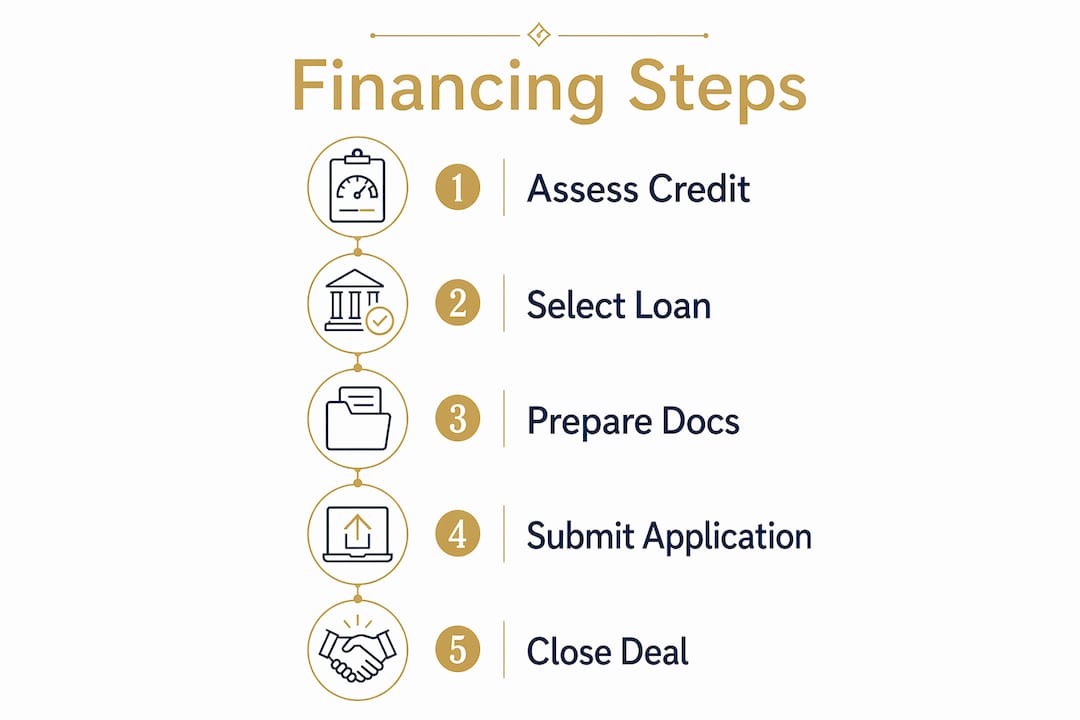
Land acquisition typically runs 9 steps from search to closing, taking 30–90 days for most financed deals, with fees outside the purchase price running 2%–5% of the transaction value. Arriving at the lender with complete documentation compresses that timeline and signals professional credibility.
Critical documents every lender will require:
- Fully executed purchase agreement with contingency periods clearly defined
- Professional boundary survey and ALTA title commitment
- Zoning verification letter from the local planning authority
- Two years of personal and business tax returns plus current financial statements
- Detailed project budget covering land cost, soft costs, contingency (typically 10%–15%), and closing fees
- Pro forma projections showing the project’s expected profitability and exit timeline
Repayment planning deserves as much attention as the acquisition itself. Most land loans mature in 2–5 years with a balloon payment, which means your exit strategy must be defined before you close. The two primary paths are a sale of the entitled or improved parcel, or a refinance into a construction loan once development approvals are in place. Engage a title company and a financing advisor early in the process. Discovering a title issue or a documentation gap two weeks before closing is a costly problem that early engagement prevents.
How Brookmontcapital structures optimal land acquisition financing
Brookmontcapital approaches land acquisition financing as a capital stack design problem, not a loan placement exercise. Every deal starts with a clear understanding of the project’s entitlement timeline, the borrower’s liquidity position, and the intended exit, then works backward to identify the right combination of debt, equity, and bridge capital to get there efficiently.
The firm’s institutional lender relationships produce pricing and terms that direct bank approaches rarely match, particularly for complex deals involving raw land, phased development, or time-sensitive closings. For acquisitions where speed is the priority, bridge financing can close in days rather than months, preserving the deal while longer-term capital is arranged.
Key principles Brookmontcapital applies to land acquisition mandates:
- Align loan structure to entitlement milestones, not arbitrary calendar dates, to minimize unnecessary carry cost
- Design the capital stack from the permanent financing backward, so the acquisition loan transitions cleanly into construction or take-out financing
- Use phased capital deployment to keep interest cost proportional to actual project progress
- Leverage institutional relationships to access competitive pricing unavailable through retail bank channels
- Incorporate bridge capital strategically for time-sensitive acquisitions, with a defined refinancing path built into the structure from day one
For developers and investors managing multiple acquisitions, Brookmontcapital’s capital stack advisory provides a coordinated view across the portfolio, identifying where capital can be recycled and where new financing structures create the most value.
The basic structure of acquisition financing
Acquisition financing is the debt or equity capital used specifically to purchase an asset, in this case land, before any development activity begins. The structure typically consists of a senior loan secured by the land itself, a borrower equity contribution, and in some cases a mezzanine or preferred equity layer that fills the gap between the senior loan and the required down payment.
The senior loan is sized based on the lender’s LTV threshold for the specific land type. Improved, entitled parcels support higher LTV ratios and lower rates. Raw land compresses both. The equity contribution is the borrower’s skin in the game, and lenders treat it as a direct signal of commitment and financial capacity. Mezzanine capital, when used, carries a higher cost than senior debt but allows the borrower to reduce the cash equity requirement at closing.
How acquisition financing works in practice
A land acquisition loan closes against the purchase price of the parcel, with the lender taking a first-lien position on the title. The borrower pays interest on the outstanding balance during the loan term, either as a fixed monthly payment or as interest-only, depending on the structure negotiated. At maturity, the balloon payment comes due, requiring the borrower to either sell the asset, refinance into a construction loan, or pay off the balance from other capital sources.
The lender’s underwriting process evaluates the collateral value through an independent appraisal, confirms title and legal access through a survey and title search, and assesses the borrower’s financial capacity through credit review and income verification. Approval timelines vary by loan type: hard money closes in 7–21 days, conventional bank loans in 45–90 days, and SBA programs in 60–120 days due to the additional government review layer.
How your financial statements affect financing approval
Lenders treat your financial statements as a window into your ability to service debt and absorb unexpected costs. For land loans, where the collateral generates no income, the borrower’s financial strength carries more weight than it would in a cash-flowing property acquisition.
The documents that matter most are your last two years of personal and business tax returns, a current personal financial statement showing assets and liabilities, and business bank statements covering at least three to six months. Lenders calculate your debt-to-income ratio from these documents and compare it against their underwriting thresholds. A high existing debt load relative to income will compress the loan amount you qualify for, regardless of your credit score.
Cash flow analysis matters particularly for developers with active projects. A lender reviewing your file wants to see that existing debt obligations are being serviced without strain and that you have sufficient liquidity to cover the down payment, closing costs, and several months of carry without depleting reserves. Presenting a clean, well-organized financial package signals competence and reduces the lender’s perceived risk, which translates directly into better pricing.
Risks in land acquisition financing and how to mitigate them
Land acquisition carries a distinct risk profile compared to income-producing property. The primary risks are entitlement failure, market value decline, carrying cost overrun, and title defects. Each can be managed with the right preparation.
- Entitlement risk: Zoning approvals can be delayed or denied. Mitigate by conducting thorough due diligence on local planning timelines and building contingency periods into your purchase agreement.
- Market value decline: Land values are more volatile than stabilized property values. Mitigate by underwriting conservatively, using a stressed sale price in your pro forma rather than the optimistic case.
- Carrying cost overrun: Balloon payments arrive whether your project is on schedule or not. Mitigate by aligning loan maturity with realistic entitlement and sale timelines, and maintaining a liquidity reserve.
- Title defects: Undiscovered liens, easements, or boundary disputes can delay or kill a closing. Mitigate by ordering a professional boundary survey and title insurance before you commit capital.
- Interest rate exposure: Variable-rate land loans expose you to rate increases during the hold period. Mitigate by locking a fixed rate where available or sizing your debt service coverage with a rate stress test.
What land acquisition financing actually costs
The purchase price is only part of the capital commitment. Fees, closing costs, and carrying expenses add up quickly, and underestimating them is one of the most common mistakes in land acquisition underwriting.
Typical cost categories to budget:
- Origination fees: 1%–3% of the loan amount, paid at closing
- Appraisal and survey: $2,000–$5,000 depending on parcel size and complexity
- Title insurance and closing costs: Typically 1%–2% of the purchase price
- Due diligence costs: Environmental assessments, zoning reviews, and legal fees, often 1%–3% of the purchase price
- Carrying costs: Monthly interest payments during the hold period, which on a $200,000 loan at 10% run approximately $1,667 per month
- Contingency reserve: Budget 10%–15% of total project costs for unexpected expenses
For a commercial real estate financing transaction, the total cost of acquisition, including all fees and carry, should be modeled in your pro forma before you negotiate the purchase price. A deal that looks profitable at the headline price can erode quickly once origination fees, carry, and closing costs are fully accounted for. Knowing your all-in cost basis is the discipline that separates disciplined underwriting from wishful thinking.
Key Takeaways
Effective land acquisition financing requires matching the loan structure to the land type, entitlement status, and borrower profile before approaching any lender.
| Point | Details |
|---|---|
| Match financing to land type | Entitled land qualifies for better LTV and lower rates than raw, unimproved parcels. |
| Know your loan terms | Most land loans carry 2–5 year terms with balloon payments; SBA programs extend up to 25 years. |
| Hard money fills speed gaps | Hard money and bridge loans close in 7–21 days at 10%–18% interest, best used as a bridge to permanent financing. |
| Document early and completely | Boundary surveys, title insurance, and a detailed pro forma are required by all institutional lenders before closing. |
| Model all-in costs | Origination fees, carry, due diligence, and closing costs typically add 2%–5% of the purchase price to your total basis. |
Brookmontcapital serves real estate developers, investors, and sponsors nationwide. If you are structuring a land acquisition and need a capital partner who understands how to align loan structure with your entitlement timeline and exit strategy, explore financing solutions or connect with the advisory team directly.
Recommended
- Acquisition Financing in Real Estate: 2026 Investor Guide | Brookmont Capital Ventures
- Construction Lender Underwriting Criteria: 2026 Guide | Brookmont Capital Ventures
- How to Finance a Value-Add Multifamily Deal | Brookmont Capital Ventures
- How to Get Your CRE Deal Funded in 2026: What Lenders Actually Want to See | Brookmont Capital