
How Syndicators Source Institutional Debt in 2026

Institutional debt sourcing is defined as the structured process by which real estate syndicators identify, engage, and close financing with institutional capital providers such as private credit funds, insurance companies, and pension funds. As of 2026, institutional lenders now dominate the $5M–$50M commercial real estate loan segment, effectively replacing traditional banks for most non-bank credit structures. Understanding how syndicators source institutional debt means understanding a managed transaction process, not a casual capital raise. Syndicators who treat it as the former close deals. Those who treat it as the latter lose lender appetite before the first term sheet.
How syndicators source institutional debt: the step-by-step process
Sourcing institutional debt follows a defined sequence. Skipping steps does not accelerate the deal. It kills it.
-
Prepare an institutional-grade due diligence package. Successful syndicators prepare audited financials, a clear use of proceeds, credible exit strategies, and a fully documented capital stack before contacting a single lender. This package signals that you operate at an institutional standard, which is the minimum threshold for serious lender engagement.
-
Identify and approach target lenders. Not every institutional lender fits every deal. Syndicators map lenders by asset class preference, loan size appetite, and geography before outreach. A multifamily bridge deal goes to a different desk than a ground-up industrial construction loan.
-
Maintain or pursue “approved lender” status. Firms with deep sponsor relationships see a steady cadence of leveraged buyouts, add-ons, refinancings, and recapitalizations. Approved lender status accelerates timing and market access. It is not a formality. It is a competitive advantage that shortens your closing timeline by weeks.
-
Run a disciplined bookbuilding process. Bookbuilding is the phase where syndicators gauge lender demand, form the syndicate, and manage allocations. Syndicators are expected to run advisor-supported bookbuilding processes that mirror institutional standards. The lead arranger anchors the deal. Syndicate participants fill the remaining allocation.
-
Negotiate terms and close. Once the book is covered, the lead arranger and borrower negotiate final pricing, covenants, and structural protections. Speed at this stage depends entirely on the quality of preparation in step one.
Pro Tip: Build your due diligence package before you have a deal under contract. Lenders reward sponsors who arrive ready. Sponsors who scramble for documents after lender outreach signal operational weakness.
How do syndicators balance sponsored vs. non-sponsored deals?

The distinction between sponsored and non-sponsored institutional debt is one of the most underappreciated variables in syndication funding strategy. Each path carries real trade-offs.
Sponsored deals involve a private equity firm or institutional sponsor co-signing the transaction. Key characteristics:
- Faster execution because lenders already know the sponsor’s credit profile and track record
- Access to dedicated origination teams at major private credit funds
- Lower pricing transparency since the sponsor relationship does the heavy lifting on trust
- Lenders accept tighter structural protections because the sponsor backstops execution risk
Non-sponsored deals are direct-lending transactions where the syndicator approaches lenders without a private equity co-sponsor. Non-sponsored transactions offer higher pricing and better structural protections for lenders, but they require more transparency from sponsors and often involve longer closing timelines. That higher pricing cuts both ways. Lenders earn more. Borrowers pay more.
- More rigorous underwriting scrutiny from lenders
- Greater transparency requirements on financials, guarantor strength, and exit strategy
- Longer timelines, often 30–60 days beyond a comparable sponsored deal
- Better covenant protections for the lender, which can limit borrower flexibility post-close
Pro Tip: If you are running a non-sponsored deal, front-load your transparency. Provide more documentation than asked for, earlier than expected. Lenders reward proactive disclosure with faster credit committee approvals.
The right path depends on your deal structure, your existing lender relationships, and your timeline. Syndicators with strong private equity partnerships default to sponsored structures. Those building direct lender relationships from scratch often start with non-sponsored deals to establish a track record.
What are the main institutional lender types syndicators target?
The institutional debt market has restructured significantly. Knowing where capital sits in 2026 determines where you direct your outreach.
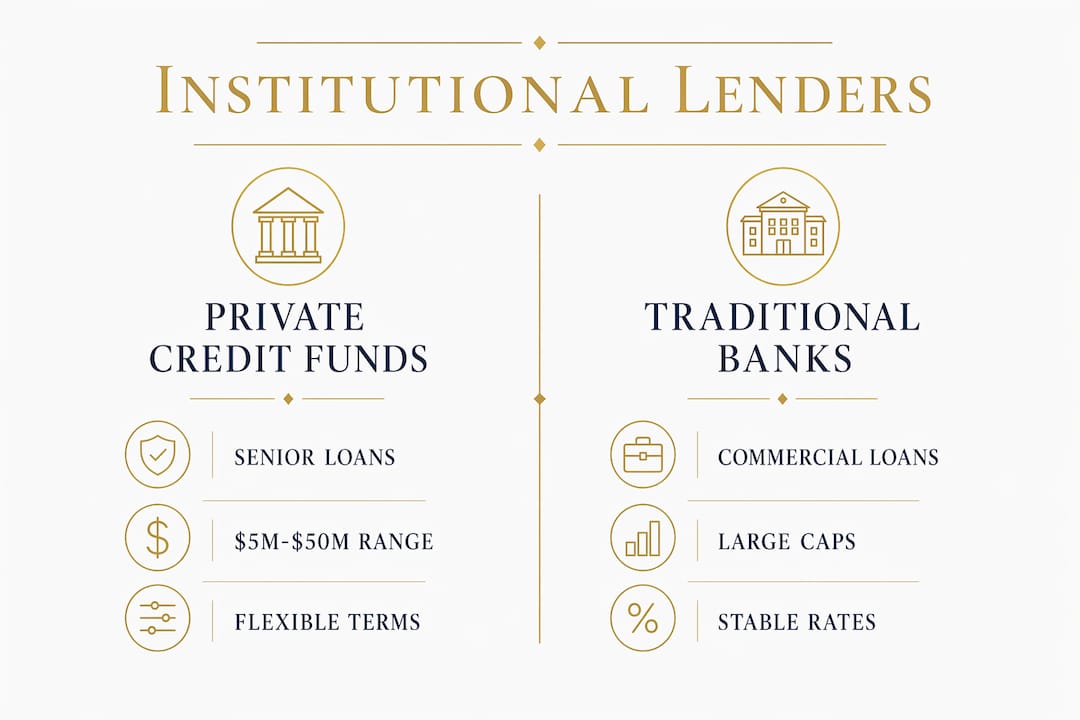
| Lender Type | Primary Focus | Typical Loan Range | Key Advantage |
|---|---|---|---|
| Private credit funds | Senior and mezzanine CRE debt | $5M–$100M+ | Speed and flexibility |
| Insurance companies | Long-term stabilized assets | $20M–$500M | Competitive fixed rates |
| Pension funds | Core and core-plus real estate | $50M+ | Patient capital, low cost |
| Debt funds (non-bank) | Bridge and transitional assets | $5M–$75M | Non-recourse structures |
| Syndicate co-leads | Seed and growth-stage rounds | Varies | Network access, co-investment |
Private credit funds now dominate the $5M–$50M real estate loan segment, replacing traditional banks for most non-bank credit structures. That shift is not cyclical. It reflects a structural change in how commercial real estate debt gets originated and held.
Leading private debt platforms deploy roughly €1 billion annually across combined strategies including senior corporate debt, leveraged loans, and commercial real estate debt. That deployment volume signals the scale at which institutional capital now operates. Syndicators targeting this capital must match that scale with their preparation and process.
Organized syndicates and executive networks increasingly co-lead alongside institutional firms, typically taking 15%–25% of total capital raised while the institutional lead takes 40%–50%. This co-lead structure gives syndicators a path into deals that would otherwise require a larger balance sheet. It also distributes execution risk across multiple parties, which lenders view favorably.
For deals in the $5M–$50M range, institutional real estate capital is returning to commercial real estate with clear preferences: stabilized cash flows, experienced sponsors, and documented exit strategies. Syndicators who fit that profile get meetings. Those who do not get ignored.
What best practices improve success in sourcing institutional debt?
Execution discipline separates syndicators who close institutional deals from those who collect term sheets that never convert.
-
Communicate on a defined schedule during bookbuilding. Sponsors who fail to maintain communication or provide requested data promptly risk losing lender appetite. Set a weekly update cadence with every lender in your book. Do not wait for them to ask.
-
Institutionalize your lender relationships before you need them. Maintaining “approved lender” status accelerates timing and market access. Attend industry conferences, share deal flow updates, and keep lenders informed of your pipeline even when you are not actively raising.
-
Prepare a documented capital stack before lender outreach. Debt syndication requires documented diligence, negotiated risk allocation, and coordinated execution across debt, equity, mezzanine, and bridge capital. Lenders want to see where their piece sits in the stack and what protects them if the deal underperforms.
-
Tailor your financing structure to the asset. A ground-up construction loan requires a different structure than a value-add bridge play. Lenders specialize. Matching your deal structure to the right lender type reduces friction and improves pricing.
-
Protect confidentiality throughout the process. Leaking deal terms or lender conversations to the market destroys trust and can pull lenders out of a live book. Treat every lender conversation as confidential until close.
-
Engage a capital markets advisor for complex deals. For transactions above $10M with layered capital structures, an advisor who maintains active lender relationships adds measurable value. They know which desks are open, which are at capacity, and which are actively seeking your asset class. Reviewing what lenders actually want to see before you approach them saves weeks of wasted outreach.
Key Takeaways
Syndicators who source institutional debt successfully treat every deal as a managed transaction, not an informal capital raise, and they build lender relationships long before they need them.
| Point | Details |
|---|---|
| Preparation drives acceptance | Prepare audited financials, exit strategies, and a full capital stack before contacting any lender. |
| Approved lender status matters | Institutionalizing lender relationships accelerates timing and improves access to the best deals. |
| Sponsored vs. non-sponsored trade-offs | Sponsored deals close faster; non-sponsored deals offer better structural protections but take longer. |
| Private credit dominates the market | Non-bank private credit funds now lead the $5M–$50M CRE loan segment, replacing traditional banks. |
| Communication discipline closes deals | Sponsors who provide data promptly during bookbuilding retain lender appetite and close on schedule. |
What the market shift means for syndicators right now
The most significant change I have observed over the past several years is not the rise of private credit itself. It is how fast lenders have raised their expectations for sponsor preparation. Five years ago, a well-connected syndicator could walk into a lender meeting with a one-page summary and a handshake relationship. That approach does not work anymore.
Private credit funds now operate with institutional-grade credit committees. They expect the same documentation quality from a $10M bridge loan sponsor that a public REIT would deliver on a $200M transaction. The gap between what most syndicators prepare and what lenders actually require is where most deals die.
The second shift I watch closely is the speed advantage that approved lender status creates. Syndicators who invest in lender relationships during quiet periods close deals in 30 days when the market moves. Those who start building relationships when they have a deal under contract spend 90 days chasing a closing that should have taken half that time.
My honest advice: treat your lender network as a capital asset. Maintain it, update it, and invest in it continuously. The syndicators who will win the next cycle are already in weekly contact with the private credit desks that matter.
— Jerry
Brookmontcapital’s approach to institutional debt structuring
Real estate syndicators working on complex capital structures need more than a list of lender contacts. They need a capital markets advisor who knows which institutional desks are actively deploying, what documentation those lenders require, and how to position a deal for the fastest possible execution.
Brookmontcapital works with developers and sponsors nationwide to structure and source commercial real estate financing across bridge loans, CMBS, construction financing, preferred equity, and full capital stack advisory. Whether your deal requires a single institutional lender or a coordinated syndicate, Brookmontcapital connects you with the right capital at the right terms. Reach out to discuss your current deal and get a clear picture of your financing options before your next lender conversation.
FAQ
What does institutional debt sourcing mean for syndicators?
Institutional debt sourcing is the process by which real estate syndicators identify and secure financing from institutional capital providers such as private credit funds, insurance companies, and pension funds. It requires a managed, documentation-heavy approach that mirrors the standards of institutional credit committees.
How long does it take to close institutional debt for a real estate deal?
Closing timelines vary by deal complexity and lender type, but sponsored deals with strong preparation typically close in 30–45 days, while non-sponsored direct-lending transactions often take 60–90 days due to more intensive underwriting requirements.
What do institutional lenders look for in a syndicator’s package?
Institutional lenders require audited financials, a documented capital stack, a clear use of proceeds, and a credible exit strategy. Syndicators who prepare these materials before outreach see significantly higher acceptance rates than those who assemble documents reactively.
What is the difference between a lead arranger and a syndicate participant?
The lead arranger anchors the deal, sets pricing, and manages the bookbuilding process. Syndicate participants fill the remaining allocation, typically taking 15%–25% of the total capital raised while the lead takes 40%–50%.
Why are private credit funds replacing banks for CRE loans?
Private credit funds offer faster execution, more flexible structures, and non-recourse options that traditional banks cannot match under current regulatory constraints. Non-bank lenders now lead the $5M–$50M commercial real estate loan market as a direct result of this structural shift.
Recommended
- Institutional Real Estate Investment 2026: Why Capital Is Returning to CRE
- The 2026 CRE Refinancing Wall: What Investors With $500K-5M Projects Need to Know Now
- Secondary Markets Are the New Primary Markets for Small-Balance CRE Investors in 2026 | Brookmont Capital Ventures
- How to Get Your CRE Deal Funded in 2026: What Lenders Actually Want to See | Brookmont Capital