
How Lenders Underwrite Mixed Use Projects: A Developer’s Guide

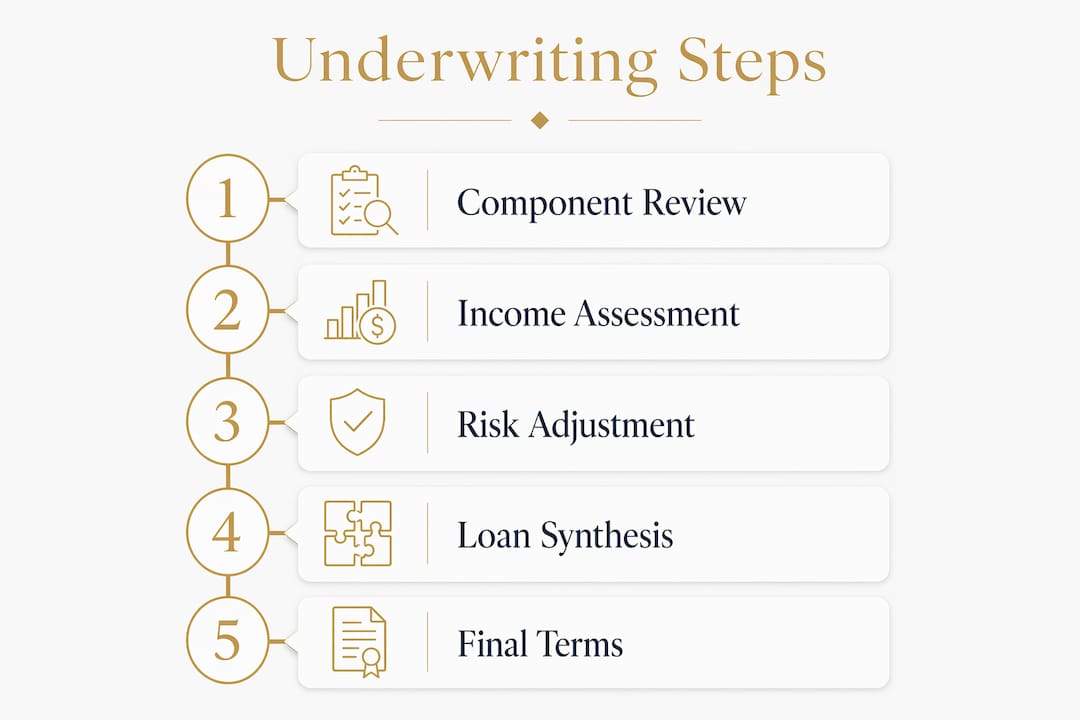
Mixed-use project underwriting is defined as the process of evaluating each income-generating component of a property independently before combining them into a single loan structure. Lenders apply multifamily DSCR logic to residential portions while scrutinizing commercial spaces based on tenant credit quality, lease terms, and local vacancy rates. The blended net operating income that results from this component-by-component analysis drives loan sizing, leverage limits, and risk pricing. Developers who understand how lenders underwrite mixed use projects gain a direct advantage in structuring deals that close on favorable terms.
How lenders underwrite mixed use projects: the core methodology
Lenders treat mixed-use assets as multiple risk categories assessed simultaneously, prioritizing security, exit viability, and borrower capacity in that order. This is not a single underwriting pass. Each income stream gets its own stress test before the results are synthesized into one loan structure.
The residential component typically anchors the senior debt position because it carries more predictable income. The commercial component, whether retail, office, or medical, is evaluated separately and often receives a haircut to its projected income due to perceived market volatility. That haircut reflects the lender’s view that commercial income is less stable than residential rent rolls, particularly in markets with rising vacancy or competing supply.

Lenders also assess synergy between uses, but only when clear demographic and usage alignment exists. A ground-floor coffee shop serving 200 apartment residents above it demonstrates measurable synergy. A luxury boutique in a workforce housing project does not. Misaligned commercial uses are treated as standalone risk, not as a value-add to the residential component.
How do lenders evaluate residential components within mixed-use projects?
The residential portion of a mixed-use project is underwritten using standard multifamily criteria. Lenders validate income using rent comparables, local market surveys, and benchmarks aligned with HUD Fair Market Rents. Vacancy assumptions must reflect realistic lease-up timelines, not best-case projections.
Key residential underwriting factors include:
- DSCR thresholds: A minimum debt service coverage ratio of 1.25x is typical, with higher ratios required in riskier markets
- Rent comparables: Lenders benchmark proposed rents against actual comparable properties within a defined radius
- Vacancy assumptions: Stabilized occupancy projections must align with local absorption rates, not developer targets
- Borrower liquidity: Construction lenders typically require 20–25% equity and post-closing reserves before committing capital
- Lease-up timeline: Lenders stress-test how long it takes to reach stabilized occupancy and whether the capital structure survives that period
Overly optimistic pro formas are the fastest way to lose lender confidence. Underwriters flag projections that exceed market rents by more than a modest margin, and they will recut your numbers using their own comps.
Pro Tip: Submit a rent comparable analysis prepared by a licensed appraiser alongside your pro forma. It signals discipline and reduces the back-and-forth that delays term sheets.
What criteria do lenders use to underwrite commercial portions in mixed-use developments?
Commercial underwriting within a mixed-use asset is more complex than residential because the income is less predictable and the tenant base is smaller. Lenders focus on tenant creditworthiness, lease term security, and the local market’s ability to support the proposed commercial use.
Retail is the most misunderstood component in mixed-use underwriting. Its performance depends on foot traffic, competing supply, parking availability, and compatibility with the residential population above or adjacent to it. A lender underwriting 5,000 square feet of ground-floor retail in a suburban mixed-use project will want to see parking ratios, nearby anchor tenants, and evidence of consumer demand before accepting projected rents at face value.
Commercial underwriting factors lenders prioritize:
- Tenant credit quality: National or regional tenants with investment-grade ratings receive more favorable income treatment than local operators
- Lease term remaining: Leases with fewer than five years remaining at loan maturity create refinance risk
- Local vacancy rates: High market vacancy forces lenders to discount projected commercial income further
- Parking and access: Inadequate parking is a hard underwriting obstacle for retail-heavy mixed-use projects
- Income haircuts: Commercial income is often discounted relative to face rents to account for rollover risk and market softness
Pro Tip: If your commercial space is designed for adaptive reuse, document that flexibility explicitly. Lenders view office-to-medical or retail-to-service conversion potential as a risk mitigant, and it can improve your loan terms.
How do lenders combine residential and commercial underwriting results to determine loan terms?
Once each component is underwritten independently, lenders synthesize the results into a blended net operating income. That blended NOI becomes the basis for loan sizing, and the process is not simply additive. The riskier component pulls down the overall valuation.
Mixed-use loans carry blended cap rates weighted toward the riskiest asset class in the deal. If office income is volatile, it compresses the overall valuation even when the residential component is strong. This is why leverage on mixed-use assets tends to be lower than on comparable single-use properties. Lenders are not penalizing the deal arbitrarily. They are pricing the complexity of managing two or more income streams with different risk profiles under one loan.
The following table illustrates how lenders typically approach blended underwriting across component types:
| Component | Underwriting standard | Key constraint |
|---|---|---|
| Residential (multifamily) | DSCR 1.25x minimum | Stabilized occupancy, rent comps |
| Retail (commercial) | Income haircut applied | Tenant credit, lease term, vacancy |
| Office (commercial) | Higher cap rate applied | Rollover risk, market absorption |
| Blended loan structure | Most conservative constraint governs | Lowest LTV component sets leverage ceiling |
The most conservative underwriting constraint in the deal governs the final loan terms. A developer cannot offset weak commercial underwriting with strong residential performance. The lender’s floor is set by the weakest link in the income stack.
What are key risk factors and common pitfalls developers should anticipate?
Mixed-use underwriting surfaces risks that single-use deals rarely encounter. Developers who anticipate these issues before approaching lenders close faster and on better terms.
-
Title and planning complexity: Lenders prioritize clear title and confirmed planning conditions before cash-flow metrics. Failing to disclose title encumbrances or unresolved zoning conditions early causes financing delays or outright failure during legal review.
-
Unsubstantiated synergy assumptions: Assuming residential and commercial uses will reinforce each other without market evidence is a common valuation error. Lenders only underwrite synergy when demographic and usage alignment is documented.
-
Exit strategy gaps: Developers frequently underestimate exit refinancing risk. Commercial vacancies or weak leases at the refinance date can block access to CMBS or agency permanent loans, leaving the sponsor trapped in expensive bridge debt.
-
Appraisal compliance: Fannie Mae requires appraisals to confirm the property’s legal use, describe each component specifically, and report any adverse impacts to marketability from commercial uses. A non-compliant appraisal stalls the loan process.
-
Optimistic pro formas: Lenders treat aggressive rent and occupancy projections as a credibility problem. Conservative pro formas backed by third-party market data close faster than developer-optimized models.
Pro Tip: Disclose every title issue, planning condition, and legal complexity in your initial loan package. Lenders discover these items during due diligence regardless. Early disclosure signals professionalism and keeps the timeline intact.
How can developers build a financing strategy around underwriting realities?
Understanding lender methodology gives you a clear framework for structuring your deal before you approach the market. The mixed-use financing market is fragmented, and lenders select deals based on their appetite for specific use mixes, geography, and deal complexity. Matching your deal to the right lender is as important as the deal itself.
Practical steps to align your financing strategy with underwriting realities:
- Plan for bridge-to-permanent financing early: Development-to-permanent bridge financing avoids capital structure problems at the refinance stage. Build the bridge loan into your initial capital stack plan, not as an afterthought.
- Select lenders with mixed-use experience: A lender that primarily does single-family or pure multifamily deals will apply the wrong underwriting template to your project. Seek lenders with documented mixed-use transaction history.
- Structure equity to absorb component risk: The capital stack must reflect the risk profile of each component. Preferred equity or mezzanine debt can fill gaps where senior debt leverage falls short due to commercial risk.
- Document adaptive reuse flexibility: If your commercial space can convert between uses, include that in your offering memorandum. Lenders view adaptive reuse flexibility as a direct risk mitigant.
- Prepare a credible market study: Third-party market data on residential demand, commercial absorption, and comparable transactions is not optional. It is the foundation of a credible underwriting submission.
Key Takeaways
Lenders underwrite mixed-use projects by stress-testing each income component independently, then applying the most conservative constraint across all components to set final loan terms.
| Point | Details |
|---|---|
| Component-by-component analysis | Residential and commercial income streams are underwritten separately before being combined into a blended NOI. |
| Commercial income haircuts | Lenders discount commercial income due to rollover risk and market volatility, reducing overall leverage. |
| Conservative constraint governs | The weakest underwritten component sets the leverage ceiling for the entire loan, not the strongest. |
| Exit strategy is underwritten too | Weak commercial leases at refinance can block CMBS or agency loans, trapping sponsors in bridge debt. |
| Lender selection matters | The mixed-use financing market is fragmented; aligning your deal with a lender experienced in your use mix improves outcomes. |
What I’ve learned from watching developers get mixed-use underwriting wrong
The most consistent mistake I see is developers treating mixed-use underwriting as a single-asset exercise. They build one pro forma, apply one cap rate, and present it to lenders as if the residential and commercial components are interchangeable. They are not. A lender underwriting a 100-unit apartment building with 8,000 square feet of ground-floor retail is running two separate analyses before they ever look at your blended numbers.
The second mistake is assuming synergy without proving it. I have reviewed deals where the developer projected a 20% rent premium on residential units because of ground-floor retail. The lender did not underwrite that premium because there was no market evidence to support it. The deal still worked, but the sponsor had to bring more equity than planned because the loan sized to the conservative NOI.
The third mistake, and the one that kills deals at the finish line, is inadequate exit planning. A developer who builds a great project but enters refinance with 30% commercial vacancy will find that CMBS lenders and agency lenders will not touch the deal. That forces a bridge extension at a cost that erodes returns significantly. Planning the exit at the same time you plan the construction is not conservative thinking. It is basic discipline.
The developers who close mixed-use deals efficiently are the ones who walk into the lender meeting with independent underwriting for each component, a realistic blended NOI, a clear exit path, and full disclosure of every legal and planning complexity. That package does not guarantee approval, but it eliminates the delays that kill timelines and erode lender confidence.
— Jerry
Brookmontcapital’s approach to mixed-use project financing
Mixed-use financing requires a lender network that understands the difference between underwriting a retail strip and underwriting a 200-unit apartment building, and the discipline to combine both analyses correctly. Brookmontcapital works with real estate developers and investors nationwide to structure and source commercial real estate financing across bridge loans, construction financing, DSCR loans, CMBS, and preferred equity.
Brookmontcapital connects sponsors with institutional lenders, debt funds, and equity partners who have documented experience with mixed-use assets. The firm structures capital stacks that reflect the actual risk profile of each component, not a one-size-fits-all template. If you are preparing a mixed-use deal and need a financing structure that holds up under lender scrutiny, Brookmontcapital provides the capital markets advisory to get it done.
FAQ
What is the minimum DSCR for a mixed-use project loan?
A DSCR of 1.25x is the typical minimum for mixed-use construction and permanent loans, with higher ratios required in markets with elevated vacancy or commercial risk.
How do lenders treat commercial income in mixed-use underwriting?
Lenders apply an income haircut to commercial rents due to rollover risk and market volatility, which reduces the blended NOI and lowers the maximum loan amount relative to a pure residential deal.
Do lenders underwrite residential and commercial components separately?
Yes. Underwriters apply multifamily DSCR logic to residential portions and analyze tenant credit, lease terms, and vacancy for commercial portions before combining the results into a single loan structure.
What kills mixed-use deals during lender due diligence?
Undisclosed title issues, unresolved planning conditions, and overly optimistic pro formas are the most common causes of financing delays or failures during legal and underwriting review.
Can a strong residential component offset weak commercial underwriting?
No. The most conservative underwriting constraint in the deal governs the final loan terms. A lender will not allow residential income strength to compensate for commercial underwriting weakness when sizing the loan.
Recommended
- Mixed-Use Property Financing | Retail + Residential Loans | Brookmont Capital
- Mixed-Use Development Case Study | Construction Financing | Brookmont Capital
- Construction Lender Underwriting Criteria: 2026 Guide | Brookmont Capital Ventures
- How Does Commercial Real Estate Financing Work? | Brookmont Capital Ventures