
How Lenders Assess Multifamily Syndications in 2026

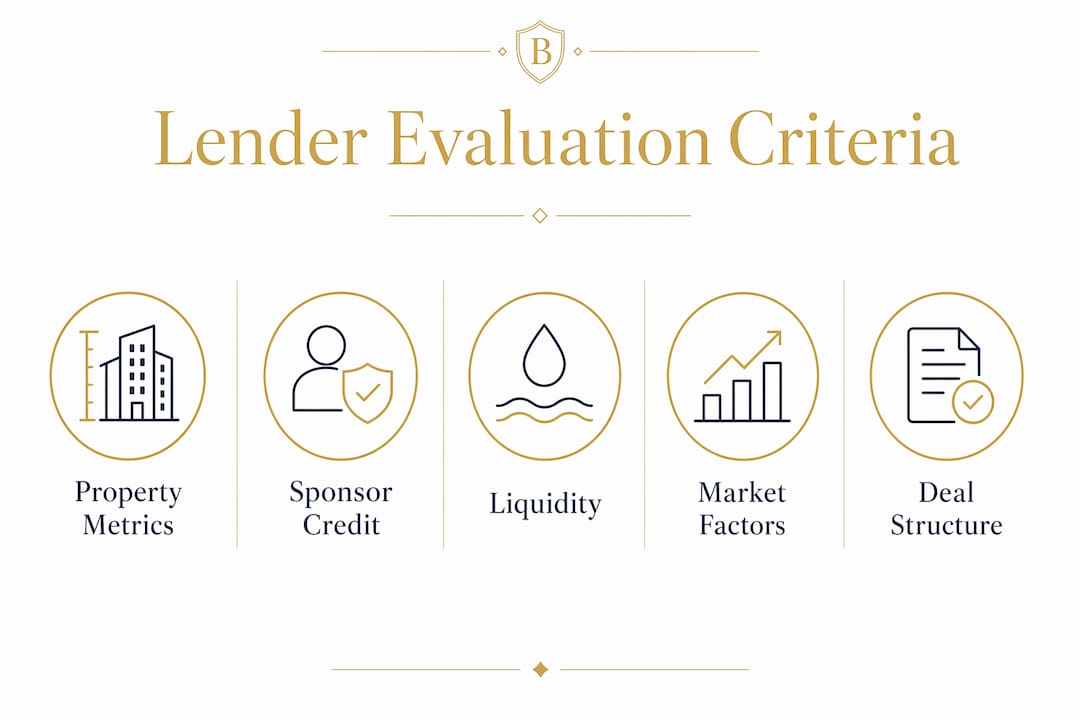
Lender evaluation of multifamily syndications is defined as the process of analyzing a property’s income potential, the borrower’s financial strength, and the sponsor’s execution track record to determine financing eligibility and risk exposure. How lenders assess multifamily syndications covers three distinct layers: quantitative metrics like the Debt Service Coverage Ratio (DSCR) and Loan-to-Value (LTV), qualitative factors like sponsor credibility, and market fundamentals like vacancy rates and local supply pipelines. Brookmontcapital works with sponsors daily who underestimate how much weight lenders place on each layer. Getting all three right is what separates a funded deal from a declined application.
How lenders assess multifamily syndications: key financial metrics
The DSCR is the single most scrutinized number in multifamily syndication underwriting. Most agency lenders require a minimum DSCR of 1.25x and a maximum LTV of 80%, with loans above 1.50x DSCR often receiving better pricing and terms. That gap between 1.25x and 1.50x is not cosmetic. It translates directly into rate reductions, reduced reserve requirements, and faster approvals.
Net operating income (NOI) drives the DSCR calculation. Lenders derive NOI from gross rental income minus vacancy allowances, operating expenses, and property management costs. A common mistake sponsors make is submitting pro forma projections that inflate rents above what a licensed appraiser will certify. Lenders do not use your projections. They use the appraiser’s market rent schedule, and that distinction creates real underwriting gaps on value-add deals.

LTV caps determine how much debt a lender will place on a property. At 80% LTV, a $10,000,000 property supports $8,000,000 in debt. Sponsors must cover the remaining $2,000,000 through equity, which shapes the entire capital stack from day one.
Multifamily syndications target an IRR of 12–18% over a 5–7 year hold period, with exit cap rates set conservatively at or above the going-in cap rate plus 10–20 basis points. Lenders pay close attention to these projections because aggressive exit assumptions signal weak downside protection.
Pro Tip: Run your DSCR at market rents, not projected post-renovation rents. Lenders will apply the appraiser’s figure regardless of your business plan, so knowing the gap early lets you adjust your equity raise before you go to market.
Here is a summary of the core financial thresholds lenders apply:
| Metric | Standard threshold | What it signals |
|---|---|---|
| DSCR minimum | 1.25x | Baseline cash flow coverage |
| DSCR preferred | 1.50x or higher | Better pricing and terms |
| LTV maximum | 80% | Loan sizing ceiling |
| Target IRR | 12–18% | Investor return expectation |
| Hold period | 5–7 years | Exit and refinance planning window |
How do lenders evaluate sponsor creditworthiness and liquidity?
Sponsor financial strength is not secondary to property metrics. Lenders treat it as a parallel underwriting track. Credit scores, liquidity documentation, and reserve balances all receive the same scrutiny as the property’s income statement.
Lenders perform hard credit pulls early in underwriting, and opening new credit lines within 60–90 days before application can materially damage scores and loan terms. That timing error is avoidable, yet it appears repeatedly in declined applications. Sponsors should freeze all new credit activity at least 90 days before submitting a loan package.
Proof of liquidity is typically set at 10% of the loan amount, distributed across general partners. On an $8,000,000 loan, that means $800,000 in verified liquid assets spread among the GP team. Concentration in a single partner’s account raises flags. Lenders want to see that multiple principals can carry the deal if cash flow is delayed.
Reserve requirements add another layer. Post-closing reserves follow a tiered structure: 2 months of PITIA (principal, interest, taxes, insurance, and association dues) for standard loans, 6 months if the loan exceeds $1,500,000, and 12 months if it exceeds $2,500,000. All reserves must sit in verified liquid accounts, not retirement funds or illiquid assets.
The practical steps lenders expect sponsors to complete before submission:
- Pull your own credit report 120 days before application and resolve any derogatory items.
- Document liquidity across multiple GP accounts with 60 days of bank statements.
- Calculate reserve requirements based on your expected loan size and set aside those funds before closing.
- Prepare a net worth statement for each general partner showing assets, liabilities, and liquid positions.
- Avoid any new debt, co-signing, or large asset transfers in the 90 days before application.
Pro Tip: Distribute liquidity across at least three general partners before submitting your loan package. Lenders view concentrated liquidity as a single-point-of-failure risk, and spreading it across the GP team strengthens your approval profile significantly.
What market and property factors influence lender underwriting decisions?
Property fundamentals and local market conditions shape how lenders price risk on any multifamily deal. A strong sponsor with weak market fundamentals still faces a difficult approval process.
Licensed appraiser market rent schedules override investor assumptions and current in-place leases when lenders calculate DSCR. This creates a specific problem for value-add strategies where current rents sit below market. The appraiser certifies current market rents, not your projected post-renovation rents, which means your DSCR at closing will reflect today’s income, not tomorrow’s upside.
Key property and market factors lenders evaluate:
- Vacancy rates: Lenders apply a vacancy assumption, typically 5–10%, regardless of current occupancy. Markets with rising vacancy or a heavy supply pipeline receive higher vacancy haircuts.
- Local supply pipeline: New construction in the submarket signals future rent pressure. Lenders in oversupplied markets tighten LTV caps and increase reserve requirements.
- Lease analysis: Lenders review lease terms, expiration schedules, and rent roll stability. Short-term leases or high near-term rollover create income uncertainty.
- Regulatory environment: Rent control jurisdictions receive additional scrutiny. Lenders in rent-controlled markets often apply more conservative rent growth assumptions in their stress tests.
- Property condition: Deferred maintenance, older mechanical systems, or environmental concerns reduce lender appetite. Properties requiring significant capital expenditure before stabilization may require a bridge loan structure rather than permanent agency financing.
The market analysis section of your loan package should address each of these factors directly. Lenders who see a sponsor proactively addressing market risks gain confidence in the deal’s downside protection.
How does lender assessment shape deal structures and financing options?
Underwriting criteria do not just determine approval. They shape the entire deal structure, from leverage ratios to fee schedules to loan product selection.
Typical multifamily syndications use 75–80% debt and 20–25% equity, with acquisition fees of 1–3% and asset management fees of 1–2%. Those fee structures are not arbitrary. They reflect what lenders will accept when reviewing the sponsor’s compensation model relative to investor returns. Excessive fees compress investor IRR and raise questions about alignment of interest.
Loan product selection follows directly from the property’s current income profile. A stabilized asset with strong in-place rents qualifies for agency financing, which offers the lowest rates and longest terms. A value-add property with below-market rents typically requires a bridge loan to cover the renovation and lease-up period before refinancing into permanent debt. DSCR loans offer a middle path, qualifying based on property income rather than personal income, which suits syndication structures where the borrowing entity is an LLC.
Pro Tip: Model your deal at both the bridge loan rate and the projected agency takeout rate. If the deal only works at the agency rate, you have a refinance risk problem. Lenders will see it. You should see it first.
The hold period and refinance plan also come under lender scrutiny. A 5-year hold with a refinance at year 3 requires the property to hit DSCR and LTV thresholds at that future date. Lenders stress-test that scenario using conservative rent growth and higher exit cap rates. Sponsors who present a credible refinance path with conservative assumptions close faster and on better terms.
What practical steps improve lender evaluation outcomes?
Sponsors who treat lender evaluation as a one-time checklist consistently underperform those who build credibility as an ongoing practice. The difference shows up in approval rates, loan pricing, and speed to close.
Building a “Credibility Stack” means layering five elements: knowledge depth, transparent underwriting, partner pedigree, consistent communication cadence, and a documented track record. New syndicators who lack their own track record can attach an experienced key principal with a proven multi-cycle history of at least 1,500 units managed. That single addition can move a deal from declined to approved.
Experienced operators treat underwriting as risk management, not revenue prediction. That means stress-testing every assumption, modeling downside scenarios at higher vacancy and lower rent growth, and presenting those scenarios to lenders proactively. Lenders who see a sponsor acknowledge risk and plan for it gain more confidence than those who see only optimistic projections.
Practical steps to strengthen your lender evaluation profile:
- Submit a complete loan package on the first pass. Incomplete packages signal disorganization and slow approvals.
- Include detailed renovation case studies from prior deals, showing before-and-after occupancy and rent data.
- Establish a monthly investor communication cadence and share it with lenders as evidence of operational discipline.
- Use conservative rent growth assumptions of 2–3% annually rather than projecting above-trend increases.
- Work with a capital markets advisor like Brookmontcapital to structure your capital stack before approaching lenders.
Pro Tip: Send lenders a one-page executive summary before the full package. It frames the deal on your terms and lets the underwriter orient before diving into the details. Sponsors who control the narrative close faster.
Key Takeaways
Lenders approve multifamily syndications when sponsors demonstrate strong property cash flow, verified liquidity, conservative underwriting assumptions, and a credible execution track record across all five layers of the Credibility Stack.
| Point | Details |
|---|---|
| DSCR and LTV are the gatekeepers | Agency lenders require a minimum 1.25x DSCR and 80% LTV; exceeding 1.50x DSCR unlocks better terms. |
| Liquidity must be distributed | Proof of liquidity at 10% of the loan amount must spread across multiple general partners, not concentrated in one. |
| Appraisers set the rent figure | Licensed appraiser market rents override your projections in DSCR calculations, creating gaps on value-add deals. |
| Sponsor credibility is underwritten | Lenders evaluate track record, communication cadence, and renovation case studies alongside financial metrics. |
| Loan product selection follows income profile | Stabilized assets qualify for agency debt; value-add properties typically require bridge financing before permanent takeout. |
What I’ve learned watching lenders evaluate syndications
The most consistent mistake I see sponsors make is treating the lender’s underwriting process as a negotiation rather than a verification exercise. Lenders are not trying to find reasons to approve your deal. They are trying to find reasons it might fail. The sponsors who close the most deals are the ones who find those reasons first and address them before submission.
The quantitative metrics matter enormously, but they are table stakes. Every competent sponsor knows the DSCR minimums and LTV caps. What separates funded deals from declined ones is the qualitative layer: the sponsor’s track record, the clarity of the business plan, and the credibility of the downside scenario. I have seen deals with strong financials decline because the sponsor could not articulate a coherent renovation timeline. I have seen deals with marginal DSCR approve because the sponsor presented a detailed risk mitigation plan.
The 2026 lending environment rewards discipline. Rates remain elevated, and lenders are applying tighter scrutiny to rent growth assumptions and exit cap rates than they did in 2021 or 2022. Sponsors who built their models on aggressive appreciation assumptions are finding that lenders simply will not accept them. Conservative underwriting is not a weakness in this environment. It is the primary signal of a credible operator.
My practical recommendation: before you approach any lender, run your deal through the same stress tests the underwriter will apply. Model it at 10% vacancy, flat rent growth, and an exit cap rate 50 basis points above your going-in cap. If the deal still works, you have something worth presenting.
— Jerry
Brookmontcapital’s multifamily syndication financing solutions
Brookmontcapital specializes in structuring and sourcing financing for multifamily syndications, from stabilized agency deals to complex value-add capital stacks. Whether you need a bridge loan to cover a renovation period, a DSCR loan for a stabilized rental portfolio, or CMBS financing for a larger asset, Brookmontcapital connects sponsors with institutional lenders, debt funds, and equity partners who understand syndication structures.
The team at Brookmontcapital reviews your capital stack, identifies underwriting gaps before lenders do, and positions your deal for the best available terms. Sponsors working with Brookmontcapital enter the lender process with a complete, credible package that addresses DSCR, LTV, liquidity, and sponsor track record from the first submission. Reach out to discuss your multifamily financing needs and get your deal structured correctly before you go to market.
FAQ
What DSCR do lenders require for multifamily syndications?
Most agency lenders require a minimum DSCR of 1.25x for multifamily loans. Deals with a DSCR above 1.50x typically receive better pricing and terms.
How much liquidity do lenders require from syndication sponsors?
Lenders typically require proof of liquidity equal to 10% of the loan amount, distributed across multiple general partners in verified liquid accounts.
What loan products work best for multifamily syndications?
Stabilized assets qualify for agency financing with the lowest rates. Value-add properties typically require a bridge loan during renovation and lease-up, followed by a refinance into permanent debt once the property hits DSCR thresholds.
How do lenders calculate DSCR on a value-add multifamily deal?
Lenders use a licensed appraiser’s market rent schedule to calculate DSCR, not the sponsor’s projected post-renovation rents. This often creates a gap between the sponsor’s pro forma and the lender’s underwritten income figure.
What reserve requirements do lenders impose after closing?
Post-closing reserve requirements are tiered by loan size: 2 months of PITIA for standard loans, 6 months for loans above $1,500,000, and 12 months for loans above $2,500,000, all held in verified liquid accounts.