
How Lenders Assess Developer Liquidity in 2026

Developer liquidity assessment is the structured process lenders use to confirm a developer can meet financial obligations throughout a project’s life cycle, not just at closing. How lenders assess developer liquidity goes well beyond checking a bank balance. Underwriters examine balance sheets, profit and loss statements, cash flow timing, debt service coverage ratios, and developer fee schedules to build a complete picture of financial strength. Industry frameworks from AHIC and OSFI now set explicit thresholds and stress-test requirements that shape lender evaluation criteria across construction and rehabilitation deals. Understanding these standards gives developers a clear target to prepare for.
How lenders assess developer liquidity: key financial metrics and thresholds
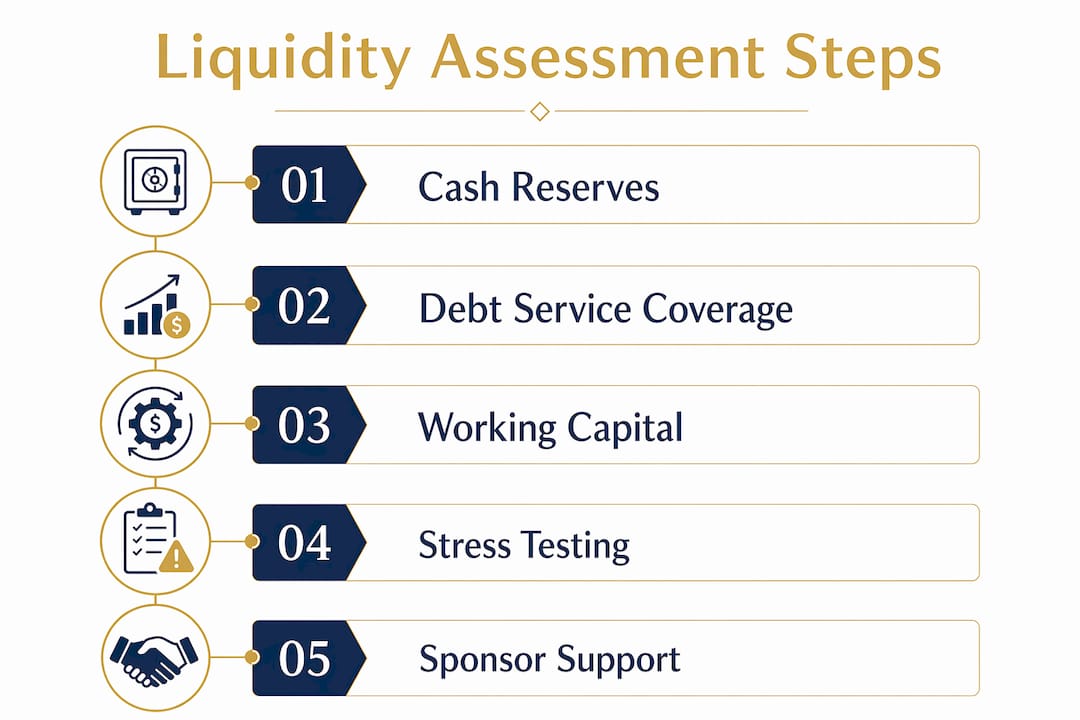
Lenders apply a defined set of quantitative metrics to evaluate developer financial stability before approving construction or bridge financing. These metrics go beyond cash on hand and include working capital, gross profit margin, and debt service coverage ratio, which together give underwriters a comprehensive risk profile for the developer.
The AHIC liquidity thresholds are among the most specific benchmarks in use today. AHIC requires 15% liquidity for new construction and 25% for rehabilitation projects, with the developer fee held until project completion counted toward that buffer. These percentages represent the minimum liquidity a developer must demonstrate to cover construction risk underwritten by the lender.
The debt service coverage ratio, or DSCR, is the other critical affordability metric. Lenders typically require a DSCR of at least 1.25, meaning the project’s income must cover debt payments by a factor of 1.25 or more. A DSCR below that threshold signals that the project cannot absorb even modest income shortfalls without drawing on developer reserves.

Working capital functions as the day-to-day liquidity indicator. Lenders calculate it as current assets minus current liabilities on the developer’s balance sheet. A tight working capital position, even with strong long-term assets, raises flags about the developer’s ability to fund construction draws on schedule.
Pro Tip: Document your developer fee schedule on a cash basis before approaching lenders. Showing exactly when fees are received versus when they are held back demonstrates the kind of timing transparency underwriters look for under AHIC guidelines.
Key items lenders pull from balance sheets and cash flow statements include:
- Cash and cash equivalents available without restriction
- Accounts receivable aging, to assess how quickly cash converts
- Contingent liabilities, including guarantees on other projects
- Replacement reserves and operating expense obligations
- Equity contribution timing relative to construction draw schedule
How do lenders incorporate stress testing and cash flow timing?
Lenders do not evaluate liquidity as a static snapshot. They model what happens when cash flows are delayed, costs overrun, or market conditions tighten. This stress-testing approach is now formalized in regulatory frameworks that directly influence how institutional lenders underwrite developer deals.
OSFI’s Liquidity Adequacy Requirements establish a 30-day stress scenario in which High-Quality Liquid Assets must cover 100% of net cash outflows. That standard shapes how lenders think about developer cash management over the near term. A developer who cannot demonstrate 30 days of unencumbered liquidity under stress conditions faces significant underwriting scrutiny.
AHIC’s guidance adds another layer by focusing on developer fee timing. Fees held back until project completion are treated as a critical reserve for meeting construction funding shortfalls. Lenders model scenarios where draws are delayed, tax credit equity is slow to close, or cost overruns require bridge funding before the next equity installment arrives.
Typical stress scenarios lenders model include:
- A 60-day delay in equity investor funding, requiring the developer to cover draws from reserves.
- A 10–15% cost overrun beyond the approved construction budget, testing contingency reserve adequacy.
- A permanent loan resizing at stabilization, where the takeout loan comes in lower than projected, leaving a gap the developer must fund.
- A lease-up shortfall that delays stabilization and extends the construction loan term, increasing carry costs.
- A draw rejection by the lender’s inspector, requiring the developer to resubmit and fund the gap period independently.
Pro Tip: Prepare a cash flow forecast that maps your draw schedule against your equity installment dates. Lenders who see that you have already stress-tested your own timeline are far more confident in your ability to manage shortfalls.
Anticipatory cash management matters as much as the reserves themselves. Developers who maintain contingency buffers of 5–10% above the required minimum signal to lenders that they understand project-level risk, not just the numbers on a term sheet. For more on how underwriting CRE deals in a higher-rate environment affects liquidity expectations, the dynamics are worth reviewing before you structure your next deal.
How does guarantor and sponsor financial strength affect lender evaluation?
Lender evaluation of developer liquidity does not stop at the project entity. Underwriters look through the special purpose vehicle to the sponsor and guarantor balance sheets, because the project’s ability to survive a shortfall often depends on the parent entity’s willingness and capacity to step in.
AHIC’s April 2026 underwriting guidelines direct underwriters to evaluate equity commitment timing, total development costs, repurchase obligations, operating expenses, replacement reserves, and debt service exposure at the sponsor level. Each of these items represents a potential drain on liquidity that the project-level balance sheet does not capture.
Scope Group’s rating methodology adds a critical distinction: non-recourse SPV debt is excluded from the liquidity assessment unless the sponsor is expected to support those loans based on business importance or reputational risk. That means a sponsor’s track record of supporting affiliated entities carries real weight in how lenders score liquidity capacity. A developer who has walked away from a distressed SPV in the past faces a harder underwriting conversation than one with a history of stepping in.
Key factors lenders assess at the guarantor and sponsor level include:
- Net worth relative to total project exposure, including contingent guarantees
- Liquidity at the corporate level, separate from project-level reserves
- Outstanding guarantees on other active projects that could compete for the same capital
- History of capital contributions to affiliated entities under stress
- Institutional haircuts applied to illiquid assets like land holdings or minority equity positions
Institutional risk models apply haircuts to liquidity sources based on expected convertibility under stress. A developer who counts a land parcel as a liquid asset will find that lenders discount it significantly. Cash, money market accounts, and undrawn lines of credit receive the highest liquidity credit. Real estate equity, even in stabilized assets, is treated as a secondary reserve at best.
What practical steps can developers take to demonstrate strong liquidity?
Developers who prepare their liquidity documentation proactively close faster and negotiate better terms. Lenders reward transparency because it reduces underwriting uncertainty. The goal is to make the underwriter’s job straightforward by presenting a clear, well-organized picture of your financial position.
Practical steps that improve lender confidence include:
- Provide a cash-basis developer fee schedule. Show exactly when fees are earned, when they are held back, and when they become available. Lenders need to see this timing mapped against the construction draw schedule.
- Maintain documented contingency reserves. A contingency line of 5–10% above the required liquidity threshold, held in a segregated account, signals disciplined cash management.
- Disclose all contingent liabilities upfront. Guarantees on other projects, repurchase obligations, and operating expense commitments should be listed with amounts and timelines. Surprises during underwriting kill deals.
- Use letters of credit where cash reserves are thin. A letter of credit from a rated financial institution can satisfy liquidity requirements when cash is deployed in the project. Lenders accept them as a recognized credit enhancement.
- Present audited or reviewed financial statements. Compiled statements carry less weight. Audited financials signal that your numbers have been independently verified, which accelerates the underwriting process.
- Provide a 12-month cash flow forecast. Map inflows from equity installments, loan draws, and fee receipts against outflows for construction costs, debt service, and operating expenses. This document alone can answer most of the underwriter’s timing questions.
For a detailed breakdown of what lenders require at the construction stage, the construction loan requirements guide from Brookmontcapital covers the documentation checklist in full.
Key Takeaways
Lenders assess developer liquidity by evaluating cash availability, draw timing, stress capacity, and sponsor support, not by cash balance alone.
| Point | Details |
|---|---|
| AHIC liquidity thresholds | New construction requires 15% liquidity; rehabilitation requires 25%, including held-back developer fees. |
| DSCR minimum standard | Lenders require a DSCR of at least 1.25 to confirm debt service coverage with adequate cushion. |
| Stress testing is standard | OSFI’s 30-day liquidity coverage ratio test sets the benchmark for near-term cash sufficiency under pressure. |
| Sponsor support carries weight | Lenders assess guarantor balance sheets and historical willingness to fund affiliated entities under stress. |
| Transparency accelerates approval | Audited financials, cash flow forecasts, and disclosed contingent liabilities reduce underwriting friction. |
What lenders are really asking when they review your liquidity
The shift I have seen over the past several years is significant. Lenders are no longer satisfied with a strong balance sheet snapshot. They want to understand how a developer behaves when the project hits a rough patch, and that question gets answered through documentation, track record, and the quality of the financial story you tell.
The AHIC and OSFI frameworks have formalized what experienced underwriters were already doing intuitively. The 30-day stress window and the developer fee holdback treatment are not bureaucratic checkboxes. They reflect a genuine understanding that liquidity is stress-absorption capacity, not a static number. A developer with $2 million in cash but $1.8 million tied up in contingent guarantees on three other projects is not liquid in any meaningful sense.
The guarantor review is where I see the most surprises. Developers often present strong project-level numbers without realizing that lenders are simultaneously running the corporate balance sheet through the same stress model. If your affiliated entities are carrying non-recourse debt that you have historically supported, lenders will assume you will support it again. That assumption either helps you or hurts you depending on your track record.
My practical advice is to get ahead of the conversation. Prepare a one-page liquidity summary that maps your cash position, contingent liabilities, and fee timing before the first lender call. Developers who walk in with that document close faster and negotiate from a position of credibility.
— Jerry
Brookmontcapital’s financing solutions for developers
Real estate developers who understand how lenders evaluate their financial position are better prepared to structure deals that close. Brookmontcapital works with developers and sponsors nationwide to source and structure commercial real estate financing, including bridge loans, construction financing, DSCR loans, CMBS, and preferred equity.
The advisory team at Brookmontcapital helps developers present their liquidity position clearly to institutional lenders, debt funds, and equity partners. Whether you need capital stack advisory to optimize your financing structure or a direct path to a construction lender, Brookmontcapital connects you with the right capital source for your project size and risk profile.
FAQ
What is the minimum liquidity threshold lenders require from developers?
AHIC guidelines set the minimum at 15% for new construction and 25% for rehabilitation projects, with cash developer fees held until completion counting toward the threshold.
What DSCR do lenders require for commercial real estate deals?
Lenders typically require a DSCR of at least 1.25, meaning project income must cover debt payments by a factor of 1.25 or more to pass the affordability test.
How do lenders stress-test developer liquidity?
Lenders model scenarios including draw delays, cost overruns, and permanent loan resizing, using frameworks like OSFI’s 30-day liquidity coverage ratio to confirm cash sufficiency under pressure.
Does guarantor financial strength affect developer liquidity assessment?
Yes. Lenders review guarantor balance sheets, contingent liabilities, and historical support behavior for affiliated entities, because sponsor willingness to fund shortfalls directly affects the project’s liquidity credit.
What documents should developers prepare to demonstrate liquidity?
Audited financial statements, a 12-month cash flow forecast, a cash-basis developer fee schedule, and a full disclosure of contingent liabilities give lenders the clearest picture of developer financial stability.
Recommended
- The 2026 CRE Refinancing Wall: What Investors With $500K-5M Projects Need to Know Now
- How to Get Your CRE Deal Funded in 2026: What Lenders Actually Want to See | Brookmont Capital
- How to Underwrite a CRE Deal When Interest Rates Stay Higher for Longer | Brookmont Capital Ventures
- Construction Loan Requirements for Developers | Brookmont Capital Ventures