
How DSCR Loans Are Underwritten: 2026 Investor Guide

DSCR loan underwriting is defined as the process of evaluating a rental property’s ability to cover its own debt obligations, without relying on the borrower’s personal income. Lenders assess three primary factors: the debt service coverage ratio (DSCR), credit score, and loan-to-value (LTV). No W-2s, pay stubs, or tax returns enter the equation. Understanding how DSCR loans are underwritten gives you a direct line of sight into what lenders are actually measuring, and where deals get approved, repriced, or declined.
What factors do lenders evaluate in DSCR loan underwriting?
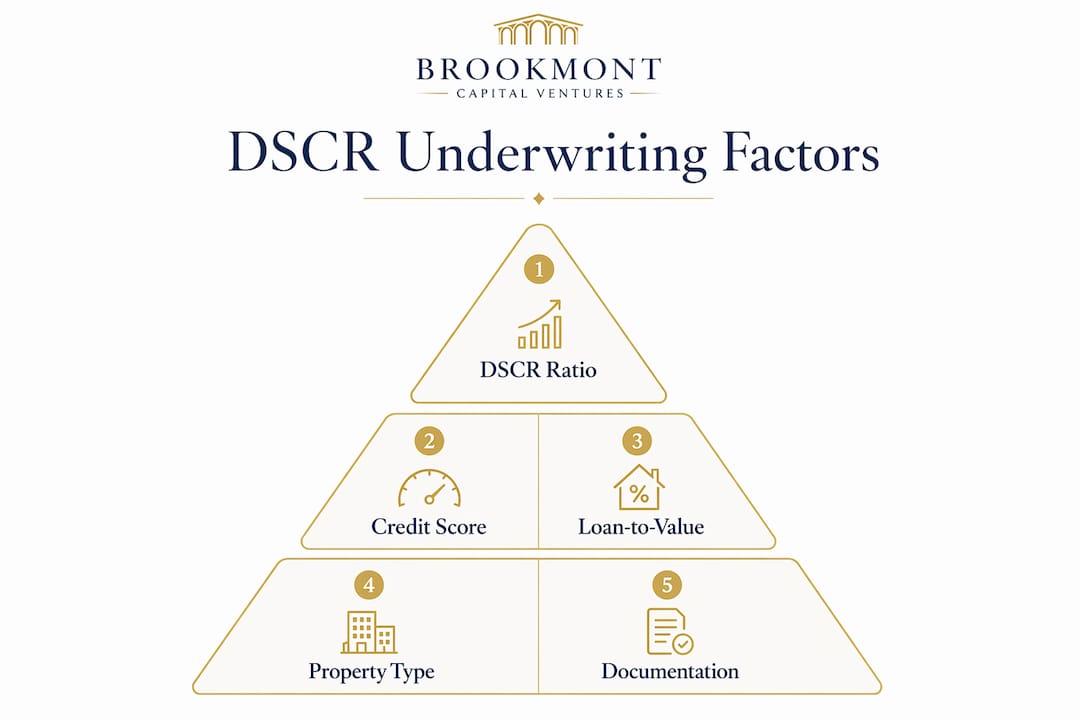
DSCR underwriting relies on seven weighted factors, with the DSCR ratio, credit score, and LTV carrying the most influence over approval and pricing. The remaining factors, including cash reserves, property type, property condition, and documentation completeness, shape the final terms once the primary three clear their thresholds.
DSCR ratio
The DSCR ratio is calculated by dividing the property’s gross rental income by its total monthly debt service, known as PITIA (principal, interest, taxes, insurance, and HOA dues). Most lenders require a minimum DSCR of 1.00x, meaning rent exactly covers debt service. A DSCR of 1.25x or higher unlocks materially better terms, including lower rates and reduced down payment requirements. Deals in the 1.00–1.19x range typically face higher rates and down payment requirements of 25–30%.

Credit score tiers
Credit score tiers directly control both the maximum LTV a lender will approve and the interest rate you receive. The floor for most DSCR programs is 660. Scores of 720 and above place you in the preferred tier, where lenders offer the best leverage and pricing. Scores between 660 and 719 still qualify, but expect tighter LTV caps and a rate premium.
Loan-to-value thresholds
LTV requirements are not fixed. They move in response to your DSCR ratio and credit score. A borrower with a 760 credit score and a 1.30x DSCR may access 80% LTV. The same property with a 670 score and a 1.05x DSCR may be capped at 70% LTV or lower. Lenders price risk by stacking these variables together, not in isolation.
Supporting factors
- Cash reserves: Borrowers typically need 6–12 months of reserves post-closing. Reserves signal financial stability and reduce lender risk on thin-margin deals.
- Property type: Single-family rentals, 2–4 unit properties, and small multifamily assets each carry different risk weights. Short-term rental properties face additional scrutiny.
- Property condition: Deferred maintenance or functional obsolescence can trigger conditions or reduce the appraised value, which compresses LTV.
- Documentation completeness: No W-2s or tax returns are required, but complete property documents, including leases, insurance declarations, tax records, and bank statements, protect your rate lock and closing timeline.
Pro Tip: Organize your full documentation package before submitting. Incomplete files trigger conditions that delay closing and can expose your rate lock to market movement.
How do underwriters calculate and verify DSCR?
The DSCR calculation sounds straightforward, but the rent figure used is not always what you expect. Appraisers determine market rent using Form 1007, a single-family comparable rent schedule, rather than accepting your lease or pro forma projections. That appraiser-determined figure is the number that goes into the underwriting model.
The critical rule: lenders use the lower of the appraised market rent and the actual lease rent. If your property leases at $2,800 per month but the appraiser’s Form 1007 shows market rent at $2,400, the underwriter uses $2,400. That single adjustment can drop a deal from a qualifying 1.10x DSCR to a failing 0.94x. A lower market rent number can cause deals to fail underwriting entirely.
The process for calculating DSCR follows this sequence:
- Order the appraisal with Form 1007. The appraiser provides both a property value and a market rent estimate based on comparable rentals in the area.
- Determine the rent figure. Compare the appraised market rent to the current lease. Use the lower number.
- Calculate PITIA. Add up the proposed monthly principal and interest payment, property taxes, hazard insurance, flood insurance if applicable, and any HOA dues.
- Divide rent by PITIA. The result is your DSCR. A ratio at or above 1.00x meets the baseline threshold.
- Apply lender overlays. Many lenders impose internal risk policies that go beyond published guidelines. These overlays can cause deals to be repriced, conditioned, or declined even when the published criteria are met.
Short-term rental properties introduce additional complexity. Lenders typically require 12 months of rental history from platforms like Airbnb or VRBO, and some apply a vacancy discount to the gross income before calculating DSCR. Interest-only loan structures raise the DSCR by reducing the monthly payment, which can be a deliberate structuring tool for borderline deals.
Pro Tip: Request the Form 1007 from your appraiser before the lender receives it. If the market rent comes in lower than your lease, you have time to challenge the comparable selection or explore a different lender with a more favorable overlay.
How does credit evaluation affect DSCR loan structure?
Underwriters use the middle score from a tri-merge credit report, which pulls from Equifax, Experian, and TransUnion, to assign a credit tier. The middle score, not the highest, determines your rate and maximum LTV. This distinction matters when one bureau shows a significantly different score than the other two.
Credit score tiers in DSCR underwriting map directly to loan terms:
- 760 and above: Best available rates, maximum LTV up to 80%, lowest reserve requirements.
- 720–759: Competitive rates, LTV up to 75–80% depending on DSCR.
- 680–719: Moderate rate premium, LTV typically capped at 70–75%.
- 660–679: Minimum qualifying tier for most programs, higher rate premium, LTV often limited to 65–70%.
- Below 660: Below 1.0x DSCR loans are often declined, and sub-660 credit scores face similar outcomes across most lender programs.
Entity structure also affects credit evaluation. Properties held in an LLC qualify for DSCR financing, but lenders typically require a personal guarantor whose credit score drives the underwriting decision. Foreign nationals face a narrower lender pool and often encounter stricter LTV caps regardless of DSCR performance.
Timing credit pulls carefully is one of the most overlooked aspects of the DSCR loan underwriting process. Hard inquiries from new credit applications, auto loans, or credit card accounts opened in the 60–90 days before your DSCR application can reduce your middle score enough to drop you into a lower tier. That tier change can cost you 25–50 basis points in rate and reduce your maximum LTV.
How can you improve your DSCR loan underwriting outcomes?
Improving your underwriting position before submission is far more effective than negotiating after a conditional approval. Each of the following steps targets a specific underwriting variable.
- Increase the rent or reduce debt service. A higher rent relative to PITIA directly improves your DSCR. If the property is below market rent, bring the lease current before the appraisal. Alternatively, a larger down payment reduces the loan amount and lowers monthly debt service, which raises the DSCR without touching the income side.
- Boost your credit score before applying. Pay down revolving balances to below 30% utilization. Dispute any inaccurate derogatory items. Avoid opening new credit accounts for at least 90 days before submitting your application.
- Manage LTV with a larger down payment. A lower LTV reduces lender risk and often unlocks a better rate tier. On a borderline deal, contributing an additional 5% down can shift the pricing by a meaningful margin.
- Organize reserves and documentation in advance. Lenders want to see 6–12 months of liquid reserves in a verifiable account. Gather bank statements, the executed lease, property insurance declarations, and tax records before the application goes in.
- Align lease terms with market rent appraisals. If your current lease is below market, negotiate a renewal at market rate before ordering the appraisal. The Form 1007 appraiser will use comparable market rents, so a lease that matches or exceeds that figure eliminates the lower-of-two calculation risk.
- Time your application to avoid credit dips. Hard pulls affect FICO scores and can reduce underwriter confidence. Plan your application window around a clean 90-day credit period.
Pro Tip: Use Brookmontcapital’s DSCR calculator to model your ratio before the appraisal is ordered. Running the numbers with conservative rent assumptions tells you exactly how much cushion you have.
Key Takeaways
DSCR loan approval depends on three interconnected variables: the DSCR ratio, credit score, and LTV, each of which must clear defined thresholds before lenders consider reserves, property type, or documentation.
| Point | Details |
|---|---|
| DSCR ratio drives approval | A minimum 1.00x DSCR is required; 1.25x or higher unlocks better rates and lower down payments. |
| Appraised rent controls the calculation | Lenders use the lower of market rent (Form 1007) or lease rent, not investor projections. |
| Credit score sets the rate tier | The tri-merge middle score determines your maximum LTV and interest rate across all DSCR programs. |
| Lender overlays add hidden risk | Internal lender policies can reprice or decline deals that meet published guidelines. |
| Preparation reduces deal friction | Complete documentation and pre-application credit management protect your rate lock and timeline. |
What I’ve learned about DSCR underwriting after years of deal flow
The investors who struggle most with DSCR underwriting are the ones who treat it like a conventional mortgage application. They focus on their personal financial story, which is irrelevant here, and neglect the property’s income profile, which is everything.
What I’ve seen consistently is that the appraisal is the single most unpredictable variable in the process. You can control your credit score and your down payment. You cannot fully control what a Form 1007 appraiser concludes about market rent in a softening submarket. Deals that look clean at 1.15x DSCR on paper can fail when the appraiser’s market rent comes in 10% below the current lease. That is not a lender problem. That is a market signal, and disciplined investors treat it as one.
The other pattern I see repeatedly is investors who are surprised by lender overlays. Many lenders use unpublished overlays based on portfolio risk appetite and current market conditions. Two lenders with identical published guidelines can reach opposite decisions on the same file. Knowing this in advance means you shop lenders before you commit to one, not after a denial.
The investors who close efficiently are the ones who understand that DSCR underwriting is a connected system where DSCR, credit, and LTV function as pillars. Strengthen all three before you submit, and the supporting factors, reserves and documentation, become formalities rather than obstacles.
— Jerry
Brookmontcapital’s DSCR and commercial financing programs
Real estate investors who understand the DSCR loan underwriting process still need a lender relationship that matches their deal profile to the right program.
Brookmontcapital structures and sources DSCR loan financing for rental property investors across the country, from single-family rentals to small multifamily assets. The firm connects sponsors with institutional lenders and debt funds that offer programs aligned with specific DSCR thresholds, credit tiers, and property types. For investors managing complex capital stacks or evaluating bridge loan alternatives alongside DSCR financing, Brookmontcapital provides advisory support to structure the most favorable terms. Explore the full range of commercial real estate financing solutions or contact Brookmontcapital directly to discuss your deal.
FAQ
What is a DSCR loan and how does it differ from a conventional loan?
A DSCR loan is a real estate investment loan underwritten on the property’s rental income rather than the borrower’s personal income. Unlike conventional loans, no W-2s or tax returns are required.
What is the minimum DSCR ratio required for loan approval?
Most lenders require a minimum DSCR of 1.00x, meaning rental income exactly covers PITIA. A ratio of 1.25x or higher typically qualifies for better rates and lower down payment requirements.
How does credit score affect DSCR loan approval?
Lenders use the middle score from a tri-merge credit report to assign a rate and LTV tier. A score of 660 is the typical floor, while 720 and above places borrowers in the preferred pricing tier.
Why does the appraisal matter so much in DSCR underwriting?
Appraisers determine market rent using Form 1007, and lenders use the lower of that figure or the actual lease rent. A low appraisal rent can reduce the DSCR below the qualifying threshold and cause the deal to fail.
Can a property held in an LLC qualify for a DSCR loan?
Yes. Properties held in an LLC or trust qualify for DSCR financing. Lenders typically require a personal guarantor, and that guarantor’s credit score drives the underwriting decision.