
Hard Money vs Institutional Construction Loans: 2026 Guide

Hard money loans are defined as short-term, asset-based financing secured by real property, while institutional construction loans are structured, milestone-driven credit facilities designed for longer development cycles. The choice between hard money vs institutional construction loans determines your project’s cash flow, cost structure, and exit timeline. Hard money closes in days and asks few questions about your credit. Institutional lenders ask many questions, move more slowly, and reward you with lower rates and a clearer path to permanent financing. Knowing which tool fits your project is the most consequential financing decision you will make.
What are the key differences between hard money and institutional construction loans?
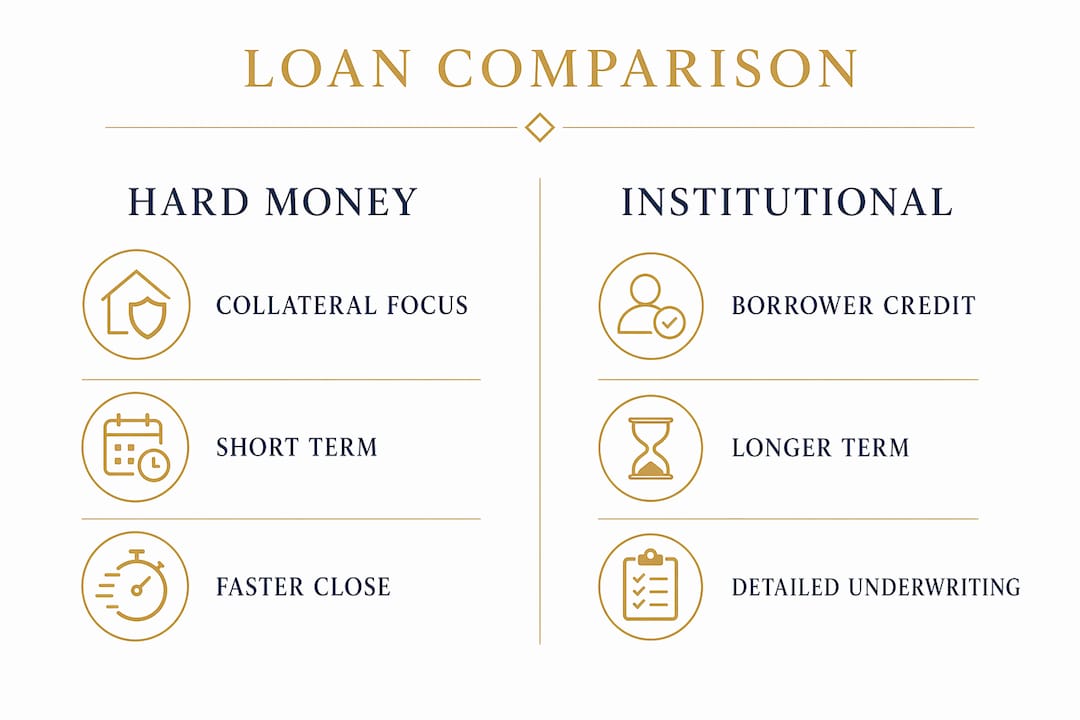
Hard money loans are short-term, asset-based loans that prioritize collateral value over borrower credit, with typical terms of 6–18 months and closing speeds of 7–15 business days versus 30–45 days for conventional financing. That speed is the product, not a side benefit. The lender underwrites the property’s value and your ability to exit quickly, not your tax returns or debt service coverage ratio.
Institutional construction loans operate on a fundamentally different logic. Institutional underwriting requires detailed financial documentation, licensed general contractors, milestone inspections, and budget oversight with contingency reserves. The lender is not just funding a property. It is funding a construction process, and it wants controls at every stage.

The table below contrasts the core underwriting and structural criteria across both loan types.
| Criteria | Hard money loans | Institutional construction loans |
|---|---|---|
| Underwriting focus | Collateral value and short-term exit | Borrower financials, GC credentials, and staged risk |
| Closing timeline | 7–15 business days | 30–60+ business days |
| Loan term | 6–18 months | 24–36 months |
| Interest rate range | 9%–13% | Typically lower, tied to benchmark rates |
| Draw structure | Lump sum or simple disbursement | Milestone-based draws with inspections |
| Credit requirements | Minimal credit review | Full credit and income documentation |
| Retainage | Rarely applied | 5%–10% withheld until completion |
| Exit path | Sale or refinance | Construction-to-permanent conversion |
Pro Tip: If your general contractor is not licensed and bonded, institutional lenders will decline the deal before reviewing your financials. Confirm contractor credentials before submitting any loan package.
The key conceptual difference is underwriting focus: hard money centers on collateral and short-term exit capacity, while institutional loans emphasize staged funding and construction risk management. That distinction shapes every term in the loan agreement.
How do timelines, costs, and loan terms compare?
Cost and timing differences between these two financing types affect your pro forma directly. Hard money loans carry interest rates of 9%–13% and close in 7–15 days, making them the fastest capital available in commercial real estate. That speed comes at a price that compounds quickly on a 12-month construction timeline.
Institutional construction loans typically run 24–36 months, with interest charged only on the drawn balance at any given time. That structure reduces your actual interest cost during early construction phases when draws are small. The trade-off is a longer approval process and significantly more documentation.
Key cost and timing factors to evaluate before choosing a loan type:
- Rate environment: Hard money rates of 9%–13% are fixed and non-negotiable. Institutional rates float or are fixed at lower spreads, but require full underwriting to access.
- Draw timing: Institutional draws are approved in 5–10 business days after inspection and documentation. Budget for that lag in your construction schedule.
- Retainage: Institutional lenders withhold 5%–10% from each draw until substantial completion. That cash is locked and unavailable for operating costs.
- Interest reserves: Institutional loans build an interest reserve into the loan at closing. That reserve funds your interest payments during construction and reduces the cash you need to bring to the table upfront.
- Prepayment: Hard money loans rarely carry prepayment penalties. Institutional loans sometimes do, particularly on construction-to-permanent structures.
The practical implication is straightforward. A $3M hard money loan at 12% for 12 months costs roughly $360,000 in interest before fees. An institutional loan at a lower rate on the same project, with interest charged only on drawn balances averaging 55%–65% of the total, produces a materially lower interest bill over the same period. The savings justify the slower close for projects with timelines that allow it.
What are the risks and benefits of each loan type?
Hard money loans carry three specific risks that developers underestimate. First, the short term creates a hard deadline. If your project runs over schedule, you face extension fees, a forced refinance, or foreclosure. Second, the higher rate erodes margin on thin-spread deals. Third, hard money lenders have minimal credit review requirements, which means less lender scrutiny but also less lender accountability if the deal goes sideways.
Institutional loans carry different risks. The approval process is long, and a lender can decline mid-process if market conditions shift or your contractor fails a background check. Funding delays tied to inspection cycles can stall subcontractors and trigger cost overruns. Documentation requirements for construction-to-permanent loans mean the permanent phase underwriting must be current and can require requalification if terms change.
The benefits of each type are equally specific:
- Hard money speed: Close in under two weeks. Ideal for competitive acquisitions, fix-and-flip projects, and bridge scenarios where time is the constraint.
- Hard money flexibility: Fewer covenants, fewer reporting requirements, and lenders who focus on the asset rather than the borrower’s balance sheet.
- Institutional cost efficiency: Lower rates and interest-only draws on outstanding balances reduce total financing cost on longer projects.
- Institutional risk controls: Milestone inspections, lien waivers, and budget oversight protect both lender and developer from contractor fraud and cost overruns.
- Institutional exit clarity: Construction-to-permanent structures provide a defined path to long-term financing without a separate refinance event.
Pro Tip: Many experienced developers use hard money for acquisition and early site work, then refinance into institutional construction financing once permits are in hand and the project risk profile improves. This two-step approach reduces total financing cost without sacrificing speed at the critical acquisition stage.
How do draw schedules and interest reserves work in each loan type?
Draw schedules and interest reserves are where institutional construction loans become genuinely complex. Institutional lenders release funds in draws tied to verified milestones, with each draw requiring a site inspection, subcontractor lien waivers, and updated budget reconciliation. That process protects the lender and the developer, but it requires active management.
Interest reserves in institutional loans are sized using an iterative calculation. Interest accrues on the drawn loan balance including the reserve itself, which means the reserve calculation is circular. A simplified 50% average balance assumption understates the actual reserve needed. Lenders model the draw schedule month by month and size the reserve accordingly.
The table below illustrates how draw mechanics and reserve structures differ between the two loan types.
| Feature | Hard money loans | Institutional construction loans |
|---|---|---|
| Draw trigger | Closing or simple request | Verified milestone and inspection |
| Draw approval time | 1–3 business days | 5–10 business days |
| Lien waiver requirement | Rarely required | Required from all subcontractors |
| Interest reserve | Typically not included | Sized iteratively at closing |
| Average outstanding balance | Not modeled | 55%–65% of total commitment |
| Retainage withheld | None | 5%–10% per draw |
| Reserve calculation method | Not applicable | Iterative, circular computation |
Hard money disbursement is straightforward by comparison. Most hard money lenders fund at closing or on a simple request basis, with no inspection cycle and no lien waiver requirement. That simplicity is valuable on short projects where speed and flexibility matter more than cost control. For ground-up construction financing on larger projects, the institutional draw structure provides a discipline that protects your budget and your lender relationship.
Understanding the construction loan requirements for institutional financing before you start the process saves weeks of back-and-forth and prevents surprises at the closing table.
Key Takeaways
The most effective construction financing strategy matches loan type to project timeline: hard money for speed-critical, short-term deals, and institutional loans for structured, longer-term ground-up development.
| Point | Details |
|---|---|
| Hard money speed advantage | Hard money closes in 7–15 days, making it the right tool for time-sensitive acquisitions and bridge scenarios. |
| Institutional cost efficiency | Institutional loans charge interest only on drawn balances, reducing total financing cost on 24–36 month projects. |
| Retainage affects liquidity | Institutional lenders withhold 5%–10% per draw until completion, requiring developers to plan for locked cash. |
| Reserve sizing is complex | Interest reserves in institutional loans require iterative calculations because interest accrues on the reserve itself. |
| Exit strategy defines the choice | Hard money exits through sale or refinance; institutional loans can convert directly to permanent financing. |
What I’ve learned from watching developers choose the wrong loan
The most common mistake I see is developers choosing hard money for projects that need 18 months to complete. Hard money’s 6–18 month term sounds like enough runway until you factor in permitting delays, weather, and subcontractor scheduling. A project that slips three months on a 12-month hard money loan is a crisis. The same slip on a 30-month institutional loan is a line item.
The second mistake is the opposite: developers who pursue institutional financing for a quick fix-and-flip because the rate looks better. By the time the institutional lender finishes underwriting, the deal is gone or the project is already half-complete. Rate optimization on a 90-day project is the wrong priority.
The developers who get this right treat the two loan types as tools in a kit, not competitors. They use hard money to move fast on acquisition, then refinance into institutional construction financing once the project is de-risked. That sequencing captures the speed benefit of hard money and the cost benefit of institutional lending without sacrificing either. It also gives the developer time to assemble the contractor documentation and financial package that institutional lenders require, rather than scrambling to produce it under a closing deadline.
The one thing I would tell every developer reading this: model your interest cost under both structures before you commit. The rate difference between hard money and institutional lending is real, but the draw mechanics and retainage in institutional loans change the actual cash-out number in ways that a simple rate comparison misses entirely.
— Jerry
How Brookmontcapital structures construction financing for developers
Real estate developers working on projects from ground-up multifamily to single-family build-for-rent need financing that fits the project, not a generic loan product. Brookmontcapital advises developers on structuring the right capital stack for each phase of development, from acquisition through construction and into permanent financing.

Brookmontcapital connects sponsors with institutional lenders, debt funds, and bridge capital sources to match the right loan structure to the right project stage. Whether you need a bridge loan to move fast on an acquisition or a structured institutional facility for a 24-month ground-up build, the team at Brookmontcapital sources and structures the financing. Developers ready to evaluate their construction financing options can also explore CMBS loan solutions for stabilized assets coming out of the construction phase.
FAQ
What is the main difference between hard money and institutional construction loans?
Hard money loans prioritize collateral value and close in 7–15 days with terms of 6–18 months. Institutional construction loans require full financial documentation, use milestone-based draws, and typically run 24–36 months with lower interest rates.
When should a developer use a hard money loan instead of an institutional loan?
Hard money is the right choice when speed is the primary constraint, such as competitive acquisitions, fix-and-flip projects, or bridge scenarios where institutional underwriting timelines would cost you the deal.
How does retainage affect developer cash flow in institutional construction loans?
Institutional lenders withhold 5%–10% of each draw as retainage until substantial completion, locking that cash in escrow and reducing the developer’s available liquidity throughout the construction period.
Can a developer use both loan types on the same project?
Yes. Many developers use hard money for acquisition and early site work, then refinance into institutional construction financing once permits are secured and the project risk profile is lower.
How are interest reserves calculated in institutional construction loans?
Interest reserves are sized using an iterative calculation because interest accrues on the drawn balance including the reserve itself, making a simple 50% average balance assumption insufficient for accurate reserve sizing.
Recommended
- Construction Lender Underwriting Criteria: 2026 Guide | Brookmont Capital Ventures
- How Syndicators Source Institutional Debt in 2026 | Brookmont Capital Ventures
- Institutional Real Estate Investment 2026: Why Capital Is Returning to CRE
- How to Underwrite a CRE Deal When Interest Rates Stay Higher for Longer | Brookmont Capital Ventures