Equity Co-Investment Structures for Sponsors: A Negotiation Guide

If you want to keep control of the deal, take on a minority JV partner or negotiate pari-passu co-investment rather than ceding board-level consent rights. If you want maximum price certainty and a faster close, preferred equity with narrowly defined consent rights is usually the better fit. If speed is the priority, whether you’re bridging to stabilization or covering a short-term capital gap, preferred equity or mezzanine debt will close faster than a full JV raise. If you want maximum upside participation, common JV equity with a layered promote still beats every other structure once you clear the preferred-return hurdle.
Every one of those choices trades control for price, or price for speed. There is no structure that maximizes all three at once. Preferred equity investors typically require 8% to 9% preferred returns before you touch promote, and that pref accrues whether or not the deal performs. JV capital partners, by contrast, will underwrite lower current pay in exchange for upside participation once you clear their IRR hurdle. Sponsors who would rather not run this negotiation solo often bring in an advisory firm like Brookmont Capital Ventures to structure the raise and manage investor conversations from term sheet to close.
- Retain operational control: Take a minority JV partner or negotiate pari-passu treatment; avoid broad consent-right language in the operating agreement.
- Maximize price and certainty: Use preferred equity with a fixed accrual rate and a tightly scoped consent list.
- Move fast on a bridge or recap: Preferred equity or mezzanine debt closes faster than a programmatic JV raise, though pricing runs higher.
- Maximize upside participation: Common JV equity with layered promote hurdles (often 20/30/40) rewards outperformance once the preferred-return hurdle clears.
- Watch the management-default trap: Loosely drafted default triggers, per a caution from Tannenbaum Helpern, can let an investor strip your fees and promote even for minor reporting lapses.
Key Takeaways
Sponsors who match their co-investment structure to their primary objective, control, price, speed, or upside, negotiate stronger terms and avoid governance traps that strip fees.
| Point | Details |
|---|---|
| Match structure to objective | Retain control with minority JV/pari-passu; maximize price with preferred equity; move fast with preferred equity or mezzanine. |
| Know the pref benchmark | JV capital partners typically expect an 8% to 9% preferred return before sponsor promote accrues. |
| Scrutinize management-default clauses | Broadly written triggers can let investors remove sponsors and strip fees over reporting lapses, per Tannenbaum Helpern. |
| Negotiate cure periods and deemed consent | A 30-day cure window and a 10 to 15 business-day deemed-consent clause protect sponsor flexibility. |
| Consider an advisor for structuring | Brookmont Capital Ventures structures and places preferred equity and JV capital, as shown in its gap-financing case study. |
Table of Contents
- Which Equity Co-Investment Structures Do Sponsors Actually Use?
- How Does Capital-Stack Placement Change the Economics?
- What Belongs on a Sponsor’s Term-Sheet Checklist?
- What Documentation and Compliance Steps Come Before Closing?
- How Do Sponsors Find and Close a Co-Investor?
- Which Structure Fits Your Sponsor Objective?
- How Did Brookmont Structure a Gap-Financing Deal for a Sponsor?
- What Do Sponsors Consistently Get Wrong About Co-Investment?
- How Can Brookmont Capital Ventures Help Sponsors Close These Deals?
- Where Can Sponsors Find Further Detail?
- Sources
- FAQ
Which Equity Co-Investment Structures Do Sponsors Actually Use?
Four structures cover nearly every equity co-investment sponsors negotiate: common/JV equity, minority preferred equity, mezzanine or subordinate debt, and single-purpose vehicle (SPV) co-investment. Each sits at a different point in the capital stack, and that placement drives everything else, pricing, control, and how fast the deal closes.
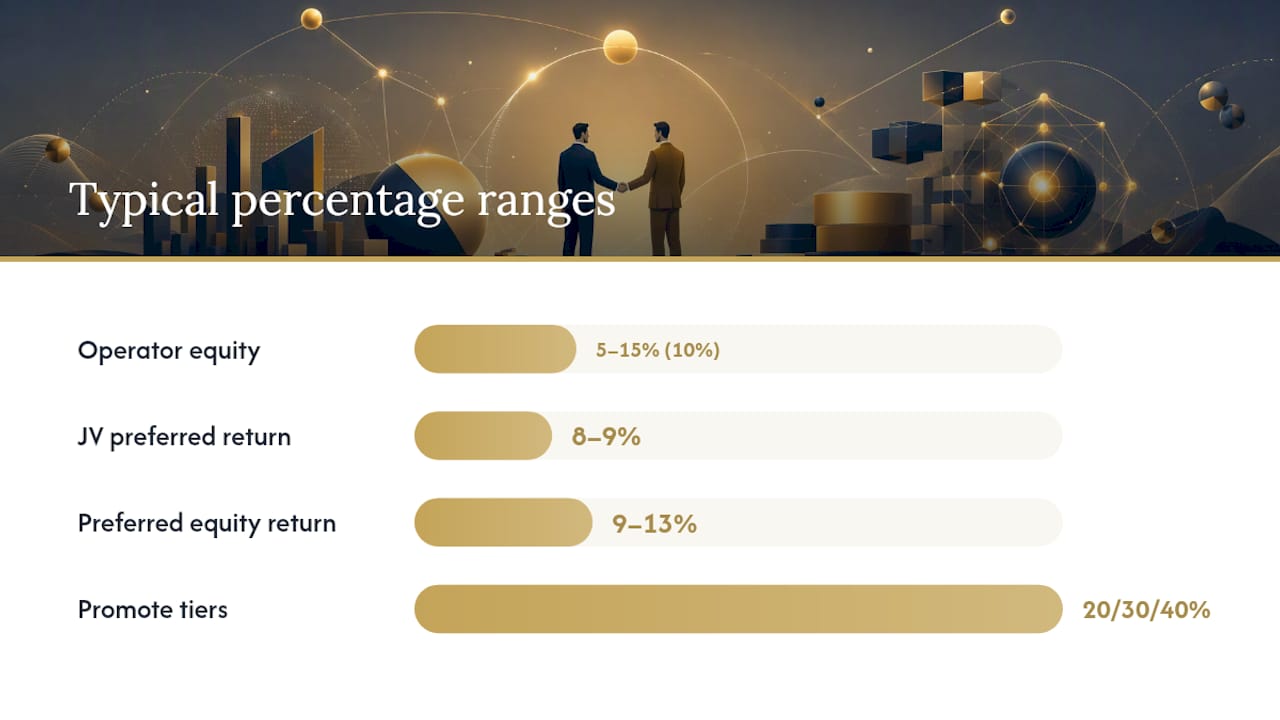
Common or joint-venture equity pairs an operating sponsor with a capital partner as true equity co-owners. It sits at the bottom of the capital stack, meaning it absorbs the first losses but also captures the most upside through a promote. Institutional JV archetypes typically allocate operator equity in the 5% to 15% range, with a market default near 10/90 operator-to-capital-partner splits. Pension funds, family offices, and discretionary funds gravitate here because the structure gives them governance rights proportional to their stake.
Minority preferred equity sits senior to JV equity but junior to the first mortgage. It’s not ownership in the traditional sense. Investors get a fixed or accruing return, often 9% to 13%, and limited upside beyond that in exchange for payment priority. This is the structure most family offices and debt funds choose when they want yield without operating exposure.
Mezzanine debt is technically debt, not equity, but it behaves like a co-investment tool because it fills the same gap between senior debt and sponsor equity. It carries fixed interest, sits junior to the mortgage, and typically triggers foreclosure-style remedies rather than removal provisions if a sponsor defaults.
SPV co-investment lets a single institutional investor or small group invest directly into a bespoke entity formed for one deal, bypassing a broader fund vehicle. It’s common when a family office or HNW investor wants direct exposure to one asset without committing to a programmatic relationship.
Sponsors chasing programmatic relationships tend to prefer common JV equity because it builds a repeatable partnership with one capital source across multiple deals. Sponsors plugging a single, time-sensitive gap, construction cost overruns, a stalled lease-up, tend to reach for preferred equity or mezzanine because both close faster and require less negotiation over long-term governance. You can compare the mechanics further in Brookmont’s breakdown of capital stack types in commercial real estate.
How Does Capital-Stack Placement Change the Economics?
Where an investor sits in the capital stack determines how much risk they absorb and how much upside they’re entitled to. A few terms govern almost every negotiation you’ll have with an institutional co-investor.
Preferred return is the minimum yield an investor must receive before the sponsor earns any promote. Catch-up is the mechanism that lets the sponsor “catch up” to a target split after the pref clears, so the sponsor isn’t stuck below the promote line indefinitely. Promote (or carried interest) is the sponsor’s disproportionate share of profit above the pref, layered in tiers, commonly 20%, 30%, and 40% as returns climb. Pari-passu means capital flows to sponsor and investor simultaneously and proportionally, without one party waiting behind the other, a structure that appears in some GP co-invest and family-office deals but is not the market default. ROFR/ROFO rights give the capital partner first crack at buying out the sponsor’s stake or approving a sale. LPAC is a limited partner advisory committee, more common in fund structures than single-asset JVs.
Placement changes economics quickly. In preferred equity structures, the sponsor keeps 100% of the common equity and all the upside, but pays a fixed cost of capital regardless of performance. Both trade-offs are legitimate. The mistake is not knowing which one you’re actually signing.
Governance is where deals get dangerous. Institutional preferred-equity investors routinely ask for consent rights over major decisions: asset sales, refinancing, budget overruns, and bankruptcy filings. That’s standard. The risk comes when those rights extend into ordinary-course management, or when management-default triggers are written broadly enough that a late report or a minor covenant miss lets the investor remove the sponsor and claw back fees and promote.
Sponsors negotiating preferred equity should scrutinize management-default provisions closely, because they can allow an investor to remove the sponsor and strip fees or promote over performance or reporting lapses that fall short of true operational failure, according to a caution from Tannenbaum Helpern.
Pro Tip: Push for a “deemed consent” clause: if the investor doesn’t respond to a consent request within a set window (10 to 15 business days is typical), the request is deemed approved. It converts a silent capital partner from a bottleneck into a rubber stamp.
What Belongs on a Sponsor’s Term-Sheet Checklist?
A term sheet is where the deal gets won or lost, long before an attorney drafts the operating agreement. Walk into every negotiation with these items non-negotiable:
- Capital contribution split. Confirm the operator equity percentage in writing, typically 5% to 15% in institutional JVs.
- Preferred return rate. Know your investor’s floor before you sit down; 8% to 9% is standard for JV capital, 9% to 13% for preferred equity.
- Promote hurdles and tier splits. Push for clearly defined tiers (commonly 20/30/40) tied to specific IRR thresholds, not vague “market” language.
- Fee protections. Lock in asset management and disposition fees independent of promote, so a management-default trigger doesn’t erase your entire economic stake at once.
- Consent-right scope. Limit the consent list to major decisions only; resist any language that reaches into day-to-day operations.
- Reporting cadence. Agree on realistic reporting deadlines and formats before you’re contractually bound to them.
- Removal mechanics. Define exactly what constitutes a management default, and separate performance shortfalls from true fraud or gross negligence.
- Cure periods. Insist on a minimum 30-day cure window for any curable default before removal rights activate.
| Term | Typical range | Notes |
|---|---|---|
| Operator equity | 5%–15% | Institutional default near 10% |
| JV preferred return | 8%–9% | Paid before promote accrues |
| Preferred equity return | 9%–13% | Senior to JV equity, junior to mortgage |
| Promote tiers | 20% / 30% / 40% | Layered above IRR hurdles |
Watch for red flags that show up more often than sponsors expect: open-ended management-default language with no cure right, veto power extending into routine leasing or vendor decisions, and cash-sweep provisions that starve the property of operating capital during a temporary dip. Every one of these should be flagged and negotiated out before you sign, because once a term sheet becomes an operating agreement, renegotiating leverage disappears.
What Documentation and Compliance Steps Come Before Closing?
Closing a co-investment requires more than a signed term sheet. You’ll need an operating or JV agreement, subscription documents for the capital partner, any side letters covering special rights, intercreditor or subordination agreements if a lender is also in the stack, a detailed management fee schedule, and mutual indemnities.
Securities considerations matter more than sponsors often assume, particularly when raising from multiple investors or using a placement agent. If you’re syndicating to more than a handful of parties, engage securities counsel early to confirm your offering complies with applicable exemptions before you circulate materials.
Tax structuring deserves its own conversation. How a sponsor’s co-invest is treated, whether carried interest rules apply, and how many SPV layers sit between the asset and the investor all affect after-tax returns differently for the sponsor and the capital partner. Bring in tax counsel before you finalize the entity structure, not after.
Sponsors should never let a management-default trigger expose them on personal or corporate loan guarantees without securing reciprocal protections, since a removal event that strips promote but leaves guarantee obligations intact is the worst possible outcome for a sponsor.
How Do Sponsors Find and Close a Co-Investor?
Sourcing capital follows a predictable sequence, whether you’re running it yourself or through an advisor:
- Build the pitch package. A teaser, a full deck, and a financial model with sensitivity cases are the baseline.
- Circulate to targeted investors. Family offices, debt funds, and institutional allocators each respond to different framing, so tailor outreach accordingly.
- Field indications of interest and issue an LOI or term sheet. This is where pricing and structure get pinned down.
- Enter diligence. Expect requests for the rent roll or lease abstracts, budget detail, sponsor track record, and market comps.
- Negotiate legal documents. This is where the term-sheet bullets above become binding language.
- Close and fund. Coordinate closely with any senior lender, since consents often lag and create the single biggest source of delay.
Materials investors expect as a baseline: a full financial model, current rent roll or lease abstracts, a detailed construction or operating budget, a sponsor track record summary, market comps, and a pro forma with downside sensitivity built in. Speed deals (bridge or gap-financing preferred equity) can close in four to six weeks with the right materials ready. Programmatic JV commitments, where an institutional partner commits across multiple future deals, often take several months of relationship-building before the first closing.
Friction shows up most often at two points: asset-level diligence, when the numbers in your model don’t match what a third-party appraisal finds, and lender consent, when a senior lender has to approve a new equity partner mid-construction. An advisor who specializes in capital stack advisory earns their fee by anticipating both bottlenecks before they stall a closing.

Which Structure Fits Your Sponsor Objective?
If your objectives conflict, say you want to retain control but also need to move fast, the practical fallback is accepting a slightly higher cost of capital through preferred equity in exchange for keeping consent rights narrow. That’s usually a better trade than giving an institutional JV partner broad governance just to get a marginally lower rate.
Whatever path you choose, ask for the same protections regardless of structure: defined cure periods, escrow mechanics that release funds on objective milestones rather than investor discretion, and reporting requirements capped at a reasonable cadence so compliance doesn’t become a full-time job.
How Did Brookmont Structure a Gap-Financing Deal for a Sponsor?
A sponsor mid-construction on a multifamily project hit a familiar wall: rising costs had eaten into the contingency budget, and the senior lender wouldn’t extend additional proceeds without a fresh equity infusion. The sponsor needed capital fast, without giving up long-term control of the asset or diluting common equity permanently.
Brookmont’s preferred-equity case study documents exactly this scenario: a construction-to-stabilize gap that required structuring and placement, not just a warm introduction to a capital source. Brookmont’s role covered three things: structuring the preferred equity tranche to sit correctly between the senior loan and the sponsor’s common equity, placing the deal with an investor whose return requirements matched the project’s risk profile, and negotiating the protective provisions that kept the sponsor’s fee structure intact.
- Capital stack before: Senior construction loan plus sponsor common equity, insufficient to cover the cost overrun.
- Capital stack after: Senior loan unchanged, new preferred-equity tranche inserted, sponsor common equity preserved.
- Outcome: The sponsor closed the gap without diluting ownership, kept asset management fees intact, and retained day-to-day operating control through a narrowly scoped consent list.
- What the sponsor gave up: A fixed preferred return to the new capital partner, paid ahead of any common equity distributions.
The lesson for sponsors facing a similar shortfall: preferred equity works best when you negotiate the consent list and fee protections before you’re desperate for the capital, not during a lender-imposed deadline. Deals structured under time pressure tend to concede more governance than the situation actually requires.
Case study details and structuring credit: Jerry, Brookmont Capital Ventures.
What Do Sponsors Consistently Get Wrong About Co-Investment?
Most sponsors underestimate how much leverage they have at the term-sheet stage and overestimate how much they’ll be able to renegotiate later. Once an operating agreement is signed, your ability to push back on a broad consent right or a vague default trigger drops to nearly zero. The negotiation that matters happens in the first two weeks, not the six months after.
Here’s what experience with these deals suggests works:
Don’t take preferred equity just because it’s faster. If your objective is a long-term programmatic relationship rather than a one-off capital fix, a minority JV structure with a real capital partner usually serves you better over five deals than five separate preferred-equity raises.
Price your GP co-invest honestly. Increasing your co-invest to 15% to 20% to signal alignment sounds appealing until you calculate what that dilution costs you across a pipeline of deals, not just one.
Treat the management-default clause as the single most important paragraph in the document. More sponsors lose fees and promote to a poorly cured reporting delay than to actual operational failure.
Get comfortable saying no to broad consent lists. Institutional capital will ask for more control than they need. That’s a negotiation opening, not a fixed requirement.
Pro Tip: Accept preferred equity when you need speed and certainty on a single, time-bound gap. Insist on JV common equity when the relationship is meant to repeat across multiple deals, because the governance concessions you make in a JV compound in your favor over time, while preferred-equity concessions reset with every new raise.
Sponsors who bring in an advisor early enough to shape the term sheet, rather than react to one, consistently close on better terms.
How Can Brookmont Capital Ventures Help Sponsors Close These Deals?
Structuring a co-investment correctly the first time is worth more than any fee you’ll pay to get there. Brookmont Capital Ventures works directly with sponsors on capital-stack advisory, preferred-equity placement, JV formation, and lender matching, the same functions covered in the gap-financing case study above, applied to your specific deal.
An engagement typically starts with a review of your capital stack and objectives, followed by packaging (financial model, sponsor track record, market comps) that meets institutional investor standards, then targeted outreach to capital sources whose return requirements match your timeline. For sponsors racing a construction deadline, Brookmont’s preferred equity team focuses on structuring the tranche and negotiating the protective provisions before you’re under lender pressure to accept unfavorable terms. If your gap sits closer to the debt side of the stack, Brookmont’s bridge loan programs may be the faster path.
Contact Brookmont’s capital stack and advisory services team to start with a review of your current structure and a term sheet template built for your objective, whether that’s control, price, or speed.
Where Can Sponsors Find Further Detail?
- Preferred Equity for Real Estate Developers — Brookmont’s overview of preferred-equity mechanics and sponsor protections.
- Preferred Equity Case Study: Gap Financing — The full sponsor-facing transaction referenced in this article.
- Capital Stack Types in Commercial Real Estate — A broader breakdown of where each structure sits in the stack.
- Sponsors’ Approach to Preferred Equity — Tannenbaum Helpern’s legal caution on management-default provisions.
- Estate Enhancement Strategies for Private Equity Investors — A partner perspective on negotiating investor consent rights and control provisions.
This article is general information, not a substitute for advice from a qualified financial advisor. Consult a qualified financial professional about your own circumstances before acting on anything here.
Sources
- Sponsors’ approach to preferred equity in a real‑estate market requiring an equity infusion
- JV Equity: Major/Minor Partner Structures
- How to Finance Commercial Real Estate Deals Using JV Equity | Lev
FAQ
What is the difference between JV equity and preferred equity for sponsors?
JV equity makes the investor a true co-owner with upside participation above a preferred hurdle, while preferred equity sits senior to JV equity, pays a fixed or accruing return, and caps the investor’s upside in exchange for payment priority.
How much operator equity is typical in an institutional JV?
Institutional JV archetypes commonly allocate operator equity in the 5% to 15% range, with a 10/90 operator-to-capital-partner split as the market default.
What is a management-default trigger and why does it matter?
A management-default trigger allows an investor to remove the sponsor and strip fees or promote if performance or reporting obligations aren’t met, and loosely drafted triggers pose a real risk sponsors must negotiate down before closing.
Can Brookmont Capital Ventures help structure a preferred-equity raise?
Yes. Brookmont Capital Ventures structures and places preferred equity and JV capital for sponsors, including negotiating the consent rights and fee protections detailed in its gap-financing case study.
How long does it take to close a co-investment deal?
Speed-focused preferred-equity or mezzanine deals can close in four to six weeks with materials ready, while programmatic JV commitments often take several months to establish the relationship before the first closing.