
DSCR vs Conventional Loan Syndication: 2026 Guide

DSCR loan syndication qualifies entirely on property cash flow, while conventional loan syndication depends on the borrower’s personal income, tax returns, and debt-to-income ratio. That single distinction drives every meaningful difference in cost, closing speed, portfolio scalability, and entity structure. For real estate investors comparing dscr vs conventional loan syndication in 2026, the choice is not about which product is better in the abstract. It is about which product fits your current portfolio stage, business structure, and acquisition pace.
What are DSCR loans and how do they work in syndication?
The debt service coverage ratio (DSCR) measures a property’s net operating income against its total debt service. A DSCR above 1.0 means the property generates more income than it costs to service the debt. Most lenders require a minimum DSCR of 1.20 to 1.25 for loan approval, and a DSCR above 1.25 can reduce your interest rate by 25–50 basis points, directly rewarding well-performing assets.
In a syndication context, DSCR loans are particularly useful because they require no personal income documents. Conventional loans demand tax returns, W-2s, and full DTI analysis. DSCR loans skip all of that. Approval rests entirely on the property’s rental income relative to its debt obligations. This makes DSCR loans the preferred tool for self-employed sponsors, investors with complex income structures, or those who have already maxed out their personal income capacity.
Key DSCR loan characteristics for syndicators:
- Rate range: 6.75%–8.75% as of may 2026, carrying a 70–120 basis point premium over conventional investor loans
- Down payment: 20–25% required, higher than the 15–20% typical for conventional loans
- Prepayment penalties: Commonly 3–5 years, which affects refinancing and exit timing
- Entity ownership: Title can vest directly in an LLC or trust at closing, a critical liability advantage for syndicators
- Portfolio limits: No cap on the number of financed properties, unlike conventional products
- Loan size range: Typically $75,000 to $2–3 million, suited to smaller syndicated deals
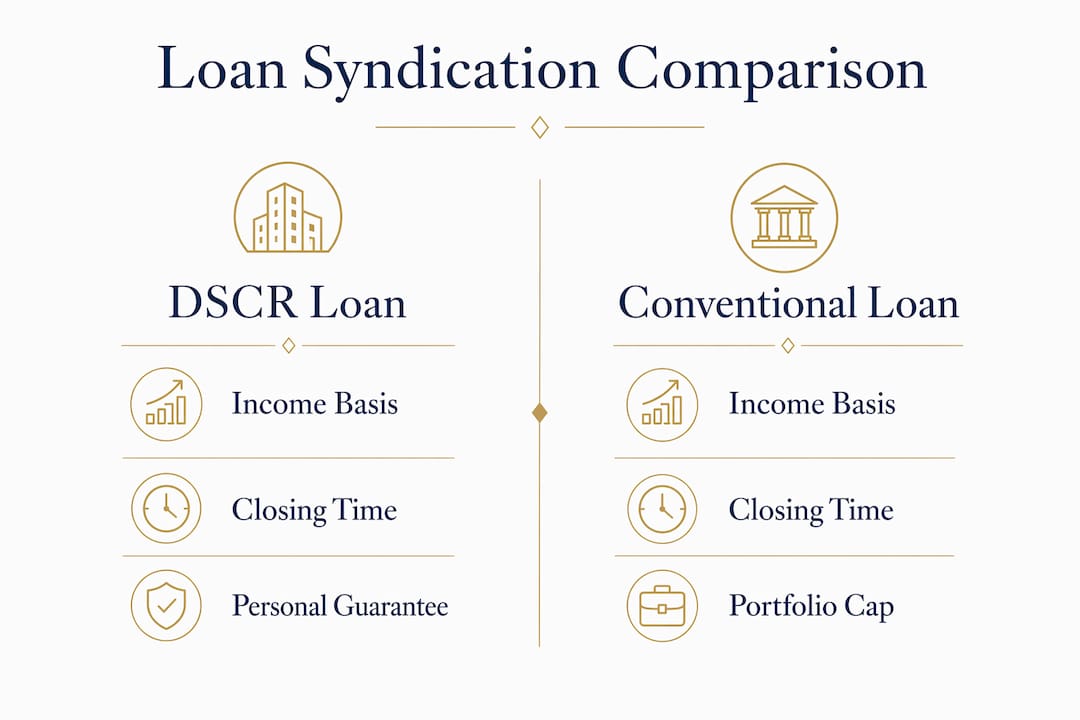
- Closing speed: 13–21 days in 2026 market conditions, versus 30–60 days for conventional loans
Pro Tip: DSCR loans close in 3 to 4 weeks in syndication structures, compared to 60 to 120 days for commercial loans. That speed lets syndicators compete on off-market deals where sellers prioritize certainty of close over price.
The personal guarantee requirement is the most overlooked risk in DSCR syndications. Unlike traditional non-recourse commercial loans, DSCR loans typically require a personal guarantee from the sponsor. That introduces personal liability, which syndicators must disclose clearly to their investor base and factor into their risk structure.
What defines conventional loan syndication and its qualification criteria?
Conventional loan syndication relies on Fannie Mae or Freddie Mac guidelines, which means the borrower’s personal financial profile drives approval. Lenders pull tax returns, W-2s, bank statements, and calculate a full debt-to-income ratio. Strong personal credit and documented income are non-negotiable.

The cost advantage of conventional loans is real. Rates currently run 6.25%–7.5%, meaningfully below the DSCR range. Down payments run 15–20%, and prepayment penalties are rare. For a syndicator with clean personal finances and a small portfolio, conventional financing delivers lower carrying costs and more exit flexibility.
Key conventional loan characteristics for syndicators:
- Income verification: Full personal income documentation required at underwriting
- Rate range: 6.25%–7.5% as of may 2026, the lower end of investor loan pricing
- Down payment: 15–20%, preserving more equity capital for deployment
- Prepayment penalties: Minimal to none, allowing flexible refinancing
- Entity ownership: Title must be in the individual borrower’s name at closing
- Portfolio cap: Fannie Mae limits conventional financing to 10 financed properties per borrower
- Closing timeline: 30–45 days, driven by income verification requirements
Pro Tip: If your personal adjusted gross income on your tax returns is significantly lower than your actual earnings due to depreciation and deductions, conventional underwriting will penalize you. Run a pro forma DTI analysis before assuming conventional is the cheaper option.
The 10-property cap is the defining constraint for growth-oriented syndicators. Once you hit that ceiling, conventional financing stops being an option regardless of your credit score or income. That is the point where most investors transition to DSCR products or commercial loan structures. Conventional loans work best for first-time syndicators or those managing a small, stabilized portfolio where personal income is strong and entity structure is not yet a priority.
How to choose between DSCR and conventional loan syndication
Selecting the right financing structure requires matching the loan product to your investor profile, deal type, and growth trajectory. Work through these decision factors in order:
-
Assess your personal income documentation. If your tax returns show strong W-2 or Schedule E income with a manageable DTI, conventional financing is worth pricing first. If you are self-employed, have significant write-offs, or your income is irregular, DSCR is the more reliable path to approval.
-
Count your current financed properties. If you are at or near 10 properties, conventional financing is no longer available to you under Fannie Mae guidelines. DSCR loans carry no portfolio limit, making them the only scalable option for investors building a dscr loan syndicated rental portfolio beyond that threshold.
-
Compare total cost of capital, not just rate. The 70–120 basis point rate premium on DSCR loans is real, but factor in the higher down payment, prepayment penalties, and closing costs before concluding conventional is cheaper. On a $1.5 million acquisition, a 1% rate difference equals $15,000 per year in additional interest. But a 5% higher down payment requirement ties up $75,000 in additional equity.
-
Evaluate your deal type. Stabilized rental properties with documented lease income are ideal for DSCR. Value-add deals where the property lacks current rental income are generally unsuitable for DSCR loans because there is no cash flow to underwrite. Those deals belong in bridge loan or construction financing structures.
-
Consider entity and liability structure. DSCR loans allow LLC or trust ownership at closing. Conventional loans require personal name vesting. If your syndication is structured as an LLC for liability protection, DSCR is the only conforming option without a post-closing transfer.
-
Factor in closing speed. If you are competing for a property with multiple offers, a 14–30 day DSCR close versus a 45-day conventional close can be the deciding factor in winning the deal.
| Decision Factor | DSCR Loan | Conventional Loan |
|---|---|---|
| Income verification | Property cash flow only | Full personal income docs |
| Portfolio scalability | Unlimited properties | 10-property Fannie Mae cap |
| Entity ownership | LLC or trust at closing | Personal name required |
| Closing speed | 13–21 days | 30–45 days |
| Rate range (2026) | 6.75%–8.75% | 6.25%–7.5% |
| Down payment | 20–25% | 15–20% |
Pro Tip: Use the Brookmontcapital DSCR calculator to model multiple loan scenarios before committing to a structure. Changing your LTV by 5% or improving your credit score by 20 points can shift your rate tier meaningfully.
Troubleshooting common challenges in DSCR vs conventional syndication
Even well-structured syndications run into financing obstacles. Knowing where the friction points are lets you address them before they delay a close.
- Weak property cash flow: A DSCR below 1.20 will either kill approval or push you into a higher rate tier. The fix is to negotiate a lower purchase price, increase rents before closing, or reduce the loan amount with a larger down payment to improve the ratio.
- Personal guarantee exposure: DSCR loans require a personal guarantee. In a syndication, this means the sponsor carries personal liability even when the property is held in an LLC. Syndicators should document this clearly in their private placement memorandum and consider umbrella liability coverage.
- Prepayment penalty timing: A 3-to-5-year prepayment penalty on a DSCR loan conflicts directly with a BRRRR or value-add exit strategy. If your business plan calls for a refinance within two years, DSCR is the wrong product. A bridge loan or short-term commercial product is more appropriate.
- Exceeding the conventional cap: Once you hold 10 financed properties, Fannie Mae guidelines close the door on conventional financing. Transition planning should begin at property seven or eight, not after you hit the wall.
- Rate optimization for DSCR: Rate differences of 0.5% to over 1.0% are common across lenders for identical DSCR loan scenarios. Shopping a single lender is a costly mistake. Working through a broker who accesses multiple wholesale lenders is the most reliable way to find the lowest rate for your specific LTV and credit profile.
“Many investors mistakenly overlook wholesale lender channels for DSCR loans. Brokers provide access to the best rates and LTVs by competing across multiple lenders, a channel most retail borrowers never see.” — Best DSCR Lenders, Zeitro
Pro Tip: A mixed portfolio strategy, using conventional loans for your first several properties and transitioning to DSCR for properties 6 through 10 and beyond, preserves your lower-cost conventional capacity while building the scale that DSCR enables. Most disciplined syndicators run both products simultaneously.
Key Takeaways
DSCR loan syndication scales without personal income limits, while conventional syndication costs less but caps out at 10 properties and requires personal name vesting at closing.
| Point | Details |
|---|---|
| Qualification basis | DSCR loans use property cash flow; conventional loans require full personal income verification. |
| Portfolio scalability | DSCR loans carry no property cap; Fannie Mae limits conventional financing to 10 properties. |
| Cost vs. flexibility | Conventional rates run 70–120 bps lower, but DSCR allows LLC ownership and faster closings. |
| Closing speed advantage | DSCR loans close in 13–21 days versus 30–45 days for conventional, a real competitive edge. |
| Personal guarantee risk | DSCR syndications require a personal guarantee from the sponsor, introducing direct personal liability. |
What I’ve learned from watching syndicators pick the wrong loan
The most common mistake I see is syndicators defaulting to conventional financing because the rate is lower, without accounting for the full cost of that choice. A 100 basis point rate savings means nothing if the 45-day closing timeline costs you the deal, or if the personal name vesting requirement forces a post-closing LLC transfer that creates title complications.
The second mistake is ignoring the personal guarantee on DSCR loans. Sponsors who structure their syndications as LLCs for liability protection often assume the LLC insulates them completely. It does not, when the DSCR lender requires a personal guarantee. That guarantee needs to be disclosed to investors and priced into the sponsor’s risk calculus.
What actually works in 2026 is a deliberate sequencing strategy. Use conventional financing early, when your personal income documentation is strong and your portfolio is small. Transition to DSCR as you approach the 10-property threshold or as your entity structure becomes more complex. And always, always shop DSCR rates across multiple lenders through a broker. The spread between the best and worst DSCR pricing for the same deal can exceed 1.0%, which on a $2 million loan is $20,000 per year in unnecessary interest expense. That is not a rounding error. It is a capital allocation decision.
— Jerry
Brookmontcapital’s financing solutions for syndicators
Brookmontcapital works with real estate investors and developers across the country to structure DSCR and conventional financing for syndicated rental portfolios. Whether you are acquiring your first syndicated asset or scaling past the 10-property threshold, the right loan structure depends on your specific income profile, entity setup, and deal timeline.
Brookmontcapital’s DSCR loan solutions are designed for rental property investors who need fast closings, LLC-compatible title vesting, and qualification based on property performance rather than personal income. Use the DSCR calculator to model your scenario before your next acquisition, and connect with the Brookmontcapital advisory team to compare loan structures across your full capital stack.
FAQ
What is the main difference between DSCR and conventional loan syndication?
DSCR loans qualify based on property cash flow with no personal income verification required. Conventional loans require full personal income documentation, including tax returns, W-2s, and DTI analysis.
How many properties can I finance with conventional loans in a syndication?
Fannie Mae caps conventional financing at 10 financed properties per borrower. DSCR loans carry no portfolio limit, making them the standard choice for investors scaling beyond that threshold.
Can I hold a DSCR loan in an LLC?
Yes. DSCR loans allow title to vest directly in an LLC or trust at closing. Conventional loans require the title to be in the individual borrower’s name at origination.
How much faster do DSCR loans close compared to conventional loans?
DSCR loans average 13–21 days to close in 2026. Conventional loans typically take 30–45 days due to income verification requirements.
Do DSCR loans require a personal guarantee in a syndication?
Yes. Most DSCR loans require a personal guarantee from the sponsor, introducing personal liability even when the property is held in an LLC. Syndicators must account for this in their offering documents.