
Construction Lender Underwriting Criteria: 2026 Guide

Construction lender underwriting criteria are the specific financial and project standards lenders apply to determine whether a construction loan can be approved and funded. Known formally as construction loan underwriting standards, these criteria cover three core dimensions: borrower credit quality, project viability, and financial risk ratios. In 2026, tightening standards have raised the bar across all three. Debt Service Coverage Ratio minimums have moved up, Loan-to-Cost caps have tightened, and regulatory costs like NYC’s Local Law 97 now factor directly into net operating income projections. Developers and investors who understand these requirements before submitting an application hold a measurable advantage.
What are the key financial ratios lenders use in construction loan underwriting?
The financial ratios in construction loan underwriting set the quantitative floor every project must clear before a lender will commit capital. Four metrics dominate the analysis: Debt Service Coverage Ratio (DSCR), Loan-to-Cost (LTC), Loan-to-Value (LTV), and Debt Yield.
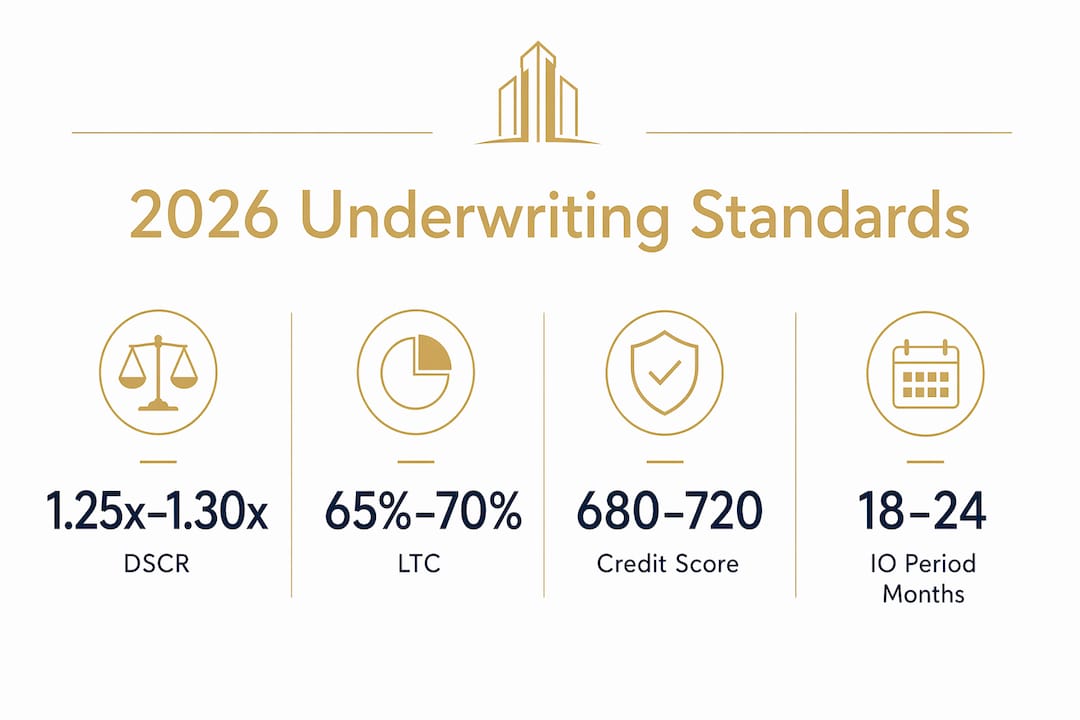
DSCR measures whether projected net operating income covers debt payments at stabilization. Most bank lenders in 2026 require a minimum DSCR between 1.25x and 1.30x, up from 1.20x in prior years. That shift alone eliminates projects that would have qualified twelve months ago.

LTC caps how much of the total project cost a lender will finance. Banks generally cap LTC between 65% and 70% for commercial construction. A developer building a $10,000,000 project must bring at least $3,000,000 in equity to the table. LTV works alongside LTC by measuring the loan against the appraised completed value, adding a second constraint on loan sizing.
Debt Yield is calculated by dividing projected net operating income by the loan amount. Lenders use it as a cap-rate-independent risk check. A higher debt yield signals a safer loan. Lenders now apply this metric more aggressively as a backstop when appraisal assumptions look optimistic.
Pro Tip: Model all four ratios against current market rents, not projected rents, before submitting. Lenders in 2026 apply conservative underwriting assumptions based on actual market data, so pro formas built on future upside will be discounted or rejected outright.
| Metric | Prior Standard | 2026 Standard |
|---|---|---|
| DSCR (minimum at stabilization) | 1.20x | 1.25x–1.30x |
| LTC cap (commercial projects) | 70%–75% | 65%–70% |
| Interest-only period | 24–36 months | 18–24 months |
| Exit cap rate stress test | Below 7% | 7% or higher |
How do borrower qualifications and sponsorship affect loan approval?
Lender underwriting committees score sponsors on a composite of financial and experiential factors. No single metric wins approval alone. A strong credit score paired with thin experience will face the same scrutiny as a seasoned developer with marginal liquidity.
Credit score minimums for conventional construction loans typically range from 680 to 720. Alternative lenders may accept lower scores when project equity and strength compensate, but bank lenders hold firm at the higher end of that range. A score below 680 shifts the conversation toward debt funds or bridge lenders with different pricing.
Sponsor experience carries significant weight. Experienced sponsors with a track record of completing comparable projects on time and on budget receive favorable underwriting consideration. Lenders distinguish between total years in real estate and recent, comparable project completions. A developer who finished a 50-unit multifamily project in the last three years scores better than one with 20 years of general experience but no recent comparable.
Lenders weight credit score, net worth, liquidity, experience, project metrics, and pre-leasing to score sponsor risk on a 0 to 100 scale. Credit score and net worth each account for roughly 20% of that score. Liquidity accounts for 15%. That weighting tells you where to focus your preparation.
The top five borrower qualification factors lenders prioritize are:
- Credit score: Minimum 680 for bank lenders, with 700+ preferred for larger loan amounts
- Net worth: Typically required to equal or exceed the loan amount
- Liquidity: Post-close reserves covering 6–12 months of debt service
- Comparable project experience: Recent completions of similar asset type and scale
- Equity contribution: Sufficient to satisfy LTC caps, typically 30%–35% of total project cost
What project documentation do lenders require before funding?
Project documentation is where many construction loan applications stall. Lenders do not review site plans for aesthetic quality. They review them as risk proxies for municipal permitting, budget accuracy, timeline feasibility, and collateral quality.
Missing components like utility will-serve letters or failure to account for local regulations such as NYC’s Local Law 97 can trigger immediate rejection. Local Law 97 imposes carbon emission penalties on buildings over 25,000 square feet, and those costs reduce projected NOI directly. A lender who spots an unaddressed LL97 liability in a New York multifamily pro forma will discount income assumptions or decline the file.
Construction budgets must include stress-tested contingencies. Lenders require hard cost contingency of 5%–10% and soft cost contingency of approximately 5%. These are not suggestions. Loan committees treat budgets without adequate contingencies as incomplete submissions.
The sequential documentation steps lenders verify before funding are:
- Municipal site plan approval: Confirm the site plan has cleared local review and carries no outstanding permitting conditions
- Utility will-serve letters: Obtain written confirmation from utility providers that water, sewer, gas, and power capacity exist for the project
- Plan and Specification Cost Review (PSCR): Submit a third-party cost review validating that the construction budget aligns with current labor and material pricing
- Construction budget with contingencies: Include hard cost contingency of 5%–10% and soft cost contingency of 5%, with line-item detail
- Project timeline with milestones: Provide a phased schedule showing groundbreaking, framing, MEP rough-in, certificate of occupancy, and stabilization dates
- Third-party appraisal: Deliver a current as-complete and as-stabilized appraisal from a lender-approved MAI appraiser
Pro Tip: Municipal review clearance on site plans significantly lowers underwriting risk and accelerates loan approval. Submit your application only after permits are approved, not while they are pending.
How have 2026 market conditions tightened construction financing eligibility criteria?
The post-2024 volatility in commercial real estate has pushed lenders toward materially more conservative underwriting assumptions. The changes are structural, not cyclical. Developers who model their projects against 2022 or 2023 lending norms will find their numbers do not clear current thresholds.
Lenders now stress test exit cap rates at 7% or higher, compared to the sub-6% assumptions common in prior cycles. A higher exit cap rate reduces the projected stabilized value, which compresses LTV and loan proceeds. A project that penciled at $8,000,000 in loan proceeds under a 5.5% exit cap may only support $6,500,000 under a 7% assumption.
Interest-only periods have shortened to 18–24 months, down from 24–36 months in prior years. Shorter IO periods increase payment pressure during construction and lease-up. Developers must build larger interest reserves or demonstrate faster stabilization timelines to satisfy lender requirements.
Regulatory cost exposure now factors directly into underwriting. Buildings subject to Local Law 97 or similar state-level energy mandates carry projected compliance costs that reduce NOI. Lenders apply those reductions before calculating DSCR, which means a project that appears to clear 1.25x on a clean pro forma may fall below threshold once regulatory costs are modeled in. Developers must address these costs explicitly in their submissions, not leave them for the lender to discover.
What steps help developers qualify for a construction loan in 2026?
Preparation before submission is the single most effective way to improve approval odds. Developers who perform pre-underwriting using bank-level criteria reduce friction and align assumptions with lender expectations before the file reaches an underwriting committee.
Lenders emphasize realistic project timelines with milestones to assess timeline risk and confirm that interest reserves are sized correctly. A timeline that compresses lease-up into 90 days for a 200-unit project will draw skepticism. Build in buffer and document your absorption assumptions with comparable market data.
Common mistakes that derail construction loan submissions include:
- Submitting pro formas based on projected rent growth rather than current market rents
- Omitting utility will-serve letters or submitting site plans before municipal approval
- Underestimating contingencies, particularly hard cost reserves below 5%
- Presenting a sponsor resume that lists total experience without highlighting recent comparable completions
- Failing to model regulatory cost exposure such as Local Law 97 or local energy compliance mandates
- Ignoring current lender standards when sizing the interest reserve for a shortened IO period
Engage your lender early in the process. Lenders who are consulted before a formal submission often clarify specific documentation requirements, flag potential issues with the pro forma, and provide guidance on structuring the capital stack to meet their criteria. That conversation costs nothing and frequently saves weeks of back-and-forth after submission.
Key Takeaways
Successful construction loan approval in 2026 requires meeting tighter DSCR, LTC, and documentation standards while demonstrating sponsor experience, realistic budgets, and regulatory cost awareness.
| Point | Details |
|---|---|
| DSCR threshold has risen | Lenders now require 1.25x–1.30x at stabilization, up from 1.20x in prior years. |
| LTC caps limit leverage | Most bank lenders cap Loan-to-Cost at 65%–70%, requiring 30%–35% equity from sponsors. |
| Documentation completeness matters | Missing utility letters or unaddressed regulatory costs like Local Law 97 trigger immediate rejection. |
| Sponsor experience is scored | Recent comparable project completions carry more weight than total years in the industry. |
| Pre-underwriting reduces friction | Aligning pro forma assumptions with bank-level criteria before submission improves approval odds. |
What I’ve learned about construction underwriting that most developers find out too late
The developers who struggle most with construction loan approvals are not the ones with weak projects. They are the ones who treat the underwriting process as a formality rather than a negotiation. I have seen well-capitalized sponsors with strong track records get declined because their pro forma used rent projections from 18 months ago, or because their site plan was still in municipal review when they submitted.
The 2026 market has no patience for optimistic assumptions. Lenders are stress-testing exit cap rates at 7% or higher, and they are doing it deliberately. They want to see that your project survives a bad exit, not just a good one. If your deal only works at a 5.5% cap, you do not have a deal. You have a bet.
What actually moves the needle is preparation that mirrors the lender’s own analysis. Run your DSCR against current market rents using a DSCR calculator before you build your pitch. Get your permits approved before you submit, not after. Include hard cost contingency at 10%, not 5%, if your project has any complexity. And present your sponsor resume with specific recent completions, not a general career summary.
The developers who close construction loans in this environment share one trait: they have done the lender’s work for them before the file arrives. That preparation signals competence, reduces perceived risk, and gives underwriting committees less reason to push back. It is not about gaming the system. It is about understanding what lenders actually need to say yes.
— Jerry
How Brookmontcapital structures construction financing for today’s market
Brookmontcapital works with real estate developers and investors nationwide to structure and source construction financing that meets current lender underwriting requirements. The firm’s advisory approach covers capital stack design, pro forma stress testing, and lender matching, connecting sponsors with institutional lenders, banks, and debt funds positioned to fund ground-up and value-add construction projects.
Whether your project needs construction financing guidance from the ground up or you need help aligning your application with 2026 underwriting standards, Brookmontcapital provides the advisory depth to get your deal structured correctly. The firm also offers capital stack advisory services for sponsors who need to layer preferred equity or bridge capital to satisfy lender equity requirements. Contact Brookmontcapital directly to discuss your project and financing objectives.
FAQ
What is the minimum DSCR for a construction loan in 2026?
Most bank lenders require a minimum DSCR of 1.25x to 1.30x at stabilization in 2026, up from 1.20x in prior years. Projects that do not clear this threshold at current market rents will not qualify for conventional bank construction financing.
What LTC ratio do construction lenders typically allow?
Bank lenders generally cap Loan-to-Cost at 65%–70% for commercial construction projects. Developers must contribute at least 30%–35% of total project cost as equity to meet this requirement.
What credit score do you need for a construction loan?
Conventional construction lenders typically require a minimum credit score of 680 to 720. Alternative lenders may accept lower scores when project equity and sponsor strength offset credit risk.
Why do lenders reject construction loan applications?
Common rejection triggers include missing utility will-serve letters, site plans still in municipal review, pro formas based on projected rather than current market rents, and construction budgets without adequate hard and soft cost contingencies.
How does sponsor experience affect construction loan underwriting?
Lenders weight recent comparable project completions heavily in their sponsor scoring. A developer with a recent, on-budget completion of a similar asset type scores better than one with broad but less relevant experience.
Recommended
- Construction Loan Requirements for Developers | Brookmont Capital Ventures
- How to Underwrite a CRE Deal When Interest Rates Stay Higher for Longer | Brookmont Capital Ventures
- How to Get Your CRE Deal Funded in 2026: What Lenders Actually Want to See | Brookmont Capital
- How Does Commercial Real Estate Financing Work? | Brookmont Capital Ventures