
CMBS vs Bank Loans: What Developers Must Know

CMBS financing is defined as securitized, non-recourse commercial mortgage debt pooled into bond trusts and sold to institutional investors, distinct from bank loans held on a lender’s balance sheet. For real estate developers and investors comparing CMBS vs bank loan options, the choice shapes not just your interest rate but your entire post-closing operating reality. CMBS issuance exceeded $150 billion in 2025, confirming the product’s scale as a primary capital source for stabilized commercial properties above $2 million. Bank loans, by contrast, remain relationship-driven bilateral agreements with recourse provisions and greater amendment flexibility. Understanding both structures at the outset prevents costly surprises at closing and beyond.
How are CMBS loans securitized compared to bank loans?
CMBS loans originate like conventional mortgages but immediately enter a fundamentally different lifecycle. After closing, the lender pools your loan with dozens of others and transfers the entire pool into a trust. That trust issues bonds in tranches, rated from AAA down to unrated equity, and sells them to institutional investors. Your loan is no longer a bilateral agreement. It is a line item inside a bond structure governed by a Pooling and Servicing Agreement, known as a PSA.

The PSA is the document that controls everything after closing. It dictates what the master servicer can and cannot do on your behalf. CMBS loans transferred to a trust structure eliminate the direct bank relationship entirely, meaning no loan officer picks up the phone to approve a lease modification or release a parcel. The master servicer collects payments and handles routine administration, but operates within strict PSA boundaries. When a loan falls into distress or requires a material modification, it transfers to a special servicer, who represents bondholder interests, not yours.
Bank loans work differently at every stage. The originating bank holds the loan on its balance sheet as a direct asset. Your relationship manager retains authority to bring amendment requests to a credit committee. That committee can approve partial releases, lease consent waivers, or maturity extensions based on your track record and the bank’s current appetite. The process is slower in some ways but far more responsive to changing business conditions.
Key structural differences between the two loan types:
- Loan holder: CMBS loans are held by a trust; bank loans are held by the originating institution.
- Post-closing contact: CMBS borrowers deal with a master servicer; bank borrowers deal with a relationship manager.
- Modification authority: Master servicers are strictly bound by PSA rules, with limited ability to approve exceptions outside those rules.
- Special servicer trigger: CMBS loans transfer to a special servicer upon default or when material modifications are needed.
- Recourse: CMBS loans are typically non-recourse with standard carve-outs; bank loans frequently carry full or partial recourse.
Pro Tip: Before signing a CMBS term sheet, request a copy of the standard PSA provisions from your attorney. Knowing which modifications require special servicer approval before closing saves significant time and legal fees later.
What are the cost components and financial trade-offs?
Interest rates on CMBS and bank loans overlap more than most developers expect, but the total cost picture diverges significantly. CMBS loan rates range from approximately 6.08% to 7.95%, while bank loan rates on conventional commercial products range from roughly 5.26% to 8.75% depending on the borrower relationship and product type. CMBS rates are fixed for the full loan term, typically 5, 7, or 10 years, which provides certainty that floating-rate bank products cannot match.
Upfront costs tell a different story. CMBS closing costs are significantly higher than bank loan equivalents, driven by mandatory third-party reports including appraisals, environmental assessments, property condition reports, and seismic studies in applicable zones. Legal fees are also elevated because CMBS transactions require specialized securitization counsel on both sides. Reserve requirements add another layer: CMBS loans typically mandate upfront reserves for taxes, insurance, capital expenditures, and sometimes tenant rollover, all held in lender-controlled accounts.
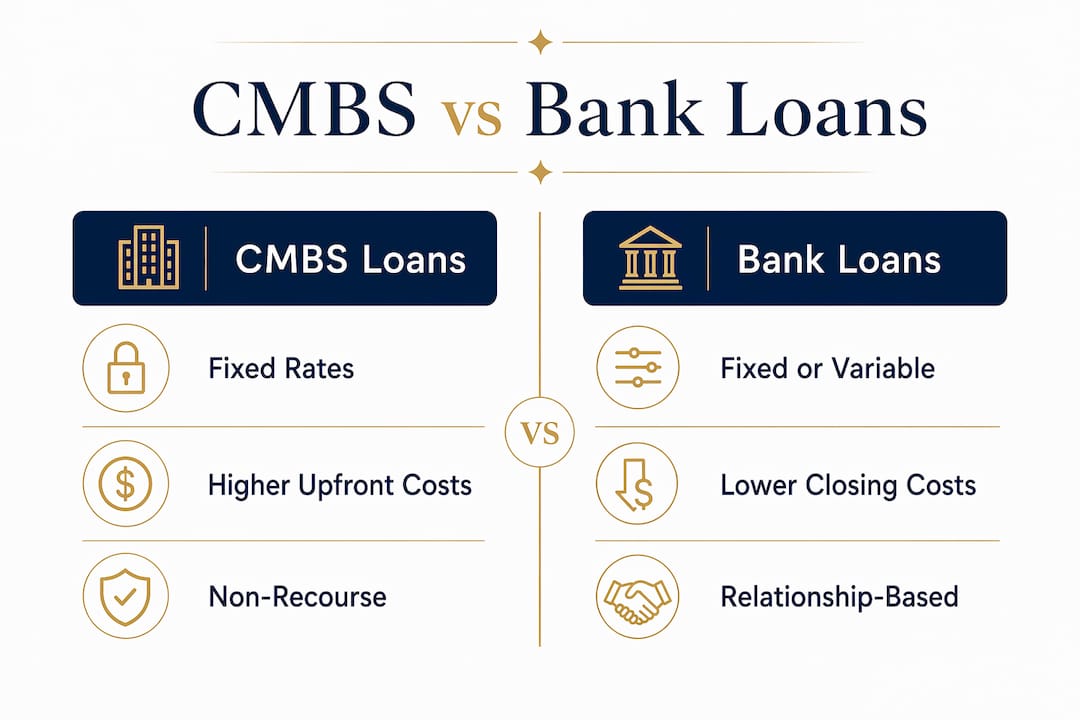
Prepayment is where the cost gap becomes most pronounced. CMBS loans use defeasance or yield maintenance as prepayment mechanisms, both of which can be substantially more expensive than the step-down penalties common in bank loans. Defeasance requires purchasing a portfolio of U.S. Treasury securities that replicate the remaining loan cash flows, a process that can cost millions on large loans when Treasury yields are low relative to the loan rate. Bank step-down penalties typically decline from 3% to 1% over a three-to-five-year schedule and disappear entirely.
| Cost Component | CMBS Loan | Bank Loan |
|---|---|---|
| Interest rate structure | Fixed, 6.08%–7.95% | Fixed or floating, 5.26%–8.75% |
| Upfront closing costs | High (reports, legal, reserves) | Moderate |
| Prepayment penalty | Defeasance or yield maintenance | Step-down schedule |
| Recourse | Non-recourse with carve-outs | Often full or partial recourse |
| Loan-to-value | Typically up to 75% | Varies, often 65%–75% |
Pro Tip: Calculate the all-in cost of a CMBS loan by modeling defeasance expense at your projected exit date, not just the stated rate. A 25-basis-point rate advantage evaporates quickly against a seven-figure defeasance bill.
How does post-closing flexibility differ for developers?
Post-closing flexibility is the single most consequential difference between CMBS and bank loans for developers with active business plans. CMBS loans are structurally inflexible because the PSA governs every material decision, and the master servicer has no authority to deviate from it. CMBS loan servicing rigidity under PSA rules means that routine requests, such as approving a new anchor tenant lease, releasing a pad site, or consenting to a mezzanine loan, require formal servicer review and often legal opinions, taking weeks to months.
Bank loans, by contrast, preserve the borrower-lender relationship as a working dynamic. A bank relationship manager can escalate a partial release request to a credit committee within days. The bank weighs its ongoing relationship with the sponsor, the property’s current performance, and its own portfolio strategy. That discretion has real value when your development plan evolves after closing.
Common scenarios where CMBS inflexibility creates problems:
- Lease modifications: Adding a co-tenancy clause or extending a major tenant’s term requires servicer consent and legal review.
- Partial releases: Selling one parcel from a multi-property CMBS loan is complex and often requires significant paydown premiums.
- Mezzanine financing: Adding subordinate debt post-closing typically requires servicer approval and may be prohibited by the PSA.
- Property improvements: Major capital expenditure plans beyond the reserve scope require formal approval.
- Loan assumptions: Selling the property with the loan in place requires servicer consent and assumption fees.
The core conceptual difference is that relationship-based bank loans offer borrower advocacy post-closing, while CMBS loans are transactional with no ongoing lender discretion. Developers who underestimate this distinction often find themselves paying legal fees to accomplish routine property management tasks.
Which projects fit CMBS financing versus bank loans?
CMBS financing suits a specific project profile. Developers prefer CMBS for deals exceeding local bank capacities, with loan sizes scaling from $2 million to $500 million, and for stabilized, income-producing assets held long term. A fully leased retail center, a stabilized multifamily property, or a net-leased industrial portfolio all fit the CMBS profile well. The fixed rate locks in debt service certainty, and the non-recourse structure protects the sponsor’s balance sheet.
Bank loans suit deals expecting business plan changes or early payoff. If you are acquiring a value-add office building, repositioning a mixed-use asset, or developing a project with a three-to-five-year exit horizon, a bank loan or a bridge loan preserves the flexibility your business plan requires. The ability to release parcels, modify leases, and refinance without defeasance cost is worth a higher rate in most active development scenarios.
| Project Characteristic | CMBS Loan | Bank Loan |
|---|---|---|
| Occupancy at closing | Stabilized, 90%+ occupied | Value-add or transitional |
| Hold period | Long-term, 7–10 years | Short to medium, 3–5 years |
| Business plan complexity | Simple, minimal changes expected | Active, modifications likely |
| Loan size | $2M–$500M | Varies, often under $50M |
| Property type | Retail, industrial, multifamily, office | Broad, including construction |
| Exit strategy | Hold or sale with loan assumption | Refinance or sale with payoff |
Pro Tip: Map your exit strategy before selecting a loan type. If there is any realistic scenario where you sell or refinance within five years, model the defeasance cost on a CMBS loan before committing. That single calculation often determines the right structure.
What are the key steps in the CMBS and bank loan application process?
The CMBS loan application process follows a defined sequence with less room for deviation than bank underwriting. Following these steps in order reduces delays and avoids costly restarts.
- Preliminary term sheet. Submit a loan request package including rent roll, trailing 12-month financials, property description, and sponsor background. The lender issues a non-binding term sheet within 5–10 business days.
- Application and deposit. Execute the application, pay the good-faith deposit, and authorize third-party reports. This triggers the formal underwriting clock.
- Third-party reports. Order the appraisal, environmental Phase I, property condition report, and any required surveys. These reports take 3–6 weeks and represent a significant portion of closing costs.
- Underwriting and credit approval. The lender underwrites the loan against CMBS bond market standards, not just internal credit policy. Debt service coverage ratio and loan-to-value thresholds are firm.
- Loan commitment. Upon credit approval, the lender issues a binding commitment letter. Review all reserve requirements, lockbox provisions, and cash management terms at this stage.
- Legal documentation and closing. CMBS legal documentation is more extensive than bank loan documents. Budget 3–4 weeks for document negotiation. CMBS loans typically close in 45–60 days from application, though complex deals take longer.
Bank loan underwriting follows a similar sequence but with more flexibility at each stage. The relationship manager can often accelerate credit approval for known sponsors, and documentation is less standardized. Bank loans can close in 30–45 days for straightforward deals. The trade-off is that bank credit appetite shifts with the institution’s portfolio concentration and regulatory environment, creating approval uncertainty that CMBS bond market standards do not carry in the same way.
Understanding how commercial real estate financing works across both structures helps you prepare the right documentation package from day one and avoid the most common application delays.
Key Takeaways
CMBS loans deliver fixed-rate, non-recourse capital at scale for stabilized assets, but developers must accept PSA-driven servicing rigidity and significant defeasance costs in exchange for those advantages.
| Point | Details |
|---|---|
| Securitization changes everything | CMBS loans transfer to a trust post-closing, eliminating direct lender discretion for modifications. |
| Defeasance is the hidden cost | Model defeasance expense at your projected exit date before committing to a CMBS loan. |
| Flexibility favors bank loans | Bank relationship managers can approve amendments and partial releases that CMBS servicers cannot. |
| Project fit drives the decision | Stabilized, long-term hold assets align with CMBS; value-add and short-hold deals align with bank loans. |
| Closing timelines are similar | Both structures close in 30–60 days, but CMBS requires more third-party reports and legal preparation. |
What I’ve learned from watching developers choose the wrong loan
Developers consistently underestimate two things about CMBS loans: the defeasance cost and the servicing friction. Borrowers frequently underestimate defeasance costs and the administrative burden when refinancing or selling a CMBS-financed property ahead of schedule. I have seen sponsors lock in a 30-basis-point rate advantage on a CMBS loan, then spend 18 months and six figures in legal fees trying to get servicer consent for a lease modification that a bank would have approved in two weeks.
The market trend worth watching is that CMBS issuance has grown substantially, which means more developers are encountering these structures for the first time. That growth brings borrowers who are accustomed to bank relationships into a world where the servicer’s hands are tied by the PSA. The mismatch between expectation and reality is where deals go sideways.
My practical advice is this: use CMBS when your business plan is genuinely simple and your hold period is long. Use a bank loan or a bridge product when there is any meaningful probability of a mid-term change. The rate differential rarely justifies the operational constraints for an active developer. And regardless of which structure you choose, engage a capital markets advisor before you sign a term sheet. The cost of that conversation is a fraction of the cost of choosing the wrong structure.
— Jerry
Brookmontcapital structures both CMBS and bank loan financing
Brookmontcapital works with real estate developers and investors nationwide to structure and source the right commercial real estate financing for each deal’s specific profile.
Whether your project fits the CMBS loan structure or requires the flexibility of a bank loan, bridge product, or preferred equity layer, Brookmontcapital connects you with the institutional lenders, debt funds, and equity partners who can execute at your deal size and timeline. The firm’s advisory process starts with your business plan and exit strategy, then works backward to the optimal capital structure. Explore the full range of commercial real estate financing solutions or contact Brookmontcapital directly to discuss your next transaction.
FAQ
What is CMBS financing in commercial real estate?
CMBS financing is a commercial mortgage loan that is pooled with other loans, securitized into a trust, and sold to investors as bonds. The loan is non-recourse, fixed-rate, and governed post-closing by a Pooling and Servicing Agreement rather than a direct lender relationship.
How does CMBS loan securitization affect borrowers?
Once securitized, your loan is managed by a master servicer bound by strict PSA rules, removing the lender’s ability to approve modifications, partial releases, or amendments outside those rules. This creates significant post-closing rigidity compared to a bank loan.
What is a CMBS special servicer?
A CMBS special servicer takes over loan management when a borrower defaults or requests a material modification that exceeds the master servicer’s authority. The special servicer represents bondholder interests and charges fees for its involvement.
How do CMBS loan reserves work?
CMBS loans require upfront reserves for taxes, insurance, capital expenditures, and sometimes tenant rollover, held in lender-controlled accounts and released only for approved expenses. These reserves increase total closing costs relative to bank loans.
When should a developer choose a bank loan over CMBS?
A bank loan is the better choice when your business plan includes lease modifications, partial property sales, mezzanine financing, or a hold period under five years. Bank relationship managers retain discretion to approve changes that CMBS servicers cannot accommodate under PSA rules.