
Bridge Loan to Permanent Financing: Your 2026 Guide

Bridge loan to permanent financing is a strategy where short-term capital funds a property acquisition or renovation, then converts to long-term debt with terms pre-negotiated at the original closing. This approach is the standard solution for value-add multifamily, commercial, and retail properties that cannot yet qualify for permanent financing due to occupancy or income gaps. The bridge-to-perm structure, as lenders formally call it, reduces refinance risk by locking exit terms upfront rather than leaving the borrower exposed to rate volatility at stabilization. Brookmontcapital structures these transactions for developers and investors across property types, aligning bridge terms with realistic stabilization timelines from day one.
What is a bridge loan and how does it function?
A bridge loan is a short-term loan, typically 6–24 months, structured as interest-only and designed to fund a property through a transitional phase. Lenders approve bridge loans based on the property’s projected value and future income, not its current cash flow. That distinction matters because it opens the door to acquisitions and renovations that permanent lenders would decline outright.
Bridge loans carry higher costs than permanent debt. Rates typically run 7–12% plus upfront origination points, which reflects the lender’s elevated risk during a property’s unstable phase. Investors absorb those costs as a calculated trade-off for speed and access.
Common scenarios where bridge financing is the right tool:
- Acquisition with deferred maintenance: The property’s physical condition disqualifies it for agency or CMBS permanent financing until repairs are complete.
- Lease-up phase: A newly constructed or repositioned asset has not yet reached the occupancy threshold required for permanent loan underwriting.
- Limited documentation: A recent acquisition lacks the 12–24 months of operating history most permanent lenders require.
- Competitive bid situations: Bridge loans enable fast closings that permanent loans cannot match, giving investors a real edge in competitive markets.
Pro Tip: Structure your bridge loan term to match your realistic renovation and lease-up timeline, not the most optimistic scenario. Adding a 3–6 month buffer protects you from construction delays that would otherwise trigger a costly extension or maturity default.
How does conversion from bridge loan to permanent financing work?
The bridge-to-perm process operates in two distinct models. The first is a true bridge-to-perm structure where the permanent loan terms are locked in at the bridge closing, and conversion happens automatically once the property hits agreed stabilization benchmarks. The second is a two-step refinance where the borrower secures a bridge loan independently and then shops for permanent financing separately after stabilization. Each model carries different risk and cost profiles.

The locked bridge-to-perm structure is the more protective option. Borrowers move from high-interest bridge rates, often around 12%, to permanent loan rates typically in the 7–8% range without a new appraisal or full re-underwriting in most cases. That eliminates the single biggest risk in value-add investing: the refinance approval risk after you have already spent capital on improvements.
Conversion is triggered by specific, pre-agreed milestones. Common triggers include:
- Occupancy threshold: The property reaches 85% or higher physical occupancy, sustained for a defined period such as 90 days.
- NOI target: Net operating income meets or exceeds the level required to support the permanent loan’s debt service.
- DSCR requirement: The debt service coverage ratio hits the lender’s minimum, typically 1.20x or higher for most commercial permanent loans.
- Stabilization period: The property maintains qualifying metrics for a minimum consecutive period before conversion is triggered.
“The most overlooked benefit of a locked bridge-to-perm is not the rate protection. It is the elimination of re-underwriting risk. Markets shift. Lenders tighten. A borrower who locked permanent terms at bridge closing does not care about either.”
If market rates drop significantly after you lock, most structures allow you to break the rate lock for a penalty. Evaluate that penalty against the potential savings before assuming the lock is always the right call.
What do you need before pursuing this financing path?
Preparation determines whether your permanent loan conversion goes smoothly or stalls. Investors need a credit score above 660, clear renovation timelines, and realistic market rent projections before approaching lenders for a bridge-to-perm structure. Lenders underwrite the permanent loan exit at origination, so your pro forma must hold up to scrutiny from day one.
| Prerequisite | What lenders evaluate |
|---|---|
| Credit score | Minimum 660 for most long-term financing options; higher scores improve rate and leverage |
| Renovation budget | Detailed line-item scope with contingency; lenders flag thin contingencies as execution risk |
| Market rent projections | Supported by comparable lease data, not developer assumptions |
| DSCR at stabilization | Projected NOI divided by permanent loan debt service; must meet lender minimums |
| Exit strategy documentation | Written plan showing how and when permanent financing replaces the bridge loan |
| Carry cost analysis | Total interest, fees, and operating costs during the bridge period modeled against projected returns |
Additional factors that affect your readiness:
- Prepayment and extension penalties: Review bridge loan terms for costs tied to early payoff or maturity extensions before you sign.
- Lender relationship: Permanent lenders who are unfamiliar with your market or asset type add approval risk. Work with advisors who have established lender relationships.
- Operating benchmarks: Some lenders require 90 days of stabilized operations before they will fund the permanent loan, even in a locked structure.
Pro Tip: Run your DSCR calculation using the permanent loan’s rate and amortization schedule, not the bridge loan’s interest-only payment. Many investors underestimate how much the debt service increases at conversion, which can push DSCR below the lender’s threshold.
When is the right time to refinance into permanent financing?
Refinance timing is the most mismanaged variable in bridge-to-perm execution. Refinancing should occur at stabilization, not at the bridge loan’s maturity date. Those two events rarely align, and treating them as synonymous is a costly mistake.
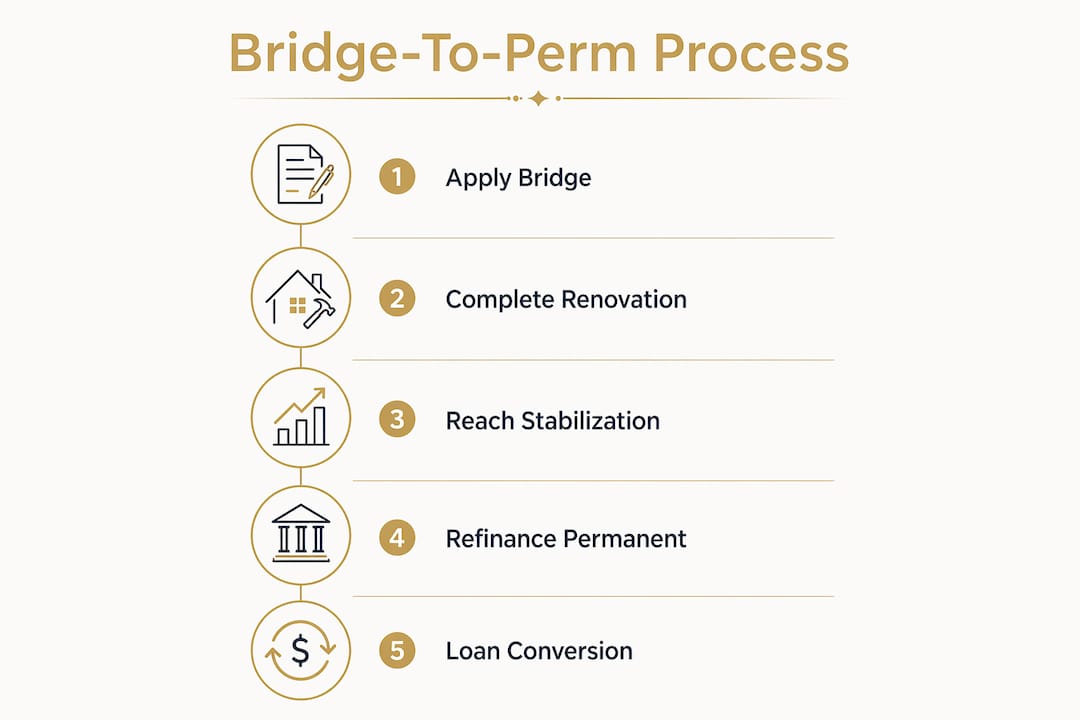
The property signals readiness through three conditions: completed renovation, stable occupancy at or above the lender’s threshold, and predictable cash flow that supports the permanent loan’s debt service. When all three are present, waiting adds carry cost without adding value.
Delaying refinance beyond stabilization increases carrying costs and exposes investors to maturity risk unnecessarily. A property that stabilizes at month 14 of a 24-month bridge loan should refinance at month 14, not month 24. The 10 months of additional bridge interest represent pure cost with no corresponding benefit.
Early refinance also supports capital recycling. Permanent financing typically releases equity through a cash-out refinance, which funds the next acquisition. Investors who refinance promptly compound their portfolio growth faster than those who let bridge loans run to maturity.
Common timing pitfalls to avoid:
- Waiting for a “better” rate environment while bridge interest accumulates
- Delaying because the permanent loan process feels complex or time-consuming
- Missing the stabilization window because renovation ran over schedule
- Assuming the lender will automatically extend the bridge loan without penalty
One-time-close vs. two-time-close: which structure fits your project?
The choice between a one-time-close and a two-time-close structure defines your project’s refinancing risk profile and total cost. One-time-close loans combine construction and permanent financing into a single approval and a single closing event. Two-time-close loans treat construction and permanent financing as separate transactions with separate qualifications.
| Feature | One-time-close | Two-time-close |
|---|---|---|
| Number of closings | One | Two |
| Closing costs | Lower, paid once | Higher, paid twice |
| Re-qualification risk | None | Required at permanent closing |
| Rate lock | Set at initial closing | Negotiated after construction |
| Flexibility | Lower; terms fixed upfront | Higher; shop permanent terms post-construction |
| Best for | Investors prioritizing certainty | Investors expecting rates to improve |
One-time-close reduces total closing costs and eliminates the risk of failing to qualify for permanent financing after construction is complete. That is a significant protection for developers who cannot afford to be left holding a completed asset with no permanent exit.
Two-time-close gives you the ability to shop permanent loan terms after construction, which is valuable if you expect rates to fall or your credit profile to improve. The trade-off is exposure to market conditions and lender requirements at the time of the second closing. For investors with strong balance sheets and high risk tolerance, that flexibility can produce better long-term terms. For most mid-market developers, the certainty of one-time-close is worth the reduced flexibility.
Key Takeaways
Successful bridge-to-perm execution requires locking permanent loan terms at bridge closing, meeting stabilization benchmarks before refinancing, and choosing the right closing structure for your project’s risk profile.
| Point | Details |
|---|---|
| Lock terms at origination | Pre-negotiated permanent loan terms protect against rate volatility and re-underwriting risk. |
| Refinance at stabilization | Trigger the permanent loan conversion when metrics are met, not when the bridge loan matures. |
| Meet DSCR requirements | Model DSCR using the permanent loan’s full amortizing payment, not the bridge’s interest-only rate. |
| Choose the right close structure | One-time-close reduces cost and risk; two-time-close offers flexibility for investors expecting better terms. |
| Prepare documentation early | Credit score, renovation budget, and market rent projections must be lender-ready before bridge closing. |
What I have learned from managing bridge-to-perm transactions
The most consistent mistake I see investors make is treating the bridge loan as the plan and the permanent financing as something to figure out later. That mindset creates the exact refinance risk the bridge-to-perm structure is designed to eliminate. By the time a property stabilizes, market conditions may have shifted, lender appetites may have tightened, and the investor is negotiating from a position of urgency rather than strength.
The investors who execute this strategy well do one thing differently: they underwrite the permanent loan exit before they close the bridge loan. They know the occupancy threshold, the NOI target, the DSCR requirement, and the lender who will fund the permanent loan. The bridge loan is simply the vehicle that gets the property to that pre-defined finish line.
I have also seen investors leave real money on the table by waiting too long to refinance after stabilization. A property that hits 90% occupancy and strong cash flow in month 15 of a 24-month bridge loan should be in permanent financing by month 18 at the latest. Every additional month of bridge interest is a direct reduction in returns, and it is entirely avoidable.
The rate lock question deserves more attention than it typically gets. Locking permanent terms at bridge closing is the right call in most rate environments, but the break-lock penalty structure matters. Before you commit, understand exactly what it costs to exit the lock if rates move 100 or 200 basis points in your favor. That analysis takes 30 minutes and can save six figures over the life of the loan.
Working with an advisor who has structured these transactions across multiple market cycles, like the team at Brookmontcapital, shortens the learning curve considerably. The nuances of conversion triggers, lock structures, and lender selection are not intuitive, and the cost of getting them wrong is high.
— Jerry
Brookmontcapital’s approach to bridge-to-perm financing
Real estate investors who need structured, exit-ready financing work with Brookmontcapital to source and close bridge loans with permanent financing built into the deal from the start.
Brookmontcapital structures bridge-to-perm solutions across multifamily, retail, and commercial property types, connecting sponsors with institutional lenders, debt funds, and banks that understand value-add execution. The advisory team helps investors plan stabilization timelines, model DSCR at conversion, and select the right closing structure for each project’s risk profile. For investors who want permanent financing options including CMBS and DSCR loans, Brookmontcapital provides direct access to lenders with competitive long-term terms. Reach out to discuss your project and get a custom bridge-to-perm financing structure built around your asset and exit timeline.
FAQ
What is a bridge-to-perm loan?
A bridge-to-perm loan combines short-term bridge financing with a pre-negotiated permanent loan that converts automatically once the property hits agreed stabilization benchmarks such as 85% occupancy or a target DSCR. It eliminates the need to refinance separately after stabilization.
What credit score do you need for bridge-to-perm financing?
Most lenders require a credit score of 660 or higher for the permanent loan component of a bridge-to-perm structure. Higher scores improve available leverage and rate terms at conversion.
When should you refinance from a bridge loan to permanent financing?
Refinance as soon as the property reaches stabilization metrics, not at the bridge loan’s maturity date. Waiting beyond stabilization adds carry costs and exposes the investor to unnecessary maturity risk.
What is the difference between one-time-close and two-time-close loans?
One-time-close combines construction and permanent financing into a single closing, reducing costs and eliminating re-qualification risk. Two-time-close involves separate closings, which adds cost but allows the borrower to shop permanent loan terms after construction is complete.
What triggers conversion in a bridge-to-perm loan?
Conversion is triggered by pre-agreed milestones, most commonly 85% occupancy sustained for 90 days, a target NOI level, or a minimum DSCR of 1.20x. Once those benchmarks are met, the loan converts without a new appraisal or full re-underwriting in most structures.