
Bridge Loan Acquisition Syndication Guide for Investors

Bridge loan acquisition syndication is the process of combining short-term interim financing with multiple institutional lenders pooling capital to fast-track real estate acquisitions. This guide covers every stage of that process, from understanding what a bridge loan is and how syndication distributes risk, to modeling your capital stack, executing the closing, and planning your exit. Real estate investors and syndicators who master this process gain a decisive edge in competitive acquisition markets where speed and execution certainty determine who wins the deal.
What is a bridge loan and how does it work in acquisition financing?
A bridge loan is short-term financing that fills the gap between a property acquisition and permanent long-term debt. Lenders structure these instruments specifically for situations where speed matters more than cost, and where a property’s current income or condition does not yet qualify for conventional financing.
Bridge loan use cases fall into five primary categories: acquisition speed plays, value-add repositioning, stabilization of underperforming assets, recapitalization of existing debt, and distressed property purchases. Each scenario shares a common thread. The sponsor needs capital now, and permanent debt cannot close in time or does not fit the asset’s current profile.

The cost structure of bridge loans reflects their short-term, high-priority nature. Institutional bridge loans carry all-in interest rates of 8–11%, with origination fees of 1–3 points. That pricing is meaningfully higher than permanent debt, but it buys something permanent debt cannot: speed.
Bridge loans close in 30–60 days, compared to 60–120 days for permanent debt. In a competitive auction where the seller demands a 45-day close, that timing difference is the entire deal. A sponsor who can commit to a 30-day close with a credible lender behind them wins over a sponsor offering a lower price with a 90-day financing contingency.
- Speed: 30–60 day closing timeline versus 60–120 days for permanent debt
- Flexibility: No stabilization or occupancy requirements at origination
- Cost: 8–11% all-in interest plus 1–3 origination points
- Term: Typically 12–36 months with extension options
- Exit: Refinance into permanent debt, CMBS, or sale upon stabilization
Pro Tip: Negotiate your extension options before closing. A 12-month bridge loan with two 6-month extensions gives you 24 months of runway without triggering a full refinance under market stress.
How does syndication work in bridge loan acquisitions?
Syndication is a funding model where multiple lenders share the commitment on a single loan facility, coordinated by a lead arranger. For large acquisitions, no single bank or debt fund wants to hold the full exposure. Syndication solves that problem by distributing risk across multiple capital participants under a single coordinated framework.
The roles in a syndicated bridge facility follow a defined hierarchy:
- Lead arranger: Originates the deal, negotiates terms with the borrower, and underwrites the full commitment before syndicating portions to other lenders.
- Mandated lead arrangers (MLAs): Senior participants who take larger allocations and often share underwriting responsibilities with the lead.
- Bookrunners: Manage the syndication process, market the facility to potential lenders, and build the final lender group.
- Participating lenders: Take smaller allocations and rely on the lead arranger’s due diligence and documentation.
The scale that syndication enables is significant. Syndicated bridge facilities can reach EUR 1.5 billion or more, with multiple lead arrangers and bookrunners sharing the commitment. That scale is simply not achievable through a single lender relationship.
Syndication also provides a stronger institutional framework for large transactions. Multiple lenders mean multiple layers of governance, reporting, and oversight. For sponsors, that structure creates accountability. For lenders, it creates confidence that no single party is overexposed.
| Feature | Single-lender bridge loan | Syndicated bridge facility |
|---|---|---|
| Typical deal size | $5M–$50M | $50M–$1.5B+ |
| Closing coordination | One lender | Lead arranger plus syndicate |
| Risk concentration | Fully with one lender | Distributed across participants |
| Documentation complexity | Standard | Intercreditor agreements required |
| Governance | Bilateral | Coordinated syndicate framework |
What prerequisites do you need before syndicating a bridge loan?
Preparation determines whether your syndication closes cleanly or falls apart at the last minute. The most critical tool is a sources and uses schedule that accounts for every dollar in and out of the transaction.
Sources and uses tables model the full capital stack at closing. Sources include buyer equity, senior bridge debt, mezzanine financing, seller notes, and any rollover equity. Uses include the purchase price, closing costs, lender fees, debt repayment on existing liens, and initial capital reserves. Every dollar must balance before you approach a syndicate.
The sources and uses schedule is not a static document. Valuations shift during due diligence, and those shifts directly affect how much equity you need to inject or how large a seller note must be to close the gap. Continuous updates to your sources and uses are the only way to catch capital shortfalls before they become closing-day emergencies.
Beyond the financial model, you need three documents in hand before approaching a syndicate:
- Commitment letter: Confirms the lead arranger’s intent to provide the full facility amount on agreed terms.
- Term sheet: Outlines rate, fees, loan-to-value, recourse provisions, and covenants.
- Fee letter: Documents all arrangement, underwriting, and syndication fees separately from the term sheet.
Pro Tip: Treat your sources and uses table as a living model throughout due diligence. Update it every time a valuation assumption changes, a fee shifts, or a lender adjusts their allocation. Sponsors who let this document go stale are the ones who face last-minute capital calls.
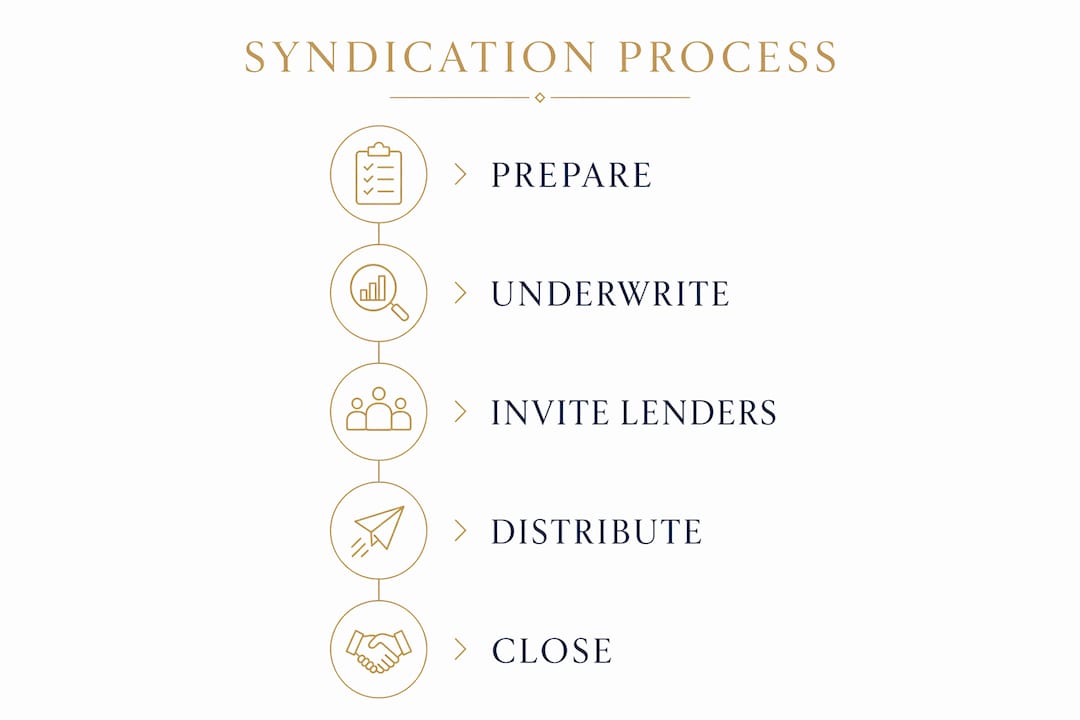
Step-by-step process to acquire and syndicate a bridge loan
Executing a syndicated bridge loan acquisition follows a defined sequence. Skipping steps or compressing timelines without lender coordination creates the closing failures that cost sponsors deals and relationships.
-
Identify and engage the lead arranger. Select a lender or investment bank with demonstrated capacity to underwrite and syndicate at your deal size. Share your pro forma, sources and uses schedule, and acquisition timeline upfront.
-
Negotiate and execute the commitment letter. The commitment letter locks in the lead arranger’s obligation to fund. Negotiate the rate, fees, loan-to-value ratio, and any conditions precedent before signing. This document is your foundation for the entire syndication.
-
Build the syndicate. The lead arranger markets the facility to participating lenders, sharing the information memorandum and financial model. This process typically runs concurrently with due diligence to preserve the 30–60 day closing window.
-
Execute intercreditor and participation agreements. Each syndicate member signs documentation defining their allocation, voting rights, and enforcement rights. These agreements govern how the syndicate acts if the borrower defaults or requests a modification.
-
Coordinate closing. The lead arranger manages the closing process, collecting funds from each participant and disbursing to the seller. Your legal team must confirm all conditions precedent are satisfied before funds move.
-
Manage ongoing reporting. Syndicated facilities require regular financial reporting to all lenders, not just the lead. Build a reporting calendar into your asset management plan from day one.
-
Execute your exit strategy. Plan your bridge-to-permanent refinance from the moment you close the bridge. Whether you exit into CMBS, agency debt, or a sale, the timeline and conditions must be modeled before the bridge matures.
The most common mistake at this stage is treating the exit as a future problem. Sponsors who close a bridge loan without a clear refinance path often find themselves in extension negotiations with a syndicate that has no obligation to accommodate them.
Common challenges and best practices in bridge loan syndication
Timing risk is the most frequent cause of syndication failures. A lead arranger who cannot fully syndicate the facility before closing either holds more risk than intended or delays the closing. Both outcomes damage the sponsor’s credibility with the seller.
- Capital stack misalignment: If your equity injection is based on an appraisal that comes in lower than expected, your sources and uses gap widens immediately. Model a 5–10% valuation haircut scenario before you commit to a purchase price.
- Valuation bridge shifts: Changes in cap rate assumptions between letter of intent and closing can alter the required loan-to-value, triggering renegotiation with the syndicate.
- Syndicate communication breakdowns: Participating lenders who receive inconsistent information from the lead arranger create delays. The lead must own all borrower communications.
- Extension option ambiguity: Poorly drafted extension provisions create disputes when the sponsor needs more time. Negotiate clear, objective extension triggers in the term sheet.
Execution certainty consistently outweighs the lowest headline rate in competitive acquisitions. Sponsors who win deals pay for speed, not savings. A 25-basis-point rate reduction means nothing if the syndicate cannot close in time.
The most disciplined sponsors treat their sources and uses schedule as a risk management tool, not just a closing requirement. Every valuation shift, fee change, or lender adjustment that goes unmodeled is a potential capital shortfall waiting to surface at the worst possible moment.
Key Takeaways
Bridge loan acquisition syndication succeeds when sponsors combine speed-focused financing with disciplined capital stack modeling and a coordinated lender group from day one.
| Point | Details |
|---|---|
| Bridge loan cost and speed | Expect 8–11% interest and 1–3 origination points, with closings in 30–60 days. |
| Syndication distributes risk | Lead arrangers coordinate multiple lenders to fund deals beyond single-lender capacity. |
| Sources and uses is a living document | Update your capital stack model continuously as valuations and fees shift during due diligence. |
| Execution certainty wins deals | Sponsors pay rate premiums to close fast; speed beats lowest cost in competitive auctions. |
| Exit planning starts at closing | Model your bridge-to-permanent refinance path before the bridge loan funds, not after. |
Why I think most sponsors underestimate the syndication coordination problem
Most sponsors I work with focus almost entirely on rate when they approach a bridge loan. They negotiate hard on the spread, push back on origination points, and then hand the syndication process to the lead arranger without tracking it. That is where deals quietly fall apart.
The syndication coordination problem is not about finding lenders. Institutional appetite for well-structured bridge facilities is strong. The problem is timing. Each participating lender runs their own credit approval process, and those processes do not always align with your closing deadline. A lead arranger who tells you the syndicate will be fully committed in two weeks is giving you their best estimate, not a guarantee.
Speed and execution certainty are what win competitive acquisitions. I have seen sponsors lose deals they should have won because they optimized for a 50-basis-point rate reduction and ended up with a syndicate that needed an extra three weeks to close. The seller moved on. The deal was gone.
The sponsors who consistently close are the ones who treat the lead arranger relationship as a partnership, not a vendor transaction. They share updated financial models proactively, flag valuation changes before they become surprises, and give the syndicate every piece of information it needs to move fast. That discipline is what separates sponsors who win auctions from sponsors who finish second.
— Jerry
Brookmontcapital’s approach to bridge loan syndication
Brookmontcapital structures and sources commercial bridge loan financing for real estate investors and sponsors across the country, connecting you with institutional lenders, debt funds, and equity partners who can close on your timeline.
Our capital stack advisory services cover every layer of acquisition financing, from senior bridge debt and mezzanine to preferred equity and CMBS takeout. We model your sources and uses from the first call, so you arrive at closing with a capital structure that holds. If you are preparing for a bridge loan acquisition and need a syndication partner who understands both the financing and the deal dynamics, contact Brookmontcapital to discuss your transaction.
FAQ
What is a bridge loan in real estate?
A bridge loan is short-term financing used to acquire or reposition a property before securing permanent debt. Terms typically run 12–36 months, with interest rates of 8–11% and origination fees of 1–3 points.
How does bridge loan syndication work?
A lead arranger underwrites the full loan commitment, then distributes portions to participating lenders under a coordinated framework. This structure allows deals to exceed single-lender capacity while distributing risk across the syndicate.
How fast can a syndicated bridge loan close?
Institutional bridge loans close in 30–60 days, compared to 60–120 days for permanent debt. That speed advantage is the primary reason sponsors use bridge financing in competitive acquisition scenarios.
What documents do I need to syndicate a bridge loan?
You need a commitment letter, term sheet, fee letter, and a fully modeled sources and uses schedule before approaching a syndicate. These documents define the capital structure and give participating lenders the information they need to approve their allocations.
Why do sponsors pay higher rates for bridge loans?
Sponsors pay the 8–11% rate premium for execution certainty and speed. In competitive auctions, a faster close with a credible lender group consistently beats a lower-cost offer with a longer or uncertain closing timeline.