Best Construction Loan Lenders 2026: Developer’s Guide

For most U.S. commercial development projects in 2026, an advisor-led match to a portfolio bank or a specialty construction lender delivers the best combination of draw flexibility, underwriting speed, and all-in cost control. The capital markets environment this year rewards sponsors who approach lenders with institutional-grade packaging, not just a rate request.
The recommended path for most commercial deals:
- Brookmont Capital Ventures (advisor): Structures and places construction debt across portfolio banks, specialty debt funds, and life insurance companies, with full capital stack advisory from ground-breakthrough to takeout. Start here for any deal above $1M or with meaningful complexity. Explore construction financing advisory to understand the engagement model.
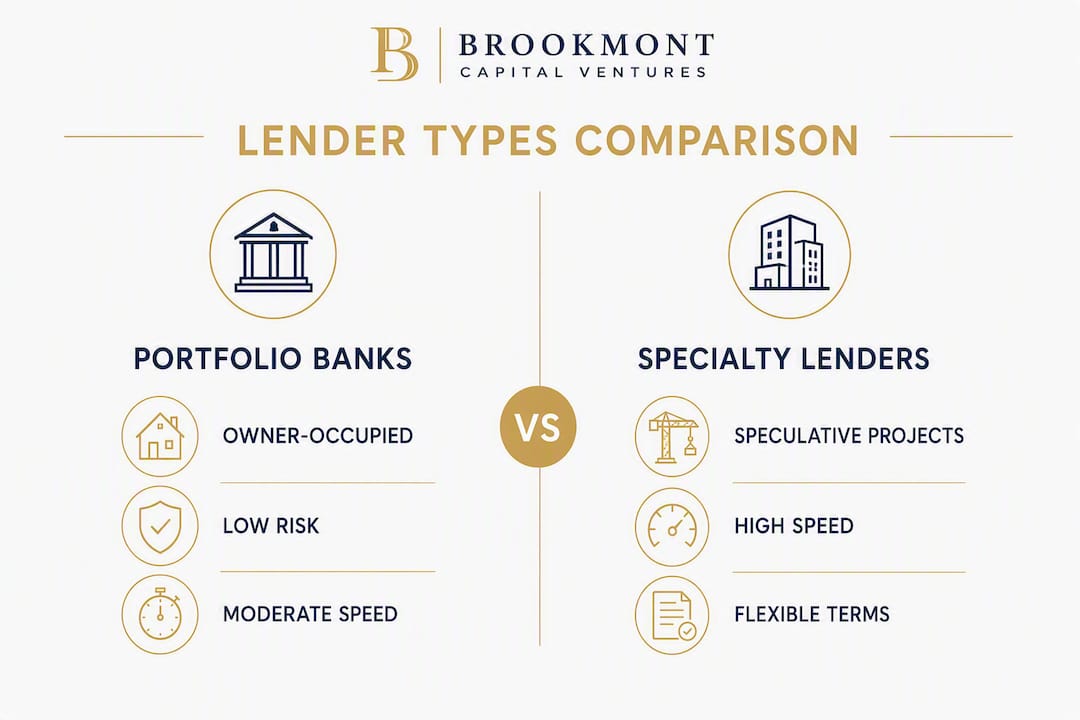
- Portfolio and community banks: Best for owner-occupied or smaller builds. Community banks hold loans on their own balance sheets, giving them underwriting flexibility unavailable at national institutions. Typical loan sizes run in a range suitable for smaller to mid-sized projects.
- Specialty construction lenders and debt funds: Purpose-built draw infrastructure, faster closings, and appetite for speculative or complex projects that community banks often decline.
- Life insurance companies: Long-term capital at competitive pricing for stabilized or pre-leased components; slower to close but often the most favorable permanent takeout source.
- Mezzanine and preferred equity: Fills the gap between senior debt and sponsor equity when LTC limits leave a shortfall in the capital stack.
Table of Contents
- What are the best construction loan lenders for 2026 commercial projects?
- How do you choose the right construction lender for your project?
- How should you match lender type to project complexity?
- What do lenders underwrite, and what is the true all-in cost?
- What documents do you need, and how long does closing take?
- What mistakes do sponsors make, and how do you avoid them in 2026?
- Key Takeaways
- Why an advisor-led approach usually wins in 2026
- How Brookmontcapital helps sponsors secure the right construction financing
- Sources and further reading
What are the best construction loan lenders for 2026 commercial projects?
The table below maps each financing route to the dimensions that matter most for commercial sponsors.
| Option | Best for | Lender type | Typical loan sizes | Speed to close | Pricing drivers | Draw flexibility | Recourse | Geographic reach |
|---|---|---|---|---|---|---|---|---|
| Brookmontcapital (advisor) | Complex deals, multi-lender stacks, sponsors needing lender access | Capital markets advisor | $1M+ | Depends on lender placed | Optimized via competition | Negotiated on your behalf | Structured per deal | Nationwide |
| Portfolio / community banks | Owner-occupied, smaller builds, local relationships | Balance-sheet bank | $200K–$2M | 30 days | Rate + origination; flexible on structure | Moderate | Often recourse | Regional |
| Specialty construction lenders / debt funds | Spec builds, ground-up, complex scopes | Non-bank lender | $1M–$5M | 7 days | Higher rate, lower friction | High; purpose-built draw infrastructure | Varies; often non-recourse available | Broad / national |
| Life insurance companies | Pre-leased, stabilized components, permanent takeout | Institutional lender | $5M+ | — | Lowest rate; strict underwriting | Low | Non-recourse typical | National |
| Mezzanine / preferred equity | LTC gap-fill, capital stack completion | Specialty capital | $1M–$5M | — | Highest cost; subordinate position | N/A | Non-recourse typical | National |
When portfolio banks win: For owner-occupied builds in the $300K–$800K range, community banks typically provide the best fit because local relationships reduce friction and balance-sheet lending allows non-standard underwriting.
When specialty lenders win: Speculative ground-up projects, tight timelines, or deals that fall outside bank credit policy. Speed and draw-process maturity are the differentiators.
When an advisor wins: Any deal where lender appetite is uncertain, the capital stack has multiple layers, or the sponsor lacks established relationships with the right institutional contacts.
Pro Tip: Ask every lender you speak with: “How many construction loans does your team close per year?” A low answer is a negative signal — it means the draw process, inspection cadence, and internal approvals are not routine for that team.
How do you choose the right construction lender for your project?
Selection criteria to evaluate before you engage:
- Experience with your specific project type (ground-up, spec, owner-occupied, mixed-use)
- Draw-process maturity: in-house inspectors vs. third-party fund control
- Speed to LOI and commitment letter
- Appetite for contingencies and mid-project scope changes
- Recourse vs. non-recourse structure and covenant package
- Required sponsor equity contribution and net worth covenants
- Geographic underwriting footprint relative to your project location
- Flexibility on interest reserve sizing and extension terms
Scripted questions to ask on your first lender call:
- “What is your typical draw cycle from inspection request to funding?”
- “Do you offer extension options, and what do they cost?”
- “How do you size the interest reserve, and is it held in escrow or funded as drawn?”
- “What triggers a loan modification vs. a default if the schedule slips?”
- “Do you require a takeout commitment before closing, or will you close on a spec basis?”
Red flags that should end the conversation:
- Lender focuses exclusively on rate and cannot discuss draw schedule mechanics
- No clear answer on extension fees or extension triggers
- Unwillingness to review contractor qualifications or GC schedule
- Large undisclosed fees surfacing after the LOI stage
- No in-house construction expertise; all draw oversight outsourced with no accountability
How should you match lender type to project complexity?
The core rule: match lender appetite to project risk and deal size before you spend time on rate negotiation. Mismatching a complex spec build to a community bank that rarely closes construction loans wastes weeks and risks the project timeline.
Decision flow:
- Classify the project: Is it spec (no pre-lease), pre-leased, or owner-occupied? Spec projects carry the most execution risk and require lenders with genuine construction expertise.
- Establish loan size: Deals below $1M fit community banks or SBA 7(a) and 504 programs for owner-occupied fixed assets. Deals from $1M–$5M suit specialty lenders or well-capitalized regional banks. Deals above $5M typically require a debt fund, life company, or advisor-placed institutional facility.
- Assess sponsor track record: First-time sponsors face tighter LTC limits and recourse requirements. Experienced sponsors with completed projects can negotiate better terms and non-recourse structures.
- Confirm timeline: If closing in under 30 days is a hard requirement, specialty lenders are the only realistic option. Portfolio banks and life companies cannot compress underwriting to that window.
Practical thresholds suggest sponsors may need to provide a significant equity portion of total project costs, with higher equity expected for speculative developments. Understand how construction loan sizing works before you submit a term sheet request.
What do lenders underwrite, and what is the true all-in cost?
Lenders evaluate loan-to-cost (LTC), loan-to-value (LTV) on the stabilized asset, debt service coverage ratio (DSCR) for any income-producing component, sponsor net worth and liquidity, contractor qualifications and licensing, and permits, environmental clearances, and zoning compliance. A weak file on any one of these dimensions can stall underwriting or trigger a pricing penalty.

The headline rate is rarely the number that determines your actual cost. Advisors consistently report that a slightly higher rate with a reliable draw schedule produces better outcomes than the lowest nominal rate with draw friction. Model your all-in cost using this framework:
| Cost component | Typical range | Notes |
|---|---|---|
| Interest rate | Varies by lender type | Applied only to drawn balance during construction |
| Origination / points | 1%–3% of loan amount | Paid at closing |
| Interest reserve | 18 months | Funded at close or drawn monthly |
| Extension fee | 1% per extension | Plan for at least one extension |
| Draw / inspection fees | — | Multiplied by number of draws |
| Exit / takeout costs | Varies | Permanent loan origination at stabilization |
Pro Tip: Use a builder loan calculator to model total financed cost across multiple lender scenarios before you accept any term sheet. The difference between two offers often lives in the extension fee and interest reserve, not the rate.
Budget a 10%–15% contingency on top of your hard cost estimate. Lenders rarely increase loan amounts mid-project, so cost overruns become an equity problem. Lock in your permanent takeout commitment before breaking ground; the construction lender will often require it.
What documents do you need, and how long does closing take?
Documentation checklist:
- Detailed development budget and sources-and-uses statement
- Executed construction contract with GC qualifications and license verification
- Contractor schedule and subcontractor agreements for major trades
- Permits in hand or documented permit timeline
- Pro forma with stabilized income assumptions and DSCR support
- Sponsor personal financial statements, tax returns (2 years), and net worth schedule
- Phase I environmental report (Phase II if flagged)
- Title commitment and survey
- Appraisal order (as-completed and as-stabilized values)
Review the full construction loan requirements checklist before your first lender submission.
| Milestone | Portfolio bank | Specialty lender | Life company |
|---|---|---|---|
| Initial contact to LOI | 7 days | 3–7 days | — |
| LOI to commitment | — | 10 days | 30 days |
| Commitment to close | — | 7 days | — |
Construction loan terms commonly span about a year to two years, with 18 months often used as a practical baseline. Acceleration tips: prepackage your full document set before the first lender call, confirm the GC schedule is locked, and use an advisor’s existing lender relationships to compress the LOI stage.
What mistakes do sponsors make, and how do you avoid them in 2026?
- Focusing on nominal rate only. Fix: calculate all-in cost including interest reserve, extension fees, draw fees, and origination before comparing offers. Two lenders with the same headline rate can differ by 150–200 basis points in effective cost.
- Under-budgeting contingencies. Fix: hold a 10%–15% contingency and build a conservative schedule. Lenders will not increase the loan mid-project.
- Banking on a mid-project loan increase. Fix: secure additional equity or a contingent line of credit before closing. Review common construction financing mistakes to stress-test your plan.
- Weak GC vetting. Fix: provide lender-ready contractor qualifications upfront; lenders who cannot validate contractor performance will price the risk into your rate or decline.
- Late documentation. Fix: assemble the full document package before engaging lenders, not after receiving an LOI.
2026-specific negotiation priorities: Lock extension options into the term sheet before closing. Insist on a transparent draw fee schedule. Negotiate interest reserve sizing tied to your actual construction schedule, not a lender’s conservative default. For 2026 construction loan rate ranges and how rate environment affects your negotiating position, review current market data before finalizing your capital structure.
Pro Tip: Prioritize draw flexibility over rate when evaluating term sheets. A lender who funds draws within 5 business days of inspection approval is worth more to your schedule than one offering 25 basis points less with a 15-day draw cycle.
Key Takeaways
Advisor-led placement to a portfolio bank or specialty construction lender is the most effective path for commercial developers in 2026, because it aligns lender appetite with project risk while optimizing all-in cost across the full capital stack.
| Point | Details |
|---|---|
| Match lender to project risk | Spec builds need specialty lenders; owner-occupied deals under $2M fit community banks best. |
| All-in cost beats headline rate | Model extension fees, interest reserve, and draw fees — not just the nominal rate — before accepting a term sheet. |
| Budget 10%–15% contingency | Lenders rarely increase loan amounts mid-project; cost overruns become a sponsor equity problem. |
| Equity requirement: 15% | Speculative developments require more sponsor equity; experienced sponsors can negotiate toward the lower end. |
| Brookmontcapital advisory | Brookmontcapital structures and places construction debt nationwide, optimizing the capital stack from ground-break through takeout. |
Why an advisor-led approach usually wins in 2026
The conventional wisdom is that sponsors with strong credit and a clean pro forma can walk directly into a bank and close a construction loan efficiently. That is true for a narrow slice of deals: owner-occupied, straightforward scope, established borrower, community bank relationship already in place. For everything else, the direct approach tends to cost more and take longer than sponsors expect.
The reason is execution risk perception. A lender evaluating a cold submission from an unknown sponsor prices uncertainty into the rate and structure. An advisor-led submission arrives with institutional packaging, a vetted capital stack, and a sponsor narrative that addresses the lender’s underwriting concerns before they arise. Institutional-grade deal packaging reduces perceived execution risk and consistently unlocks more competitive terms on complex deals.
Consider a mid-market ground-up multifamily project: a sponsor who submitted directly to three regional banks received terms ranging from 70% LTC with full recourse to a decline. After engaging an advisor to repackage the deal, the same project closed at 75% LTC, partial recourse, with a negotiated extension option and a draw cycle under seven days. The rate was not the lowest on the market. The structure was the best available.
The one scenario where going direct makes sense: a sponsor with deep, long-standing relationships at a specific community bank, on a deal that fits squarely within that bank’s credit box. In that case, the relationship is the advisor.
How Brookmontcapital helps sponsors secure the right construction financing
Securing construction financing in 2026 requires more than a strong pro forma. It requires lender access, institutional packaging, and a capital stack structured to survive cost overruns, schedule slippage, and takeout timing risk.
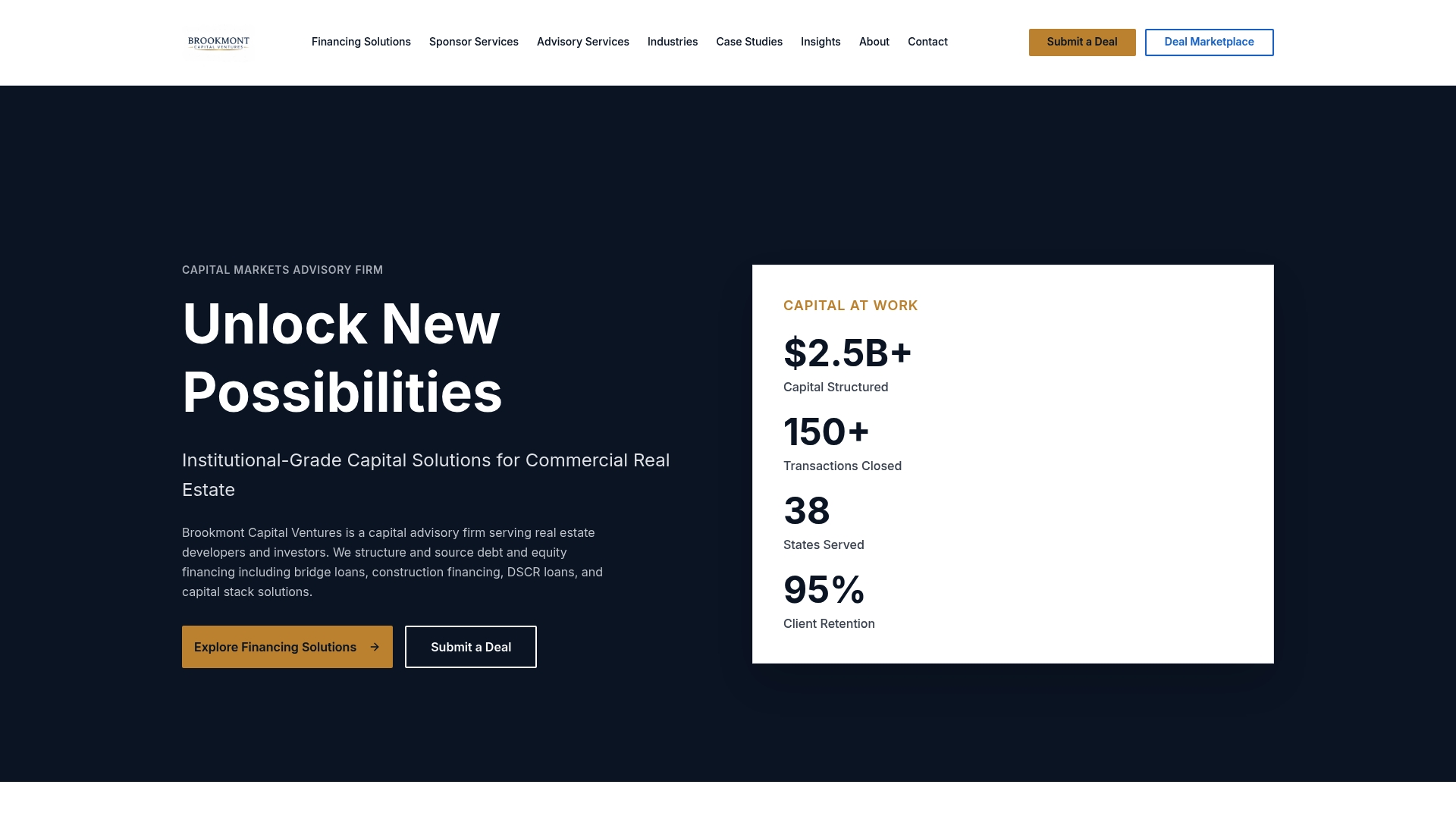
Brookmontcapital provides capital markets advisory for commercial real estate developers and sponsors nationwide, covering construction debt placement, bridge financing, DSCR loans, CMBS, preferred equity, and full capital stack structuring. The firm’s lender relationships span portfolio banks, specialty debt funds, life insurance companies, and institutional equity partners, giving sponsors access to the full range of commercial real estate financing solutions rather than a single lender’s product menu.
Client-ready outcomes include faster time to commitment through pre-packaged submissions, optimized capital structure across debt and equity layers, transparent all-in cost analysis before any term sheet is accepted, and negotiation support through closing. Request a financing analysis or advisory engagement at Brookmontcapital’s advisory services page to discuss your 2026 project.
Sources and further reading
The findings and underwriting norms in this article draw from the sources below, used for lender-type characteristics, underwriting benchmarks, and SBA program context.
- Ground-Up Construction Financing: Real Costs & Terms in 2026 — all-in cost components, extension fee ranges, contingency guidance, and draw-process benchmarks.
- Construction Loan Lenders 2026: Banks, Credit Unions & Specialty — community bank loan size ranges, portfolio lending characteristics, and lender screening questions.
- Ground-Up Construction Financing: How Developers Fund New Construction Projects in 2026 — sponsor equity requirements and institutional packaging outcomes.
- SBA Loans for Construction Companies: 2026 U.S. Guide — SBA 7(a) and 504 program roles, documentation expectations, and eligible use cases.
- Brookmontcapital Construction Financing — advisory services, lender access, and capital stack structuring for commercial developers.
- Brookmontcapital Insights: Underwriting Criteria — detailed underwriting criteria guide for sponsors preparing submissions.
This article provides general market information for educational purposes and does not constitute financial, legal, or investment advice. Confirm current lending terms, program eligibility, and regulatory requirements with a qualified professional or the relevant primary source before making financing decisions.
Recommended
- Construction Lender Underwriting Criteria: 2026 Guide | Brookmont Capital Ventures
- Construction Loan Requirements for Developers | Brookmont Capital Ventures
- How Construction Loan Sizing Works: 2026 Guide | Brookmont Capital Ventures
- Vertical Construction Financing: A Developer’s 2026 Guide | Brookmont Capital Ventures