
Agency Financing for Multifamily: 2026 Investor Guide

Agency financing for multifamily properties is defined as mortgage debt backed by government-sponsored enterprises (GSEs), specifically Fannie Mae and Freddie Mac, for residential buildings with five or more units. These programs set standardized underwriting guidelines, publish consistent rate sheets, and guarantee loan performance, which is why agency debt for apartments carries lower rates than most private alternatives. Understanding what is agency financing multifamily means recognizing that the GSEs do not lend directly. They buy loans from approved lenders, freeing capital for the next deal. Brookmontcapital works with sponsors across this entire ecosystem, from initial structuring through final placement.
What is agency financing for multifamily properties?
Agency financing is exclusively for stabilized multifamily properties, typically with five or more units, backed by Fannie Mae and Freddie Mac. The GSEs issued over $143 billion in multifamily loans in 2018 alone. That volume reflects the depth of the market and explains why agency rates consistently undercut most bank and debt fund alternatives.
The standard industry term for these products is “GSE multifamily loans,” though the market uses “agency loans” interchangeably. Fannie Mae operates through its Delegated Underwriting and Servicing (DUS) program, which accounts for nearly 48% of total outstanding balances among core agency programs. DUS enables approved lenders to underwrite, close, and service loans while sharing default risk with Fannie Mae. That risk-sharing structure is why DUS lenders apply rigorous underwriting standards at origination.
Freddie Mac operates its own parallel program, the Optigo network, with similar delegated authority. Both programs cover conventional apartments, affordable housing, senior living, student housing, and cooperative apartments. The breadth of eligible property types makes agency debt the default permanent financing solution for most stabilized multifamily assets.
How do agency loans for multifamily properties work?
Agency loans follow a consistent structure regardless of which GSE backs them. The lender originates the loan, sells it to Fannie Mae or Freddie Mac, and retains servicing rights. The GSE pools the loan into a mortgage-backed security, which institutional investors buy. This secondary market mechanism is what keeps agency rates competitive across market cycles.

Loan terms and structure
Typical agency loan terms include the following:
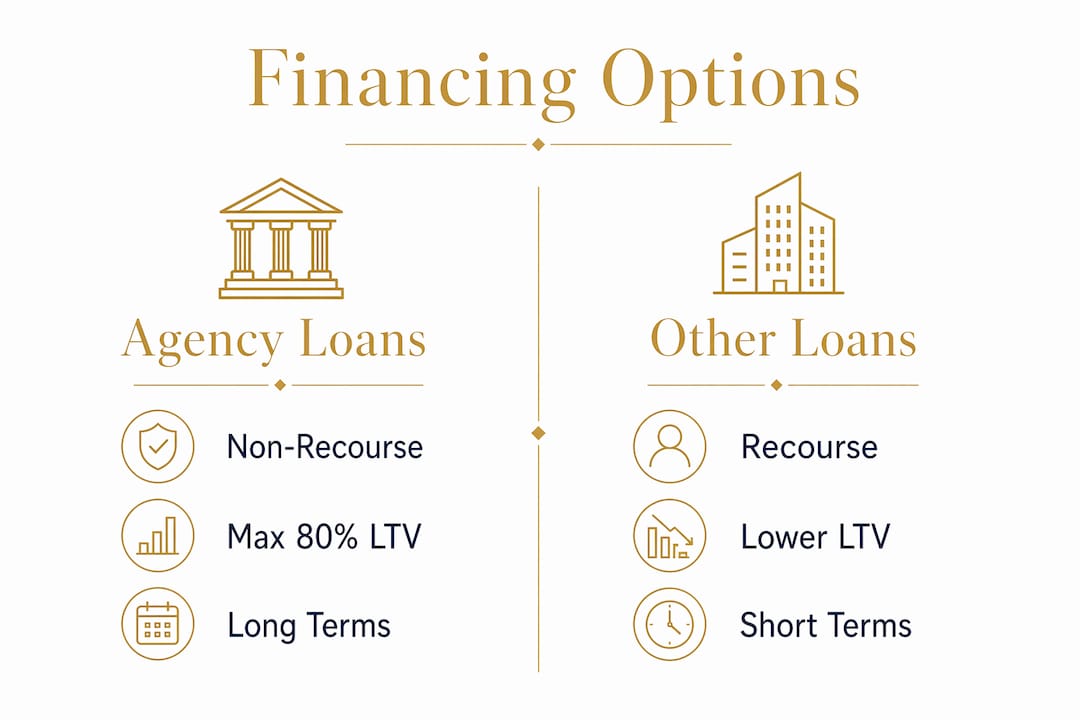
- Loan-to-value (LTV): Up to 75–80% on stabilized properties
- Amortization: Up to 30 years, even on fixed terms of 5 to 10 years
- Rate type: Fixed or floating, with fixed rates most common for long-term holds
- Recourse: Non-recourse with standard “bad boy” carve-outs for fraud and misrepresentation
- Loan size: Small Balance Loan programs start around $1 million; standard DUS loans typically begin at $3 million
Agency loan rates typically range from 4.95% to 7.05% depending on term, LTV, and market conditions. That range reflects the spread over the corresponding Treasury benchmark, not a fixed price. Rates shift with the 10-year Treasury, so timing your lock matters.
Pro Tip: Request a rate lock as early as the lender allows. Agency rate sheets reprice daily, and a 25-basis-point move between application and closing can meaningfully affect your debt service coverage ratio (DSCR).
Eligible property types
Agency programs cover conventional market-rate apartments, affordable housing under Section 8 or Low-Income Housing Tax Credit (LIHTC) structures, senior housing, student housing, and manufactured housing communities. Over 50 multifamily financing product types exist across both GSEs, but most investors will work with a handful of core programs. Knowing which product fits your asset class before you approach a lender saves weeks in the approval process.
What are the benefits of agency financing for multifamily investors?
The benefits of agency financing are structural, not incidental. They flow directly from the GSE guarantee and the secondary market that guarantee creates.
- Non-recourse protection: Agency loans are generally non-recourse, meaning your personal assets are not at risk if the property underperforms. Most bank loans are full-recourse. That distinction is significant for investors managing multiple assets simultaneously.
- Higher leverage: LTV ratios up to 80% on stabilized assets allow you to preserve equity capital for additional acquisitions or capital expenditures.
- Longer amortization: A 30-year amortization schedule on a 10-year fixed loan produces lower monthly debt service than a 25-year bank amortization. Lower debt service improves DSCR and cash-on-cash returns.
- Competitive rates: Agency rates consistently price below most bank portfolio loans and CMBS alternatives for equivalent credit quality assets.
- Product depth: Specialized programs for affordable housing, senior living, and student housing mean agency debt is available across a wide range of asset types, not just conventional apartments.
The non-recourse feature alone changes the risk profile of a multifamily portfolio. When a single asset faces occupancy pressure or a capital event, the exposure stays contained to that property. That containment is what allows disciplined investors to scale.
How does agency financing compare to other multifamily financing options?
Understanding multifamily financing options requires knowing where agency loans fit relative to bank loans, bridge loans, and CMBS. Each product serves a different stage of the asset lifecycle.
| Financing type | Recourse | Max LTV | Amortization | Best use case |
|---|---|---|---|---|
| Agency (Fannie/Freddie) | Non-recourse | 80% | Up to 30 years | Stabilized, long-term hold |
| Bank portfolio loan | Full-recourse | 70–75% | 20–25 years | Smaller deals, relationship banking |
| Bridge loan | Recourse or partial | 75–80% | Interest-only | Value-add, lease-up, renovation |
| CMBS | Non-recourse | 70–75% | 25–30 years | Larger assets, fixed-rate certainty |
Bank loans underwrite heavily on the borrower’s personal financial profile, including personal income, tax returns, and global cash flow. Agency loans underwrite primarily on the property’s income potential, specifically the DSCR and LTV. That shift in underwriting focus is the most important conceptual difference for investors moving from single-family to multifamily financing.
Bridge loans serve as short-term financing for acquisition and renovation before agency refinancing. A common execution strategy is to acquire a value-add property with a bridge loan, stabilize occupancy above 90%, then refinance into a long-term agency loan. This sequence captures the value created during renovation while locking in permanent, non-recourse debt at stabilized rates.
Pro Tip: Model your agency refinance assumptions before you close the bridge loan. If your pro forma stabilized DSCR does not clear 1.25x at current agency rates, the exit may not work. Stress-test the refinance at rates 50 basis points higher than today’s market.
CMBS offers non-recourse terms similar to agency loans but typically requires larger loan sizes and carries prepayment structures, such as defeasance or yield maintenance, that are more restrictive than agency prepayment options. For most multifamily investors in the $2 million to $20 million range, agency loans are the more flexible permanent financing solution.
What are the qualification requirements for agency multifamily loans?
Agency loan qualification focuses on the property first and the borrower second. That said, borrower requirements are real and non-negotiable.
Property requirements
- Occupancy: The property must be stabilized at 90% occupancy for at least 90 days prior to closing. Value-add properties that do not meet this threshold require bridge financing first.
- Property condition: The asset must meet minimum physical condition standards. Deferred maintenance above lender thresholds triggers required reserves or repairs at closing.
- DSCR: Most agency programs require a minimum DSCR of 1.25x, meaning net operating income must cover debt service by at least 25%.
Borrower requirements
- Credit score: A minimum of 660–680 is standard, though exceptions exist with compensating factors or lower leverage.
- Net worth: Borrowers generally need net worth at least equal to the loan amount.
- Liquidity: Post-closing liquidity of at least 10% of the loan balance is required.
- Experience: Some multifamily ownership or management experience is expected, particularly for larger loan sizes.
The most common mistake investors make when applying for agency debt is treating it like a single-family mortgage. Agency underwriters do not care about your W-2 income. They care about the property’s rent roll, expense history, and in-place DSCR. Investors who transition from residential to commercial financing often underestimate how thoroughly lenders will scrutinize the property’s operating statements.
Key Takeaways
Agency financing for multifamily properties is the most cost-effective permanent debt solution for stabilized apartment assets, defined by non-recourse terms, 80% LTV, and 30-year amortization backed by Fannie Mae and Freddie Mac.
| Point | Details |
|---|---|
| GSE-backed, property-first underwriting | Agency lenders underwrite on DSCR and LTV, not personal income, which benefits cash-flowing assets. |
| Non-recourse protection | Personal assets are shielded from property-level losses, unlike most bank portfolio loans. |
| 90% occupancy threshold | Properties must be stabilized for at least 90 days before agency financing is available. |
| Bridge-to-agency strategy | Acquire value-add assets with bridge financing, stabilize, then refinance into permanent agency debt. |
| Borrower minimums matter | A 660+ credit score, net worth equal to loan size, and 10% post-closing liquidity are standard requirements. |
Agency financing rewards disciplined underwriting, not optimism
The investors I see get the most out of agency debt are the ones who treat the GSE underwriting standards as a design constraint from day one, not a hurdle to clear at the end. When you build your acquisition model around a 1.25x DSCR at stabilized occupancy, you are effectively pre-qualifying the deal for permanent financing before you write the offer. That discipline filters out a lot of marginal deals that look attractive on a pro forma but fall apart at the agency underwriting desk.
The bridge-to-agency execution is where I see the most value creation in the current market. Buying a 75% occupied property at a discount, executing a targeted renovation, and refinancing into a 30-year amortizing non-recourse loan at 80% LTV is a repeatable playbook. The key variable is the spread between your bridge rate and your projected agency exit rate. If that spread compresses because rates move against you during the renovation period, your returns compress with it. Model that risk explicitly.
One thing most articles do not address: agency lenders will scrutinize your operating expense ratio as carefully as your revenue. An expense ratio that looks too low relative to market comparables raises red flags. Underwriters assume you are understating expenses, and they will normalize the numbers upward. If your pro forma shows a 30% expense ratio on a 1980s vintage property, expect the lender to push that to 40% or higher. Build your models with conservative expense assumptions from the start.
— Jerry
How Brookmontcapital structures multifamily financing for investors
Brookmontcapital advises real estate developers and investors on structuring the full capital stack for multifamily acquisitions and refinances, including agency loan placement, bridge financing, and preferred equity.
Whether you are refinancing a stabilized apartment community into a long-term Fannie Mae or Freddie Mac loan, or structuring a bridge loan ahead of a value-add repositioning, Brookmontcapital connects you with the right institutional lenders for your asset type and deal size. Our capital stack advisory covers every layer of the financing structure, from senior debt through preferred equity, so you enter every transaction with a clear picture of your cost of capital and exit options. Contact Brookmontcapital to discuss your next multifamily financing transaction.
FAQ
What is agency financing for multifamily real estate?
Agency financing for multifamily real estate is mortgage debt backed by Fannie Mae or Freddie Mac for residential properties with five or more units. It offers non-recourse terms, LTV up to 80%, and amortizations up to 30 years.
What are the minimum requirements for an agency multifamily loan?
Borrowers typically need a credit score of 660–680, net worth equal to the loan amount, and post-closing liquidity of at least 10% of the loan balance. The property must be stabilized at 90% occupancy for at least 90 days before closing.
How does agency financing differ from a bank loan for apartments?
Agency loans are non-recourse and underwrite primarily on the property’s DSCR and LTV, while bank loans are typically full-recourse and weight the borrower’s personal income and financial history heavily.
Can I use agency financing on a value-add multifamily property?
Not directly. Value-add properties that are below 90% occupancy require bridge financing first. Once the property is stabilized, you can refinance into a permanent agency loan.
What is the DUS program in agency multifamily lending?
Fannie Mae’s Delegated Underwriting and Servicing (DUS) program allows approved lenders to originate, underwrite, and service agency loans while sharing default risk with Fannie Mae. DUS accounts for nearly 48% of total outstanding balances among core agency programs.