
Acquisition Financing in Real Estate: 2026 Investor Guide

Acquisition financing in real estate is the capital used to fund the purchase of a property or investment asset, combining debt, equity, and other capital sources to close the deal. Lenders typically cover 50%–80% of the purchase price, with the borrower funding the remainder through equity or secondary financing. The industry term for this practice is “property acquisition financing,” though investors and developers use the phrase interchangeably with “real estate investment loans” and “purchase financing.” Brookmontcapital works with sponsors nationwide to structure these capital stacks across asset classes ranging from multifamily to industrial. Understanding how acquisition financing works, and which structure fits your deal, is the single most consequential decision you make before signing a purchase agreement.
What is acquisition financing in real estate, and what types are available?
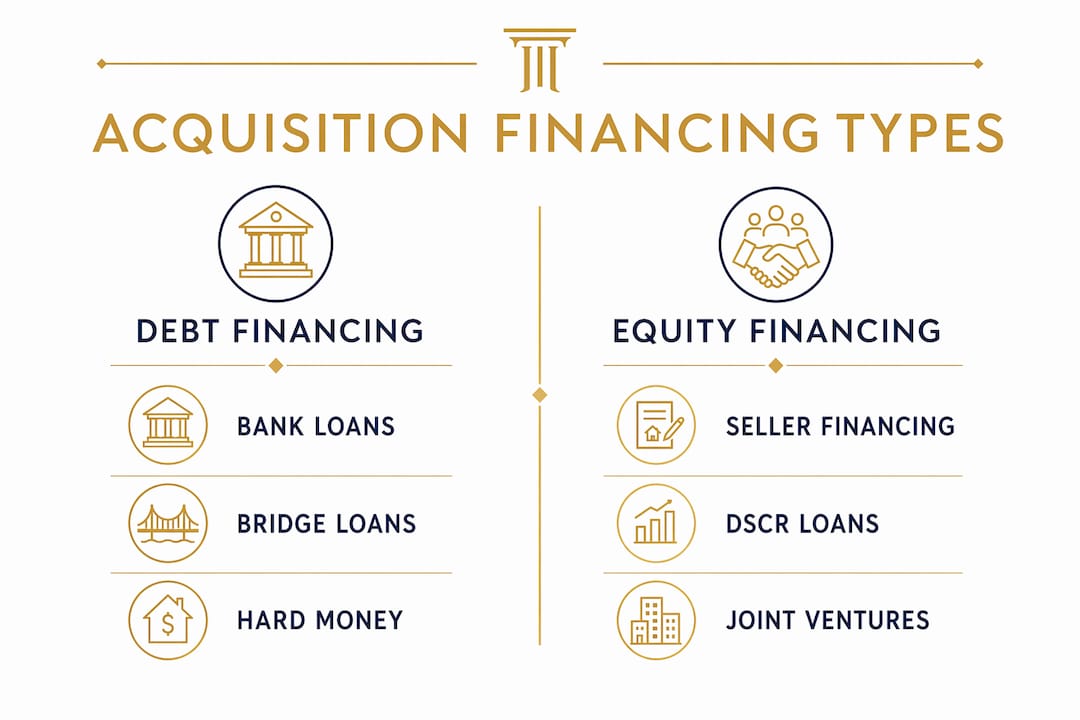
Property acquisition financing falls into several distinct categories. Each carries different cost, speed, and underwriting requirements. Matching the right loan type to your deal is more important than chasing the lowest rate.
Conventional bank loans offer the lowest interest rates and longest amortization periods, but they require strong borrower financials, stabilized assets, and approval timelines of 60–90 days. They work well for investors with clean credit profiles acquiring stabilized, income-producing properties.
Bridge loans are short-term instruments designed for speed. Bridge loans close in 7–45 days with terms of 6–24 months, making them the preferred tool when a seller demands a fast close or when the asset needs repositioning before permanent financing is viable. Bridge loan rates run 7.75%–15%, reflecting the flexibility and speed they provide. Brookmontcapital structures bridge loan financing for investors who need to move quickly in competitive markets.
Hard money loans serve a narrower purpose. Hard money rates range from 10%–15%, plus 2–4 points in upfront fees, with a typical exit horizon of 6–12 months. These loans fund distressed acquisitions or situations where conventional lenders will not engage. The cost is high, but the speed and minimal underwriting requirements justify the premium for the right deal.

Seller financing occurs when the property seller acts as the lender, carrying a note for part or all of the purchase price. This structure benefits buyers who cannot qualify for institutional debt or who need to bridge a valuation gap. Sellers benefit from installment sale tax treatment and a higher effective yield than cash alternatives.
DSCR loans (Debt Service Coverage Ratio loans) underwrite based on property cash flow rather than borrower income. A DSCR target ratio of approximately 1.25 is the standard threshold most lenders require. This structure suits investors with multiple properties or complex income profiles who cannot document personal income in a traditional format.
Equity financing through joint ventures, preferred equity, or limited partnerships layers non-debt capital into the stack. Preferred equity vs. mezzanine debt each carry distinct risk and return profiles that affect how the capital stack performs under stress.
Which factors determine the right acquisition financing structure?
No single financing type fits every deal. The following factors drive the decision:
- Down payment capacity. Investment properties typically require 20%–25% down, reflecting the higher risk lenders assign to non-owner-occupied assets. A thinner equity contribution pushes you toward bridge or hard money products.
- Borrower credit and financial profile. Conventional lenders scrutinize personal financials, tax returns, and liquidity. Bridge and hard money lenders focus primarily on the asset and exit strategy, making them accessible to borrowers with complex financial histories.
- Property condition and type. Lenders will not finance distressed or vacant properties through conventional channels. Asset condition directly determines which lender categories will engage and at what loan-to-value ratio.
- Closing timeline. A 30-day close requirement eliminates conventional bank financing almost entirely. Bridge lenders and hard money sources are built for compressed timelines.
- Exit strategy. Every lender asks how you plan to repay the loan. A clear, credible exit, whether through refinance, sale, or lease-up, reduces lender risk and improves your terms.
- Cash flow and DSCR. Properties generating sufficient net operating income to cover debt service at 1.25x or above qualify for a wider range of permanent financing options.
Pro Tip: Verify your financing assumptions with at least two lenders before submitting a formal offer. Testing lender appetite early prevents renegotiations and closing delays, which are the most common deal killers in competitive acquisition markets.
Understanding commercial real estate loan down payments in detail before you underwrite a deal saves significant time during the lender diligence process.
How does acquisition financing affect deal structure and closing certainty?
Financing complexity is directly proportional to closing risk. The more conditions, approvals, and third-party reviews a loan requires, the greater the chance that something delays or kills the transaction. Sellers know this, and they price it into their willingness to accept your offer.
Testing leverage capacity and lender diligence requirements before making an offer is the single most effective way to reduce closing risk. Buyers who skip this step often discover mid-contract that their assumed loan-to-value is unavailable, forcing renegotiation or forfeiture of earnest money.
Seller notes and earnouts serve a specific structural purpose. When a buyer and seller disagree on valuation, a seller-carried note bridges the gap without requiring the buyer to raise additional equity or pay a higher purchase price in cash. The seller receives future payments tied to asset performance, and the buyer preserves liquidity at closing.
- Confirm lender appetite early. Contact your primary lender before executing a letter of intent. Confirm the loan-to-value, rate range, and diligence timeline.
- Stress-test your pro forma. Run your debt service coverage ratio at both the current rate and 100 basis points higher. If the deal breaks at a modest rate increase, the financing structure is too aggressive.
- Negotiate financing contingencies carefully. A financing contingency protects you, but an overly broad contingency signals weakness to sellers. Define the contingency with specific loan terms rather than open-ended language.
- Align your equity and debt closing timelines. Equity partners and debt lenders operate on different approval cycles. Misalignment between the two is a common source of closing delays.
Pro Tip: If you are using bridge financing to acquire a value-add asset, confirm your permanent takeout lender’s stabilization requirements before you close. Many investors acquire on a bridge loan only to discover the permanent lender requires 90% occupancy for 90 days before funding.
What strategic approaches work best for structuring acquisition financing?
The capital stack is the architecture of your deal. Getting it right determines your return, your risk exposure, and your ability to execute the business plan without running out of capital.
Layering senior debt, mezzanine financing, and preferred equity optimizes leverage while managing covenant conflicts. Senior debt sits in the first-loss position for the lender and carries the lowest rate. Mezzanine debt and preferred equity fill the gap between senior debt and common equity, each with higher cost but greater flexibility.
Key strategic principles for structuring acquisition financing:
- Match loan term to business plan duration. A 12-month bridge loan on a 24-month renovation plan creates a refinancing crisis. Build in a 6-month extension option at minimum.
- Preserve liquidity. Maintaining cash reserves for renovations and contingencies often matters more than minimizing your interest rate. A deal that runs out of capital mid-execution is worse than a deal with a slightly higher cost of debt.
- Sequence your financing. Close on senior debt first, then layer in preferred equity or mezzanine once the asset is in your control. Trying to close all capital simultaneously creates coordination risk.
- Plan your refinance before you acquire. Know which permanent lender you will approach, what stabilization metrics they require, and what rate environment you are underwriting to.
The table below summarizes the cost and speed trade-offs across the primary acquisition financing types:
| Financing type | Typical rate | Closing speed | Best use case |
|---|---|---|---|
| Conventional bank loan | Below 7.75% | 60–90 days | Stabilized, income-producing assets |
| Bridge loan | 7.75%–15% | 7–45 days | Value-add, time-sensitive acquisitions |
| Hard money loan | 10%–15% + fees | Under 14 days | Distressed assets, rapid acquisitions |
| DSCR loan | Varies by market | 30–45 days | Income-based underwriting, complex borrowers |
| Seller financing | Negotiated | Flexible | Valuation gap, non-qualifying borrowers |
Bridge loans for real estate investors deserve particular attention in 2026, as lender appetite for asset-focused underwriting has remained strong even as conventional credit standards have tightened.
Key Takeaways
Acquisition financing in real estate requires matching the loan type, term, and capital stack structure to the specific deal, borrower profile, and exit strategy, not simply selecting the lowest available rate.
| Point | Details |
|---|---|
| Lender coverage range | Lenders fund 50%–80% of purchase price; the gap requires equity or secondary financing. |
| Loan type determines speed | Bridge loans close in 7–45 days; conventional loans require 60–90 days. |
| DSCR is the cash flow benchmark | A DSCR of 1.25x or above qualifies assets for the widest range of permanent financing. |
| Capital stack sequencing matters | Layer senior debt first, then mezzanine or preferred equity to avoid covenant conflicts. |
| Liquidity preservation is non-negotiable | Cash reserves for contingencies protect deal execution better than a lower interest rate. |
What I’ve learned about acquisition financing after years of watching deals close and fall apart
The most common mistake I see investors make is treating acquisition financing as a commodity. They shop for the lowest rate, ignore the loan structure, and then discover at the closing table that the financing does not actually fit the deal. Rate matters, but matching loan fit to deal specifics is the decision that determines whether you close on time and execute your business plan.
The second mistake is underestimating how much lender diligence affects your timeline. Bridge lenders move fast because they underwrite on asset value and exit strategy, not on three years of tax returns. That speed is worth real money in a competitive market where a 30-day close wins the deal over a 90-day conventional loan. Investors who have not worked with bridge lenders before are often surprised by how straightforward the process is once you have a clear exit strategy documented.
In 2026, I am watching lenders tighten their standards on value-add acquisitions, particularly in secondary markets. Loan-to-value ratios that were available 18 months ago are no longer on the table at the same pricing. That means your equity contribution is going up, and your pro forma needs to be more conservative. The investors who are closing deals right now are the ones who engaged their lenders early, stress-tested their capital stacks, and built in contingency reserves rather than underwriting to best-case assumptions.
One more thing: do not neglect your exit strategy documentation. Every lender I work with asks for it, and a vague answer costs you either rate or proceeds. Know your takeout lender, know your stabilization timeline, and put it in writing before you go to market for financing.
— Jerry
How Brookmontcapital structures acquisition financing for investors and developers
Brookmontcapital serves real estate developers, investors, and sponsors who need more than a rate quote. The firm specializes in structuring and sourcing commercial real estate financing solutions across bridge loans, DSCR loans, construction financing, CMBS, and preferred equity, connecting sponsors with institutional lenders, debt funds, and equity partners to secure terms that fit the deal.
Whether you are acquiring a value-add multifamily asset on a 45-day close or structuring a ground-up development with a layered capital stack, Brookmontcapital provides capital stack advisory to ensure your financing aligns with your business plan and exit strategy. The team works with sponsors on deals ranging from $500K to $50M across all major asset classes. Contact Brookmontcapital to discuss your acquisition financing needs and get a financing structure that actually fits your deal.
FAQ
What is acquisition financing in real estate?
Acquisition financing in real estate is the capital used to purchase a property or investment asset, typically combining senior debt, equity, and secondary financing. Lenders generally fund 50%–80% of the purchase price, with the borrower contributing the remainder.
How long does it take to close acquisition financing?
Closing timelines vary by loan type. Bridge loans close in 7–45 days, while conventional bank loans typically require 60–90 days.
What down payment is required for an investment property loan?
Investment property loans generally require a 20%–25% down payment, reflecting the higher risk lenders assign to non-owner-occupied assets compared to primary residences.
What is a DSCR loan and when should investors use it?
A DSCR loan underwrites based on property cash flow rather than personal borrower income, with a standard minimum ratio of approximately 1.25x. Investors with complex income profiles or multiple properties use DSCR loans when conventional income documentation is not feasible.
How does a bridge loan differ from a conventional acquisition loan?
A bridge loan closes in days rather than months because lenders underwrite primarily on asset value and exit strategy rather than borrower financials. Bridge loans carry higher rates of 7.75%–15% but provide speed and flexibility that conventional loans cannot match.
Recommended
- How Does Commercial Real Estate Financing Work? | Brookmont Capital Ventures
- Institutional Real Estate Investment 2026: Why Capital Is Returning to CRE
- The 2026 CRE Refinancing Wall: What Investors With $500K-5M Projects Need to Know Now
- How to Underwrite a CRE Deal When Interest Rates Stay Higher for Longer | Brookmont Capital Ventures